
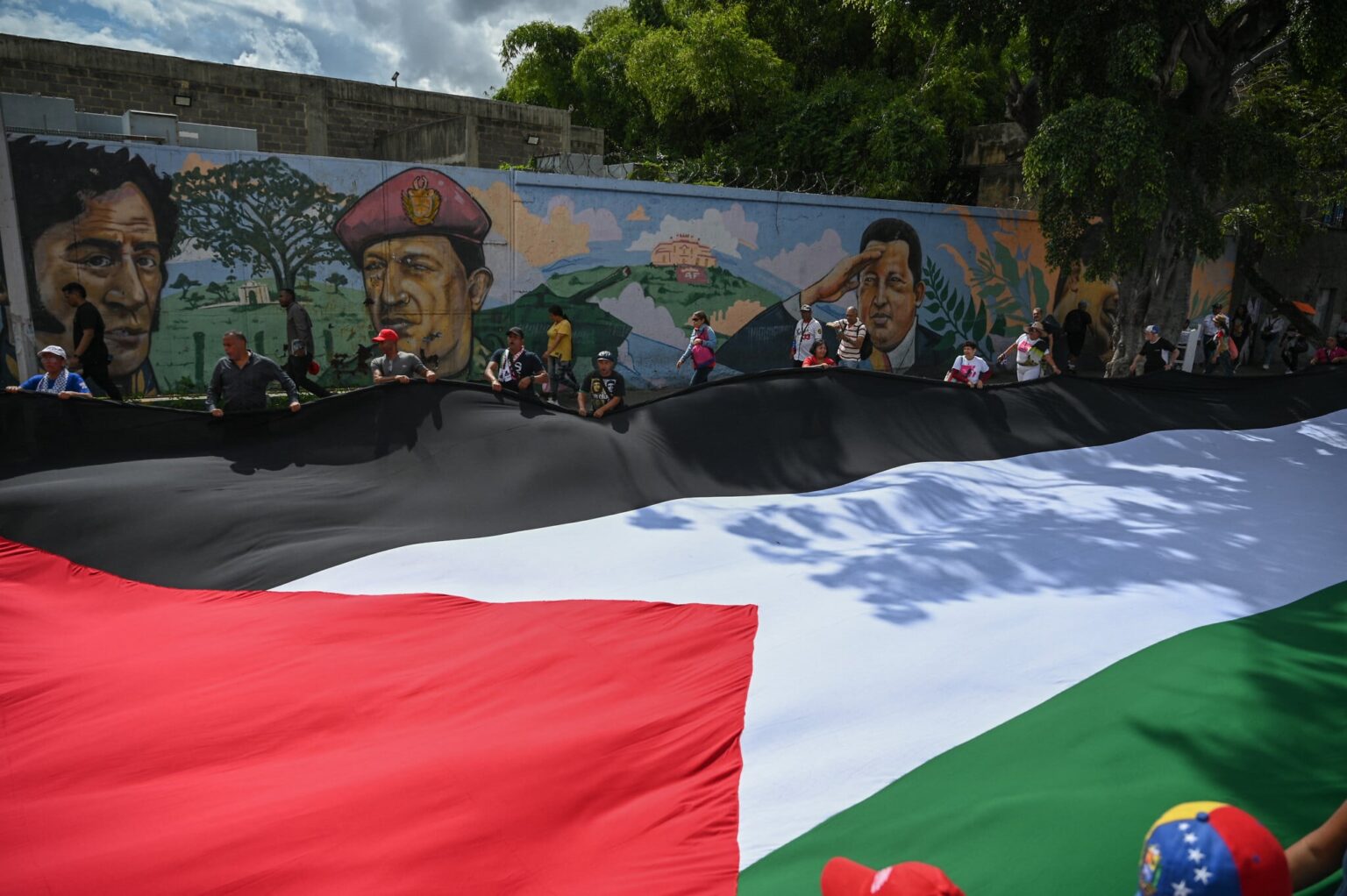
As scenes of celebration spread across Venezuela following the US-led deposition of President Nicolas Maduro Saturday, the country’s small and diminished Jewish community is keeping quiet.
While Jews in the country’s capital city of Caracas are largely optimistic about the prospects of regime change, they have learned, after more than two decades of repression, to be fearful of retaliation if they celebrate too soon.
“Everyone is very happy about the news, but they have to be very cautious,” said Daniel Behar, an Israeli resident who moved from Venezuela 20 years ago as the regime’s authoritarian power consolidated. “There is fear that the entire community might face repercussions later on.”
Jews aren’t the only ones celebrating Maduro’s capture by US forces in a lightning predawn attack Saturday morning. Venezuelan natives around the world, many of whom left to escape his style of authoritarian rule, greeted the news with celebration.
But a history of violence and threats by government officials to expropriate Jewish schools, restaurants, and other institutions has made community members fearful of rejoicing too soon.
“The community’s chief rabbi has warned many times not to publicly oppose the government,” Behar said. “There was always a fear that if something happens, people will blame Israel and the Jews.”
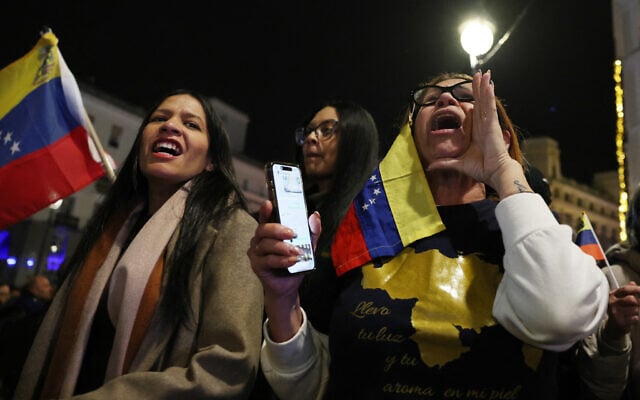
Venezuelan citizens living in Spain gather at Puerta del Sol square in Madrid on January 3, 2026, after US forces captured Venezuelan leader Nicolas Maduro following a “large-scale strike” on Venezuela. (Pierre-Philippe MARCOU / AFP)
Shifting tides
Venezuela’s Jewish history dates back at least 200 years, around the time the country achieved independence from Spain in 1821. While it is believed that Jewish Conversos forcibly converted to Christianity may have arrived centuries earlier, the first record of Jewish communities is found in coastal cities such as Coro and Caracas, where an influx of Sephardic Jews engaged in trade and commerce during the country’s early days.
Later waves of immigration in the 20th century swelled the community’s ranks, and the country reached 25,000 to 45,000 Jews in the years before Hugo Chávez came to power in 1999, according to various estimates.
In the years that followed, Venezuelans fled the country in droves as the government openly punished political opponents and destabilized the economy, a trend that escalated after Maduro replaced Chávez in 2013. As much as 25 percent of the country’s total population is believed to have left in the last two decades, and the Jewish community dwindled to just 4,000 to 6,000, a fraction of its former peak.
“This used to be the richest country in South America, and one of the wealthiest in the world,” said Arie Kacowicz, the Chaim Weizmann Chair in International Relations and professor of International Relations at the Hebrew University of Jerusalem. “The Jewish community was quite wealthy and generally pro-Israel, but ten years after Chávez came to power, he broke off diplomatic relations with Israel in 2009. Since then, reports of antisemitism have been sporadic.”
Most of the antisemitism that exists in Venezuela today tends to be directed by the political echelon and tied to the Israeli–Palestinian conflict, with state media using anti-Zionist rhetoric that blurs into classic antisemitic tropes.
“The revolutionary left-wing government has an intrinsic distrust and hatred for the Jewish community, but they aren’t persecuted for being Jewish,” said Gustavo Aristegui, a Spanish diplomat and analyst who has written extensively about Venezuela’s regime. “They are persecuted mainly for being against the regime and its relationships with Iran and Hezbollah.”
Behar agreed.
“Antisemitism in Venezuela is not the same as in Europe,” he said. “It’s mostly tied to the Palestinian issue, and it is encouraged by the dictatorship. The people on the streets have bigger problems to worry about.”
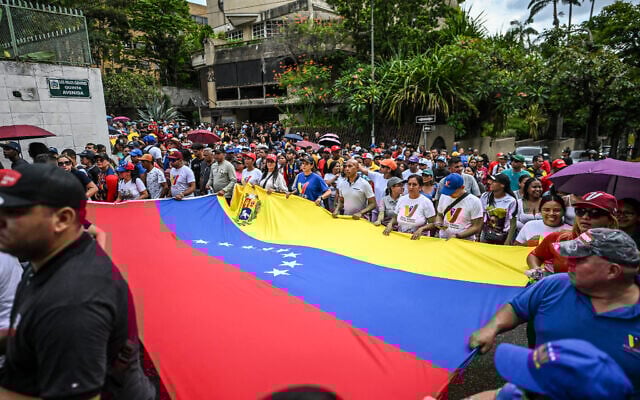
Demonstrators hold a giant Venezuelan flag as they take part in a march against the war in Gaza, marking the second anniversary of the attacks by Hamas, in Caracas on October 7, 2025. (Juan BARRETO / AFP)
Suppressive violence
Nonetheless, the anti-Israel stance adopted by Chávez and Maduro, along with their penchant for punishing dissidents, has kept the small Jewish community exposed to a constant threat of danger.
“You have to remember that we are talking about one of the most violent countries in the world,” said Aristegui. “The regime has used a constant threat of violence to repress its people.”
While violent crimes in the country have declined substantially since peaking in the middle of the last decade, the country’s homicide rate is still among the highest in the world. Aristegui said the government takes advantage of that fact to silence its opponents.
“Often, what looks like a mugging in the street, or a home robbery that leads to a whole family being killed, is really a political assassination,” he alleged. “The Jewish community is particularly vulnerable to these attacks, and that’s why you only see them speak out against the regime after they have left the country.”
Meanwhile, Aristegui said, Venezuela maintains close relationships with Iran and Hezbollah, using its vast drug smuggling and money laundering networks to support their terror activities. The country openly hosts terrorist training camps for Hezbollah, and runs a massive network dealing in the illegal stimulant Captagon, he charged.
“Venezuela is Tehran’s most important ally in Latin America,” Aristegui said. “Its 27-year relationship with Hezbollah and Iran has been very profitable.”
“Hopefully this will all end with the fall of the regime,” he added.
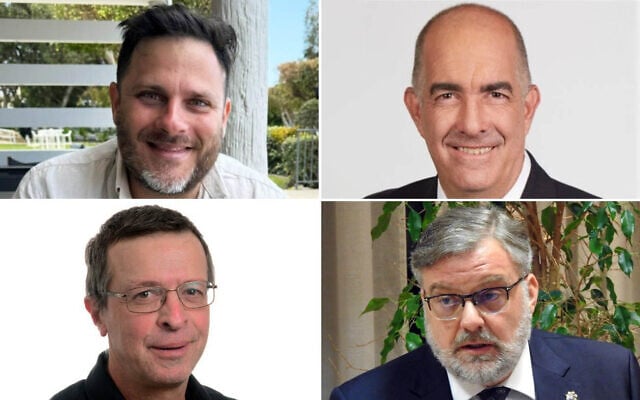
Clockwise from top left: Daniel Behar, Samy Yecutieli, Gustavo Aristegui, and Arie Kacowicz (Courtesy)
A tenuous future
It is not yet clear what the future holds for Venezuela. Large and heavily armed state-sponsored militias still roam the streets, indicating that a peaceful resolution to the current situation may still be far off, Aristegui noted.
The United States has said that it plans to take over Venezuela’s oil fields and invest billions of dollars to modernize them, with the promise of revitalizing the country’s most lucrative natural resource. And Vice President Delcy Rodríguez has been appointed the country’s interim president to maintain “administrative continuity.”
However, the country’s Jewish community was put on edge after Rodríguez charged that the US attack on Maduro had “a Zionist tint.” Aristegui referred to her as “one of the most dangerous members of the current regime.”
“The Jewish population is on standby,” said Samy Yecutieli, a member of the Security Forum of the Israel-Latin America Chamber of Commerce. “Everyone is staying low-profile. The regime controls everything, and repression could still be very aggressive.”
Yet there is also cautious optimism, Yecutieli said. Opposition leader María Corina Machado, a Nobel Peace Prize recipient, is a potential future leader for the country who has expressed support for restoring ties with Israel.
“That would be very good for Israel and for the local Jewish community,” Yecutieli said.
For Donna Benzaquen, a 17-year-old from Caracas studying at Ohr Torah Stone’s Midreshet Lindenbaum in Jerusalem, the coming months will be critical as she watches events in her home country unfold.
“I love Venezuela, but I can’t imagine making my future there,” she said. “I just hope things get better for my family and everyone there.”