

For many business aviation pilots, devoting time for family and friends, as well as for maintaining physical and mental health, has become a high priority. At the same time, a challenging workforce landscape is pushing many Part 91 and Part 135 operators to prioritize pilot recruitment and retention.
These two key factors, and others, have been driving changes in business aviation workforce dynamics.
The numbers tell much of the story: In the next eight years, 33,000 new business aviation pilots will be needed to match projected industry growth and replace retiring aviators, according to CAE. The data indicates a tightening labor market, making it more important than ever for business aviation operators to find the best and most promising aviators and to keep the pilots they have.
 California-based Part 135 pilot Keith Wolzinger’s company allows him to request days off for the subsequent month, and he almost always gets approval – an important benefit that he values highly. “With no minimum number of available days or maximum number of days off, we have complete control of our own monthly schedule,” Wolzinger said. “No ‘10 days on, six off’ or anything like that. As long as we’re reasonable with our days-off requests.”
“For a long time, the business aviation industry didn’t pay attention to the need to consider a pilot’s personal life needs,” said Megan Knox, CAM, senior operations manager at M&N Aviation. “The industry expected pilots to build flight time above anything, so scheduled time off wasn’t a priority. Everything worked around the expectation that pilots only wanted to fly.
“As the industry has grown over the past 15 years, the FAA has taken a hard look at the issues of pilot fatigue and has implemented some mandates to make sure pilots have ‘protected time off,’” Knox said. “And while the FAA’s regulations (for Parts 121, 125, and 135) have had an impact, it’s the demands of the pilots themselves that have really forced business aviation to adopt a new way of looking at the importance of scheduled time off.”
“Being paid to fly was our jackpot,” said James Lara, principal at Gray Stone Advisors. “Today, it’s a totally different environment.”
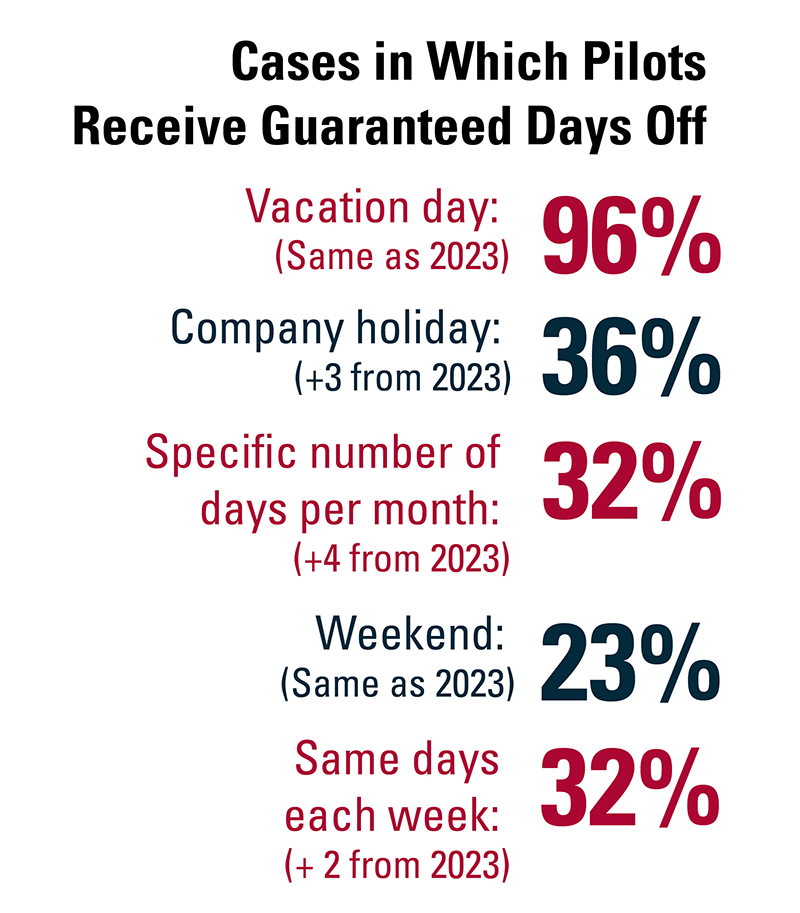
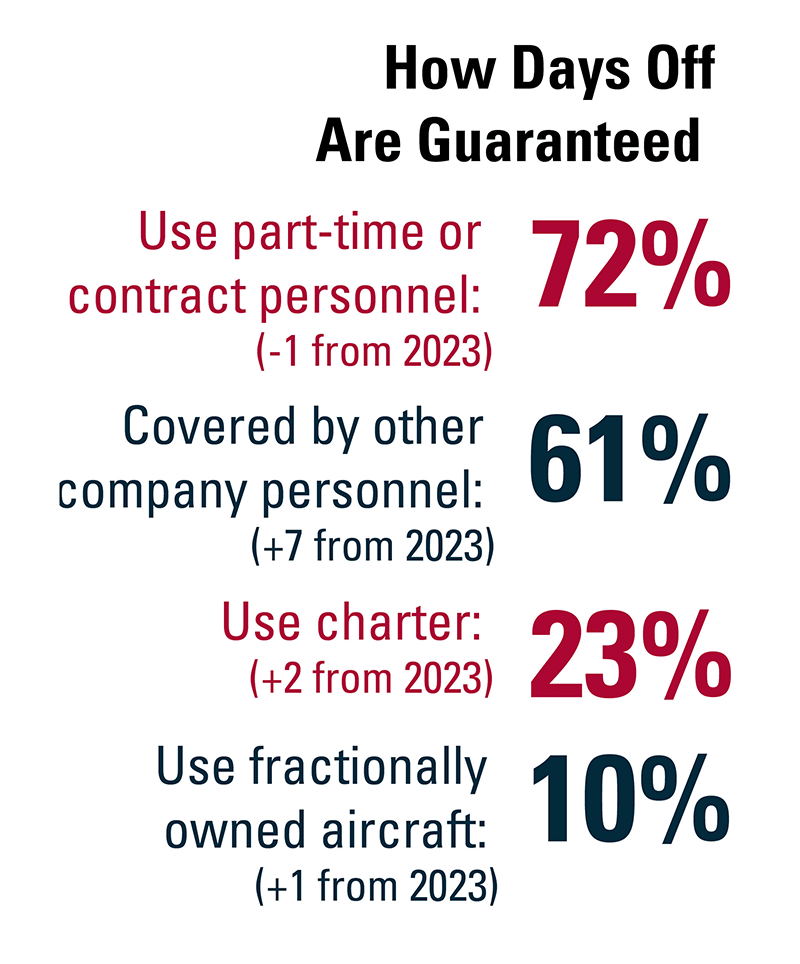
Source: NBAA 2025 Compensation Survey of 415 NBAA member participants providing data for 4,421 flight department employees
As Priorities Shift, Avoid Turnover
“While it can’t be said for everyone, it’s pretty common that pilots and maintainers aren’t as focused on climbing the corporate ladder as the generations before them,” Lara said. “Today, the priority is balancing what they do with who they are, and the company’s efforts to achieve that balance are key to attracting and retaining the best talent.
“Think about it: If you turn over a Gulfstream pilot today, between hiring, training and compensation, it’s going to cost the company around $300,000 the first year, so you want to avoid turnover at all costs,” said Lara. “That’s why giving pilots more control over their scheduling and being cognizant of their work-life needs is now a top priority.”
And while it can be challenging for typical Part 91 and Part 135 flight operations to meet the varied professional/personal scheduling needs of its pilots, try doing it for an operation that specializes in the life-and-death business of moving donor organs for transplants.
“We have 18 aircraft and 65 pilots, and more than half of our fleet is dedicated to transporting donor organs, so it’s a pretty demanding business,” Knox explained. “We fly a lot on the backside of the clock, and obviously, pilot scheduling and aircraft availability are critical.
“For example, with our [Bombardier] Challenger 300s, the crew works two weeks on, and off for one week,” she continued. “It’s a very set schedule for the most part, and that week off is ‘protected’ time off. They can’t be called in for any reason.
“It’s a huge challenge for us to coordinate everyone, and we try to be proactive in making the schedule as far in advance as we can,” Knox said. “We typically let the crews know by the 15th of the month prior so they can make their plans.”
Another thing Knox stressed was the company’s commitment to meeting the needs of its many managed aircraft clients. While the crew scheduling may not be as rigid as with their medical flights, the M&N Aviation schedulers work hard to keep the aircraft’s owners apprised of the availability of their pilots, so they can schedule their travels to avoid any interruptions.
“We work with lots of flight departments, and the best operations do this kind of scheduling on a collaborative basis.”
James Lara Principal, Gray Stone Advisors
Encourage ‘Open Give-and-Take’
Although many operators still base vacation scheduling on seniority, our experts agree that this is not the best model to use in today’s world.
“We work with lots of flight departments, and the best operations do this kind of scheduling on a collaborative basis,” Lara said. “They get all the pilots together in early November and tell them there will be a scheduling meeting in December to set next year’s vacation schedules.
“They can get with their families and figure out what time they want off next year and then come back together and figure out what works,” he said. “If there’s open give-and-take among the pilots, then things go much smoother. If any bargaining needs to be done, everyone is involved in the process. The important thing is it’s not the boss dictating who gets what.”
Of course, while long-range negotiations may work very well for planned time off, life doesn’t follow that kind of scripting. So, scheduled vacation time and “days off” need to be viewed in a different light.
It’s also essential to keep the parent company’s management informed regarding pilot and aircraft availability, especially when working around the FAA’s mandates for pilot rest.
“A pilot may be ‘home’ for a few days, but that doesn’t always impact the regulatory requirement for ‘days off’ before flying again,” Knox said. “It can be hard to make everyone understand that a ‘day off’ is only a ‘day off’ if you know it is coming.”
Dealing With Surprises
Business aviation is nothing if not built on flexibility, and that goes double for the need to seamlessly react to the inevitable phone call from a pilot saying they “can’t fly today” – for whatever reason.
“Unexpected time off needs happen to everyone,” Knox said. “Pilots get sick. Doctors’ appointments change. Family issues happen. All kinds of things come up, and we try to work with our pilots the best we can.”
And while the solution is most likely to come from another pilot on your staff filling that last-minute, left-seat need, there are times when you will need to bring in a contract pilot.
“What we see in the top-tier flight departments is that they’ve planned for this need in their yearly budgeting and pre-authorizations, so there’s no scrambling at the last minute and risk of canceling the flight,” Lara explained. “You need to make these planned actions, not reactions to the need.”
“Building good relationships with the pilots and the aircraft owner’s assistant is key. They both need to understand that the scheduler is trying to find a solution that works for everyone.”
Megan Knox, CAM Senior Operations Manager, M&N Aviation
Effectively solving these kinds of unexpected situations is the result of planning and ongoing communication between everyone – from the flight crew to maintenance to schedulers to the CEO’s executive assistant, who are all involved on a continual basis, said Lara.
“Building good relationships with the pilots and the aircraft owner’s assistant is key,” Knox said. “They both need to understand that the scheduler is trying to find a solution that works for everyone. It’s not about disrespecting the personal needs of the pilots; it’s about providing a travel resolution that works for everyone.”
“The entire team must work together to coordinate pilot time off, aircraft maintenance or anything that impacts aircraft availability so that it has minimal impact on the executive team’s ability to travel,” said Lara. “While our business is always evolving, ensuring that the aircraft owner’s travel needs are met is the one part of business aviation that will never change.”
Review NBAA guidance on flight crew scheduling in the NBAA Management Guide at nbaa.org/management.