
Ultima is a moderne music festival, but it reflects many facets. There is jazz, improvisation, folk, ambient and electronica amidst orchestral, chamber and string quartet works. Ultima goes adventuring. Oslo is colonised across multiple venues. This is often the Oslo way: see also the Oslo Jazz Festival and Oslo World.
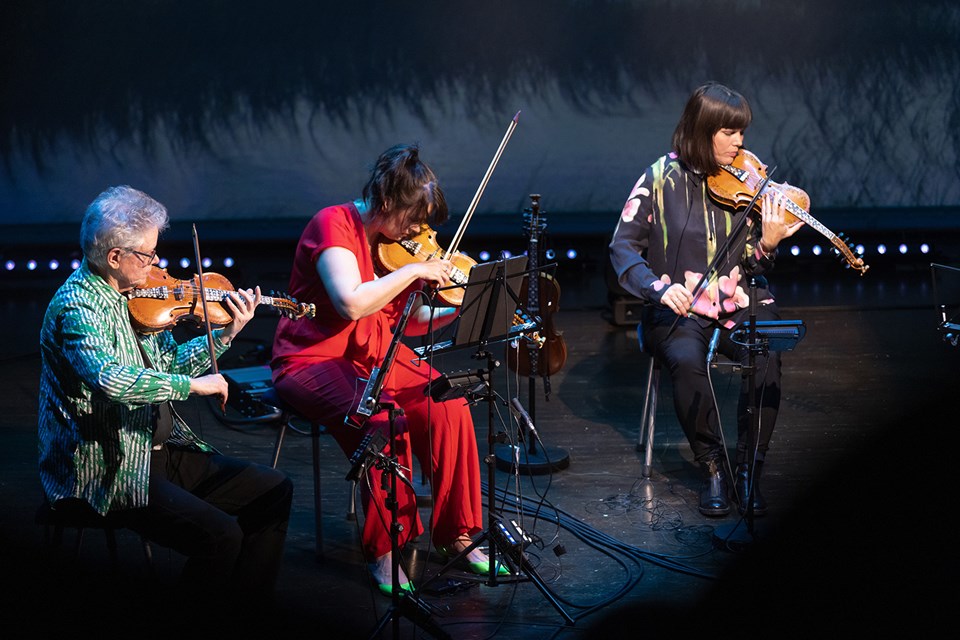
Hubro is one of Norway’s most creative labels, its core in jazz, but with simpatico artists dipping their circle-rippling elbows into the liquid realms of rock, folk, ambient country and moderne classical. One of the starriest gigs of Ultima featured a collaboration between California’s seemingly eternal Kronos Quartet and the rapidly rising composer and Hardanger fiddler Benedicte Maurseth whose recent Mirra, released by Hubro, also featuring Mats Eilertsen and Morten Qvenild. This transpired at Riksscenen, which is Oslo’s devoted traditional music venue and clubhouse. The still wet-inked ‘Elja’ (in collaboration with fellow Norwegian composer Kristine Tjøgerson) was given an early performance, with Kronos playing specially crafted Hardanger variants on their accustomed viola and cello, as well as violins, of course. These were made by luthier Ottar Kåsa.
Maurseth became the soloist for ‘Elja’ (meaning ‘raise’ or ‘foster’ in Norwegian), continuing her vivid sonic connection with endangered wildlife, including wolverine and whimbrel. The piece opened with a softly cantering motion, soon entering a period of near silence, before again rousing into a nonchalant ride, swaying softly. Meanwhile, creature recordings were cosseted before being released, as fowl call-outs rose to the rafters. A patch of extreme subtlety was welcomed by the capacity crowd of the evening’s sold out second performance. Mouthpieces were employed, over a jaunty cello action, Kronos confidently coming to terms with their newfound resonant string-additions, helping to construct the sound of a near-orchestral virtual Hardanger. Percussive, playful, robust and swaggering, the piece finished on an extroverted plane, following ample time for profound contemplation in its earlier phases, Maurseth singing low and powerful, on strings and vocal cords alike.
On the second day of your scribe’s three-day stint, there were three concerts to catch. In the late afternoon, Lithuanian composer Arturas Bumsteinas took over a large hall in the marbled Sentralen. He’s penned ‘Navigations’, music for ‘weather instruments’, which is one of the abilities of the invented Futurist sound-makers that completely inhabited the space, mimicking the sonic qualities of storms and milder conditions. These semi-primitivist post-Luigi Russolo intonarumoriinstruments (Italian for noise-makers) have been seen more frequently at performances during 2025. These are based around decayed theatre versions, often rebuilt from scratch by Ernestas Volodzka.
The work was performed by a five-piece crew of movers-players. There was an abundance of wood, rope and pseudo-wheel-of-fortunes spindles. Heavy tarpaulins were draped for muting effect, one instrument was like a see-saw, another wheeled out into the large floorspace, as the audience sat along the walls. Sounds like autumn leaves being collected, shells tipped out of bags, tiny brass bells, big sheets of metal, thundering, the majority moving out onto the floor as the performance proceeded. Silvered cloths were wiped with friction on the wooden exteriors, rain sticks brandished, skinny-sticks dragged across the marble floor, making this work as much visual as sonic, like a performance art piece. There’s a rotary pile-up, all sounding like a meteorological nightmare. Eventually, blinds sliding across the glass ceiling, calling down the winter, concluding in darkness.
A westerly tram whisked to the Norwegian Radio Studios, the Store being suitably quaint and elderly: a classic classical concert edifice. On this evening, the Norwegian Radio Orchestra played a trio of relatively recent works, featuring soloists Ellen Ugelvik (piano/voice) and Jennifer Torrence (percussion), both of these players possessing a strong sense of visual presence. The evening opened with Sarah Nemtsov’s recent ‘Black Trees’, beginning with a festive pomp-bustle, percussion hitting hard, with a sudden clarinet lead. Its second part was more considered, with flute enlarging towards a string-sweeping mystery.
The golden oldie of Witold Lutosławski’s 1951 ‘Mala Suita’ had roiling basses, accumulating the power of a filmic suspense, as apocalypse neared. A hive susurrus was matched with percussion bombast against drone-walls, with muted tuba, a surging recurrence leading to a sparse distress.
The new concerto work by Henrik Hellstenius had Ugelvik intoning vocally, under her piano lid, ‘And Fear Of Loss Will Not Oppress Your Heart’ operating on a theatrical level, as the soloists thoroughly inhabited the stage. The behemoth orchestra awakened, Ugelvik finally sat on her piano stool, while Torrence scampered across her expansive percussion array, circulating around the set-up as she activated its largest kettle-booms, gongs and woodblocks also busily vibrating. Torrence, too, intoned text. An enlarged scale of expression was explored.
This was followed by the contrasting location of Trekanten, a slightly slick bar that hosted late night electronica-with-film and percussion. Håkon Stene and Bendik Hovik Kjeldsberg provided a rogue modern-day soundtrack for a vintage silent jungle-monster flick, this mystery movie looking well worth a concentrating living room re-watch, filled with vibraphone and drumkit propulsions.
The cinematically-inclined Vega Scene hosted a concluding festival day of Moroccan-grounded music (and talks), a highlight of which was provided by the electroacoustic practitioner Leila Bencharnia, presenting her new ‘Fatima And The Dust’ extended piece. She uses Berber gnaoua music as a beginning-point, sampling sonic snatches for an evocative field recording aura (zoomed-in sintir strings, for instance, then big bendir frame drum reverb snatches), subtly combining with disembodied electronics and then moving to the upright piano for a more improvisatory episode. A thunder-gathering hum hovered around the edges, then echo-qraquebstook over (metal castanet variants), with wind-hums, vocal strains and stray oud phrasings.
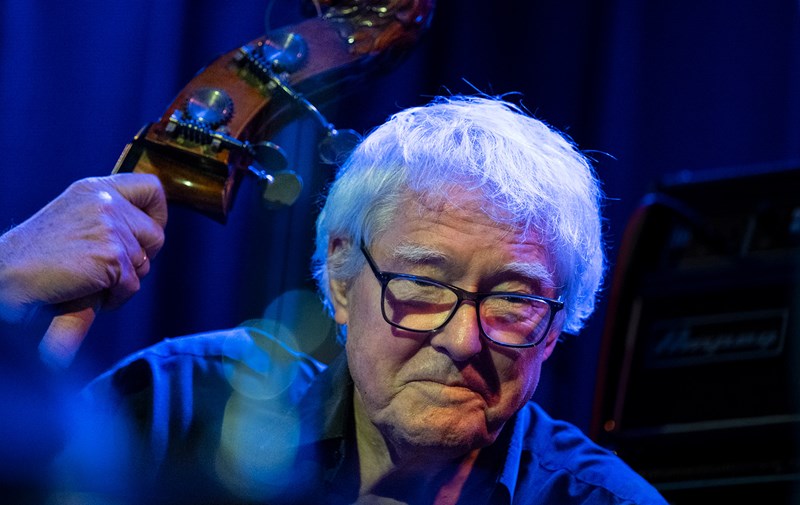 Very soon afterwards, speeding southwards, as Ultima wound down, your scribe alighted at the Victoria Nasjonal Jazzscene (Oslo’s Ronnie Scott’s equivalent). The Arild Andersen Group (The bassist pictured above – photo by Stein Hødnebø) sold out on Saturday night, led by one of the greatest Norwegian bassists (now 80 years old), and featuring the dynamic Marius Neset as side-scorching saxophonist. Eschewing the two-set club norm, Andersen’s foursome opted for an extended single rush of power-jazz, virtuoso and hard-hitting. Perhaps they were a touch too full-on, as the long numbers offered few dynamic variations, mostly conveying an ecstatically dense gush of soloing complexity. This was highly impressive, but shading gradations were not so present, or pauses for reflection and consideration. All four players excelled, the roster completed by pianist Helge Lien and drummer Håkon Mjåset Johansen, the latter’s solos being particularly creative.