
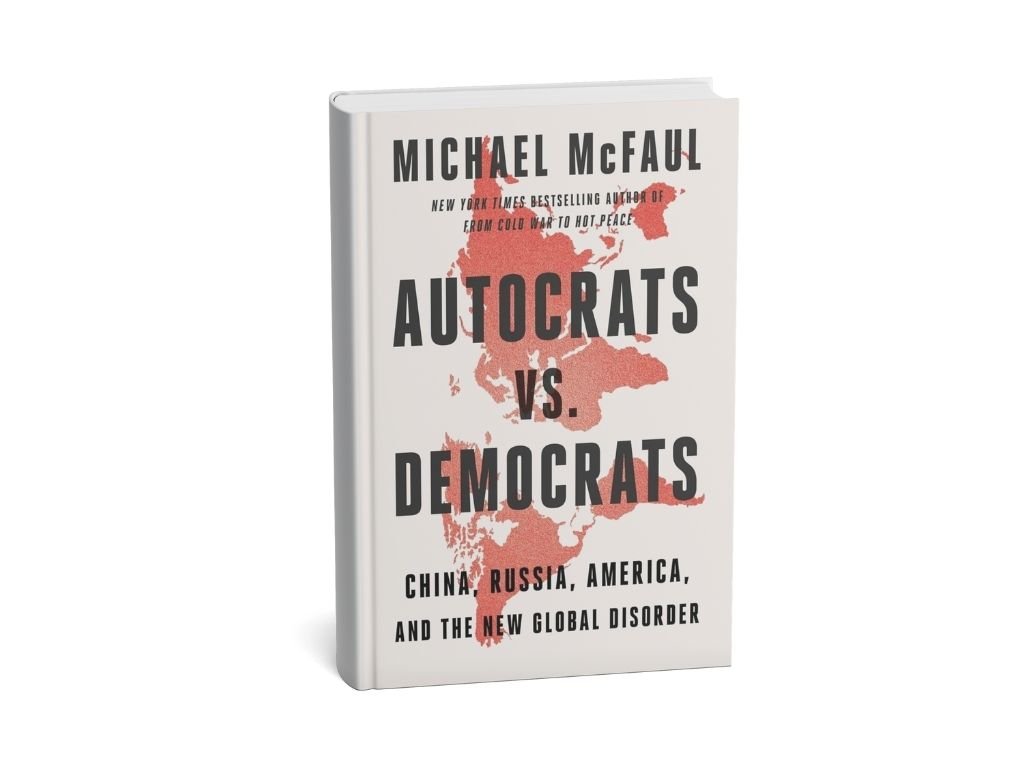
Autocrats vs. Democrats: China, Russia, America, and the New Global Disorder (2025), by Michael McFaul | India’s World
Michael McFaul’s Autocrats vs. Democrats is both an ambitious chronicle and a pointed manifesto. Drawing on his dual vantage point as Stanford scholar and former U.S. ambassador to Russia, McFaul maps the long and tangled contest between democracy and authoritarianism. He argues that today’s struggle among the US, China, and Russia cannot simply be reduced to a “new Cold War.” The world, he reminds us, has changed too deeply in terms of economy, technology, and ideology for that comparison to hold. What he offers instead is a call for “fresh thinking,” grounded in history but focused squarely on the challenges of the 21st century.
The book unfolds in three parts: a deep historical survey of U.S. relations with Russia and China, an analysis of today’s geopolitical balance, and a detailed policy agenda for strengthening the democratic world.
McFaul’s core argument is that democracies are not only morally superior but also structurally more successful. He marshals data to show that most of the world’s largest and most advanced economies are democratic, and that these systems outperform autocracies across development, education, and security metrics. This, he contends, is not a coincidence but evidence of democracy’s long-term advantages.
The book also tempers alarmism about America’s adversaries. McFaul sees China as formidable but not unstoppable, a nation whose economic rise is plateauing and whose diplomatic reach remains limited. Russia, meanwhile, is portrayed as militarily aggressive but economically diminished. Both powers, he suggests, can be contained through a confident, coordinated, and values-driven U.S. foreign policy.
Yet McFaul’s sharpest warning is directed inward. He argues that America’s biggest vulnerability is not external but domestic: the erosion of democratic norms and the rise of polarisation. The book’s most persuasive passages link internal division to global weakness, insisting that “autocrats abroad clearly understand the benefits of our disunity.” In this sense, McFaul reframes the democracy-versus-autocracy contest as both an international struggle and a domestic battle for political legitimacy.
The strengths of Autocrats vs. Democrats lie in its range and clarity. McFaul writes with the authority of experience and the conviction of a believer in liberal democracy. His historical sections are vivid, and his policy agenda is ambitious. Still, the book is not without blind spots. It assumes the virtue of the U.S. democratic model without deeply engaging its contradictions, and it glosses over episodes where American foreign policy has undermined its own ideals. At times, some of the proposed reforms—like democratic-only trade blocs or large-scale capital redirection abroad—feel politically unrealistic. The book’s final note is one of guarded optimism: democracy, however flawed, has repeatedly outlasted its rivals.