
BAKU, Azerbaijan, January 6. By early 2026,
Azerbaijan’s emergence as a key connector between Central Asia and
the West is no longer perceived as a coincidence of geography. It
is increasingly understood as the result of a leadership-driven
strategy implemented consistently over more than a decade by
President Ilham Aliyev. What distinguishes Azerbaijan’s current
role is not its location alone, but the political will,
institutional discipline, and strategic continuity that transformed
location into leverage.
Unlike many regional initiatives shaped by reactive diplomacy,
Azerbaijan’s connectivity policy reflects a coherent doctrine
personally articulated and advanced by President Ilham Aliyev. His
approach has been defined by a simple but decisive premise:
infrastructure without political reliability is ineffective, and
geography without strategy remains inert. This logic has guided
Azerbaijan’s investments in transport, energy, and regional
partnerships at a time when alternative routes were either
politically constrained or structurally fragile.
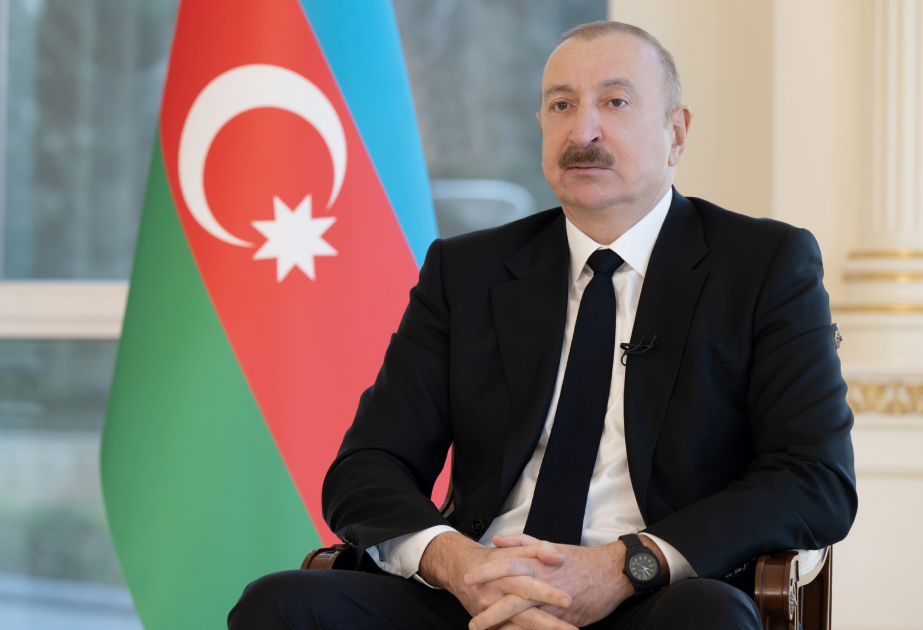
In an interview with local television channels on January 5,
President Ilham Aliyev openly framed Azerbaijan’s growing role not
as an aspiration, but as an objective outcome of geopolitical
reality. He emphasized that while alternative routes may exist in
theory, current global conditions render many of them unacceptable
for Western partners. Azerbaijan, by contrast, offers something
increasingly scarce in international transit politics:
predictability combined with execution capacity.
“Today, the Central Asia-Azerbaijan unity and the transformation
of the C5 into C6 carry great importance not only for our region
but for the world. Because connectivity, transport, and logistics
are of major significance for many leading international actors,
and in this regard, the only reliable country geographically
capable of linking Central Asia with the West is Azerbaijan,”
President Ilham Aliyev emphasized.
This leadership-driven vision has reshaped regional dynamics.
The long-standing C5 framework of Central Asia is gradually
evolving into a functional C6, with Azerbaijan integrated into
Central Asian economic and logistical planning. This shift did not
occur organically. It reflects years of diplomatic engagement,
summit diplomacy, and targeted economic initiatives personally
overseen by President Ilham Aliyev, who positioned Baku not as an
external intermediary, but as a stakeholder in Central Asia’s
long-term development.
The results are measurable. In the first ten months of 2025,
Azerbaijan’s trade with Central Asian states expanded at a pace
that exceeded historical trends. Trade turnover with Uzbekistan
approached $472.5 million, increasing by $276.4 million
year-on-year. Trade with Kazakhstan surpassed $600.3 million,
growing by more than $224.5 million. These figures point to a
deliberate recalibration of regional economic flows toward
corridors and partnerships shaped by Azerbaijani policy.
President Ilham Aliyev’s strategic imprint is especially visible
in the evolution of the Middle Corridor. While competing routes
remained subject to political uncertainty, Azerbaijan focused on
operational readiness. In 2025 alone, cargo throughput via the Port
of Baku increased by more than 6 percent, while container transit
volumes surged by 70%. This performance reflects a leadership
choice to prioritize delivery over declarations – a hallmark of
President Ilham Aliyev’s governance model.
Crucially, Azerbaijan’s role under President Ilham Aliyev
extends well beyond transit logistics. He has consistently promoted
a shift from transactional trade to industrial partnership. Joint
investment funds worth hundreds of millions of dollars,
manufacturing facilities developed with Central Asian partners, and
industrial projects launched in the liberated territories of
Karabakh illustrate a model of cooperation based on shared
production rather than short-term exchange. Initiatives such as the
Uzbekistan-backed textile facility in Khankendi and cooperation in
automotive and light manufacturing underscore this long-term
vision.
Energy policy provides another example of leadership-driven
strategy. President Ilham Aliyev personally advanced the concept of
integrated green energy corridors linking Azerbaijan, Kazakhstan,
and Uzbekistan – an agenda formalized during COP29 and further
operationalized in 2025. By expanding cooperation beyond
hydrocarbons to include renewable energy exports from the Caspian
basin to Europe, Azerbaijan has positioned itself as a pragmatic
contributor to the West’s energy transition, rather than a passive
supplier.
The frequently cited notion of Azerbaijan as a living bridge is
therefore best understood as a political construct shaped by
leadership decisions. Infrastructure projects such as the
Baku-Tbilisi-Kars Railway, alongside the strategic logic of the
Zangezur corridor, did not materialize spontaneously. They are the
product of sustained presidential oversight, regional risk
management, and long-term diplomatic investment.
As 2026 unfolds, Azerbaijan’s role as a central node of Eurasian
connectivity increasingly appears inseparable from the leadership
style of President Ilham Aliyev. By aligning geography with
governance and infrastructure with political trust, he has
transformed Azerbaijan into an indispensable partner for both
Central Asia and the West. This is not merely a regional success
story – it is a case study in how leadership can redefine a
country’s strategic weight in a fragmented global order.