
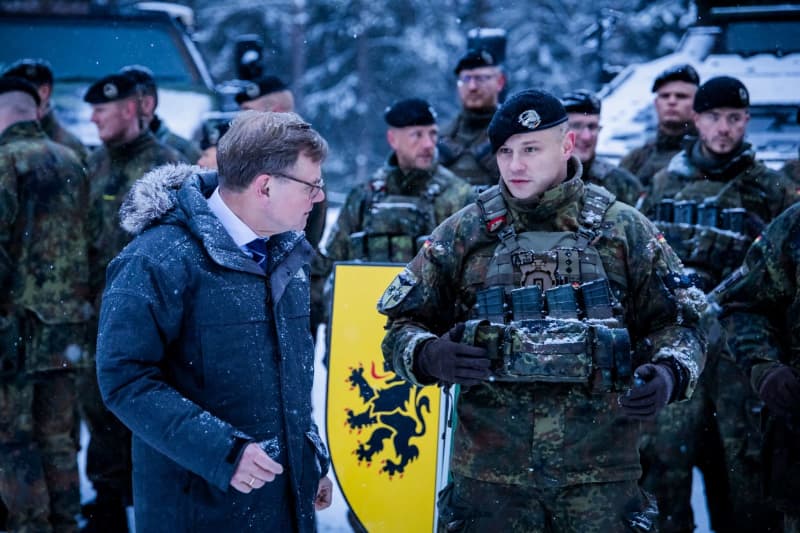
German Foreign Minister Johann Wadephul has hailed a German brigade deployed to Lithuania as a clear sign of NATO solidarity and a strong signal to Russia during a visit to troops on Monday.
“This is not only about defending the freedom and security of Lithuania, but also the freedom and security of Europe and thus also Germany,” he said while inspecting the 45th Armoured Brigade, dubbed “Lithuania,” in Nemenčinė near Vilnius.
The fact that Germany has for the first time stationed a force of this kind abroad is “a sign of the seriousness of the situation, but also of the seriousness of our decision to stand by our friends and allies,” the minister said.
The tank brigade, which was formally commissioned in April 2025, is intended to boost protection of NATO’s eastern flank as European allies are responding to Russia’s growing expansionist ambitions.
It represents the first permanent German deployment of a large unit abroad.
The brigade is expected to be fully operational as a combat unit by 2027, with a total strength of 4,800 soldiers and 200 civilian employees.
Germany is making an “indispensable contribution to security and stability” on NATO’s eastern flank, said Wadephul, thanking the soldiers for their service.
Wadephul thanked Lithuania for the “immense trust and great hospitality” shown by the population towards the soldiers. This cannot be taken for granted, he said, referring to the German occupation of Lithuania during World War II when Nazi forces and local volunteers killed over 90% of the roughly 200,000 Jews living in the country between July 1941 and July 1944.
During his visit to Lithuania, Wadephul also met with his counterpart Kęstutis Budrys.
The talks were expected to focus on supporting Ukraine, which was invaded by Russia almost four years ago, as well as close cooperation on NATO’s eastern flank and in the fight against hybrid threats, according to the Foreign Office in Berlin.
Hybrid threats are understood to include state-directed cyberattack as well as military, economic, intelligence and propaganda tools, which can also influence public opinion.
Wadephul calls for European unity in face of Russia threat
“We must counter the threat from Russia with strong European cohesion,” Wadephul said before his departure.
He said the decisive factor is “that we are prepared to defend ourselves and our freedom more independently,” stressing that Germany is working with Lithuania and its partners in NATO and the EU to conduct more checks in the Baltic Sea and to invest in more robust infrastructure.
Both countries also stand firmly alongside Ukraine, he said, especially in “this potentially decisive phase of international efforts to end Russia’s war of aggression.”
Vilnius and Berlin are guided by the shared conviction that only a strong Ukraine and a Europe capable of defending itself can secure lasting peace on the continent, he added.
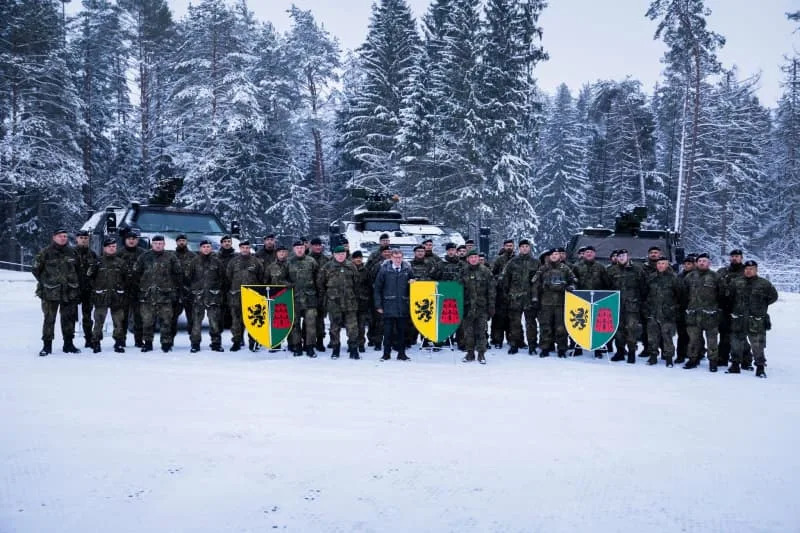
German Foreign Minister Johann Wadephul (C) poses for a photo with soldiers during a visit to Panzerbrigade 45 “Lithuania”. Christoph Soeder/dpa
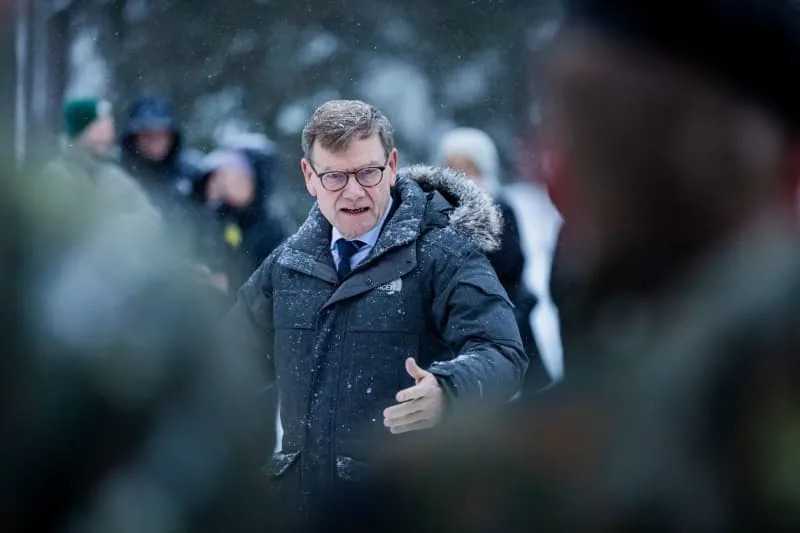
German Foreign Minister Johann Wadephul speaks to soldiers during a visit to Panzerbrigade 45 “Lithuania”. Christoph Soeder/dpa