
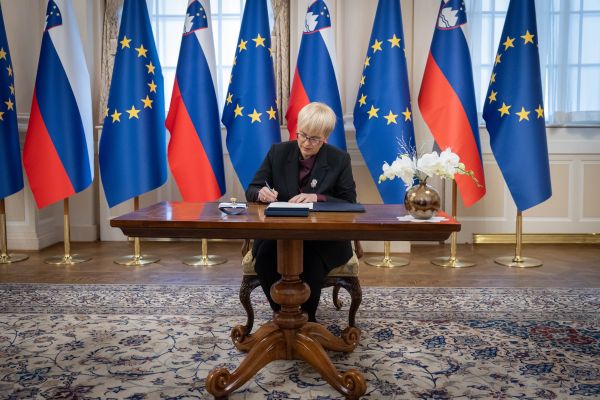
Slovenia’s President, Natasa Pirc Musar, announced on Tuesday that the parliamentary elections in the European Union member state will be held on 22 March. In her statement, the Slovenian president expressed her commitment to ensuring that the elections are conducted fairly, emphasising the importance of vigilance against disinformation and manipulation, including from foreign actors.
“I have signed the decree on the calling of regular elections for the National Assembly of the Republic of Slovenia, which will take place on Sunday, 22 March 2026. With this, an important period for democracy begins, in which we citizens will decide on the future direction of the country. May content take precedence over politicking during the campaign. May the discussion be directed towards finding solutions to the issues facing society, rather than towards divisions,” the Slovenian president stated today.
The elections for the 90-member National Assembly are viewed as a significant test for the current liberal government, which faces challenges from the main opposition populist right-wing Slovenian Democratic Party (SDS).
Prime Minister Robert Golob‘s coalition government assumed office in 2022 after defeating the populist government of his predecessor, Janez Jansa, who sought to push the country toward far-right policies. Golob’s coalition comprises his liberal party, Svoboda (Freedom), with 41 seats, the Social Democrats with seven seats, and The Left with five seats. This coalition provides a working majority of 53 seats in the Assembly.
Under Prime Minister Golob’s leadership, Slovenia officially recognised the state of Palestine. However, the opposition has accused his government of impeding economic growth. A recent opinion poll published on 5 January indicates that Golob’s party currently holds 16.3% support, while the populist SDS stands at 21.5%. Additionally, four other parties appear likely to gain representation in the parliament.
By law, the National Assembly must convene within 20 days following the election, after which the President has an additional 30 days to appoint a prime minister-designate who enjoys the support of a majority of lawmakers. President Pirc Musar has called for “respectful, responsible, and tolerant communication during the election campaign.”
Slovenia, with a population of approximately 2 million, gained independence from the former communist-run Yugoslavia in 1991 and became a member of NATO and the European Union in 2004.
A referendum in November saw the electorate reject a bill concerning assisted dying, which would have permitted terminally ill patients to end their lives.
This article used information from The Associated Press.