
The Paris meeting of the “Coalition of the Willing” – a group set up by France and the UK with about 40 other nations – did not put a number on how many troops would be deployed, and did not include similar pledges from any other country.
The pledges include plans to deploy European fighter jets and surveillance aircraft to monitor any peace deal, while also setting up military hubs across Ukraine to shield its military forces and equipment. Turkey committed to lead work in removing mines from the Black Sea in order to secure shipping routes.
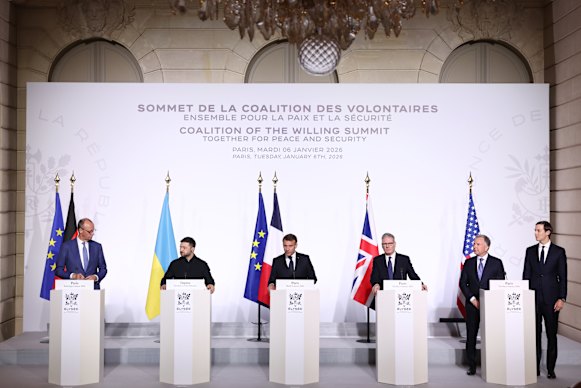
Leaders gather for talks on Ukraine security on Tuesday. From left, Friedrich Merz of Germany, Volodymyr Zelensky of Ukraine, Emmanuel Macron of France and Keir Starmer of the UK join US Special Envoy Steve Witkoff and Jared Kushner.Credit: Getty Images
Kushner and Witkoff repeated American pledges to offer a security guarantee to Ukraine against Russian aggression if there was a peace deal, but did not reveal any details about the scale or timeframe for this safeguard, seen as an essential element in any lasting peace.
“This does not mean that we will make peace, but peace would not be possible without the progress that was made here today,” Kushner said.
While the outcome showed progress on defending Ukraine in the event of a ceasefire with Russian President Vladimir Putin, the concerns over Greenland have highlighted the differences with Trump over security in Europe.
While Greenland is a self-governing territory with a parliament and a premier, it is also part of the Kingdom of Denmark and subject to a defence agreement between Denmark and the US from 1951, which gives the US broad discretion to build and operate military bases.
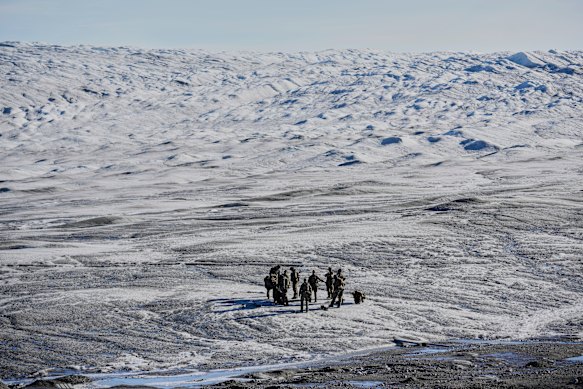
Danish forces join NATO troops in exercises in Greenland in September.Credit: AP
Danish Prime Minister Mette Frederiksen warned that an American move to gain control of Greenland by force would mean the end of NATO, given that both nations are signatories to the security treaty.
“If the US chooses to attack another NATO country militarily, then everything stops, including NATO and thus the security that has been established since the end of the Second World War,” she told Danish broadcaster TV2.
Frederiksen signed the statement along with German Chancellor Friedrich Merz, Italian Prime Minister Giorgia Meloni, Polish Prime Minister Donald Tusk, Spanish Prime Minister Pedro Sánchez, Starmer and Macron.
“NATO has made clear that the Arctic region is a priority and European allies are stepping up,” the seven leaders said.
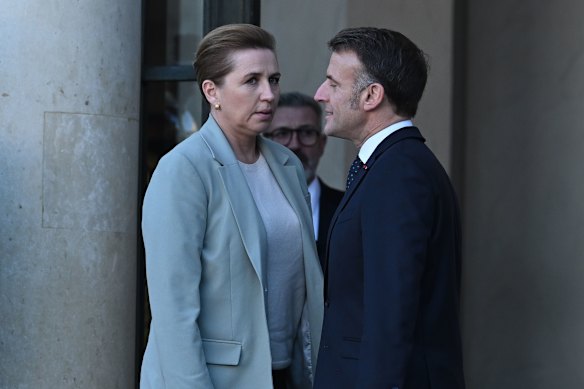
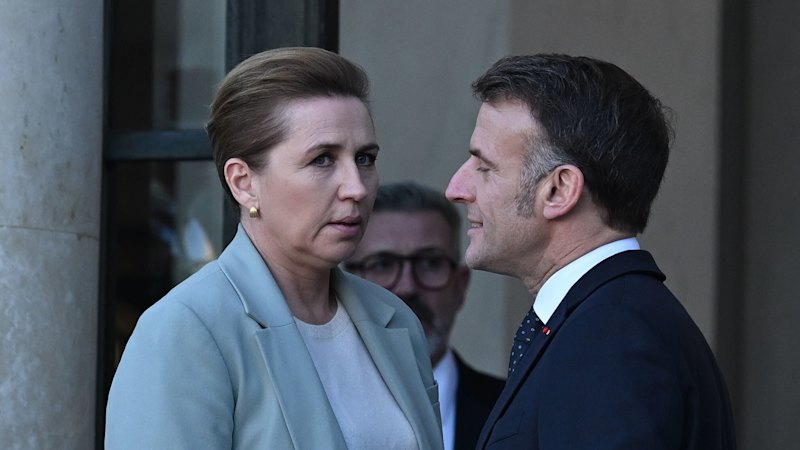
Danish Prime Minister Mette Frederiksen and French President Emmanuel Macron in Paris on Tuesday.Credit: Bloomberg
“We and many other allies have increased our presence, activities and investments, to keep the Arctic safe and to deter adversaries. The Kingdom of Denmark – including Greenland – is part of NATO.
“Security in the Arctic must therefore be achieved collectively, in conjunction with NATO allies including the United States, by upholding the principles of the UN Charter, including sovereignty, territorial integrity and the inviolability of borders.
“These are universal principles, and we will not stop defending them.”
Carney, who flew into Paris for the meeting on Ukraine, echoed the European message.
“The future of Greenland is a decision exclusively for the people of Greenland and Denmark,” Carney told reporters. He met Frederiksen at the Canadian embassy while in Paris, and announced that Canada’s Indigenous governor-general and its foreign minister would visit Greenland next month, where they are expected to open a consulate in Nuuk.
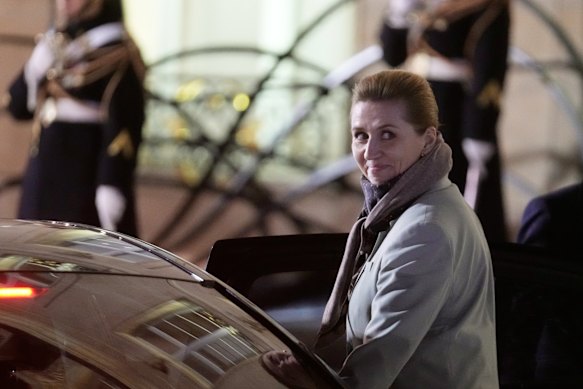
Danish Prime Minister Mette Frederiksen leaves a meeting in Paris with other European leaders on Tuesday.Credit: AP
Trump said in an interview with The Atlantic on the weekend that Greenland was “surrounded by Russian and Chinese ships” and would be needed for US security.
“We do need Greenland, absolutely,” he said. “We need it for defence.”
Loading
He did not say the US would take the territory by force, although he has refused to rule this out in the past, and he did not threaten an imminent move to seek American control.
But White House deputy chief of staff Stephen Miller used combative language on Monday to suggest the US was willing to force the outcome it wanted.
“Nobody’s going to fight the United States militarily over the future of Greenland,” Miller said.
Secretary of State Marco Rubio, however, downplayed military intervention for Greenland when he briefed US lawmakers on Monday night, according to The Wall Street Journal, saying the Trump administration was focused on trying to buy the territory.
The US operates a major air base and missile defence facility in the far north of Greenland under its 1951 treaty with Denmark, raising questions among experts about why the US would need to take full control.
While there are mineral resources in Greenland, these would be costly to extract because of the sub-zero conditions and some projects have proceeded under the existing governance of the territory.
Arctic Frontiers, an independent group based in Norway, noted the swift response from Nordic countries defending Denmark and Greenland against the US president’s claims.
“The Nordics stand as a united front in response to the recent US comments about Greenland,” group executive director Anu Fredrikson said in a statement to this masthead.
Loading
“In addition, we also see that the language used by the Danish government is more direct and less patient than previously.
“Moving away from multilateral collaboration can have dire consequences. Security guarantees formed the foundation of NATO deterrence. What happens to the perception of security guarantees when one ally threatens another?”
Get a note direct from our foreign correspondents on what’s making headlines around the world. Sign up for the weekly What in the World newsletter here.