
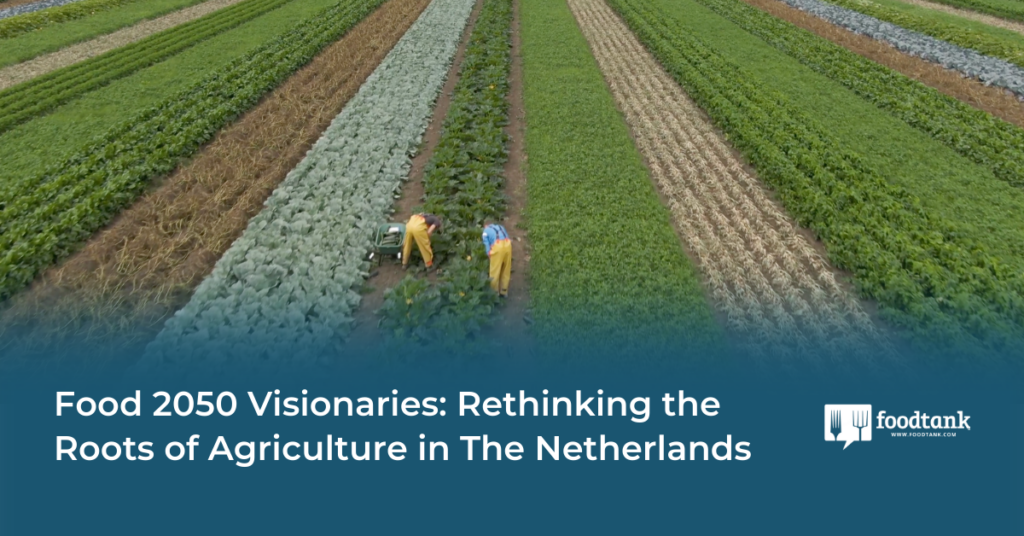
The Netherlands—a country smaller than the state of West Virginia—is the world’s second-largest agricultural exporter by value. That productivity, however, has come with environmental and social costs, according to researchers at Wageningen University & Research (WUR). The current economic system prioritizes efficiency and growth over ecological and human well-being.
“This efficiency, this focus on more, has come at an expense of animal welfare and human welfare,” Evelien de Olde, Researcher at the Animal Production System Group, says in the Food 2050 film, which premieres January 2026 in partnership with Media RED, the Rockefeller Foundation, and Food Tank.
Together with Dr. Imke de Boer, Professor of Livestock and Sustainable Food Systems at WUR, de Olde wrote Re-rooting the Dutch Food System, a blueprint for transforming Dutch agriculture by redesigning how food is produced, consumed, and valued. They were named named a Top Food System Visionary in 2020 by the Rockefeller Foundation. Their vision calls for a fundamental shift toward circular food systems that work with natural processes rather than against them.
“A circular system to feed the soil, respecting the life of the animals, and creating more conscious consumers. This combination of elements makes more sustainable food systems,” says de Olde.
One key change involves how land is used. In the Netherlands and globally, about 40 percent of arable land is used to grow feed for livestock instead of food for people. De Boer says that this is an inefficient use of land and nutrients that circular food systems can help correct.
“When you produce plant-sourced food for our consumption, you also automatically produce all kinds of co-products that you can feed directly to the animals. You want to circulate nutrients into the system,” says de Boer.
Protecting soil life is also critical to circulating nutrients. De Boer says a healthier, more sustainable food system uses intercropping, or planting multiple types of crops in one field to reduce the risks of pests and diseases, and avoids the use of pesticides.
Cornelis Mosselman is testing nature-based systems that emphasize biodiversity and soil health at Bi-Jovira Farm in South Holland. He says the results are fascinating.
“Plants, roots, and the organisms in the soil interact. And together they are forming a powerful stimulus for the soil and natural processes. And that leads to certain balances that ensure that excesses and plagues are manageable,” says Mosselman.
For de Olde and de Boer, animal welfare is equally important to building truly sustainable food systems.
“We continuously learn more about the emotional intelligence of animals and the importance of giving space to their natural behavior,” says de Olde. For example, grazing cows ensure grass doesn’t grow too high, so rivers can go into the floodplains when needed. This keeps the cities safe while producing nutritious, locally sourced dairy and meat.
Re-rooting the food system also means reconnecting consumers with the origins of their food.
“The biggest problem with our food system currently is that it’s become so globalized that people have lost the connection of where their food comes from,” says Fabian, a farmer at Herenboeren. Fabian’s farm brings together about 200 families who collaborate to plan which crops are grown, allowing them to actively participate in the production of their own food and “create a kind of ‘pro-sumer.’”
That connection helps shift mindsets, says de Olde: “It allows people to enter the farm, learn about how food is produced, and thereby also create more conscious consumers…people have to learn to respect food, as it takes a lot of energy and effort to produce it. And this is a mindset that we need to learn again.”
Since being named a Food Systems Visionary, de Boer has seen a growing movement of people interested in strengthening that connection. She says that communicating success stories—not just focusing on what’s broken—has engaged more people in this work, especially young people.
Articles like the one you just read are made possible through the generosity of Food Tank members. Can we please count on you to be part of our growing movement? Become a member today by clicking here.