
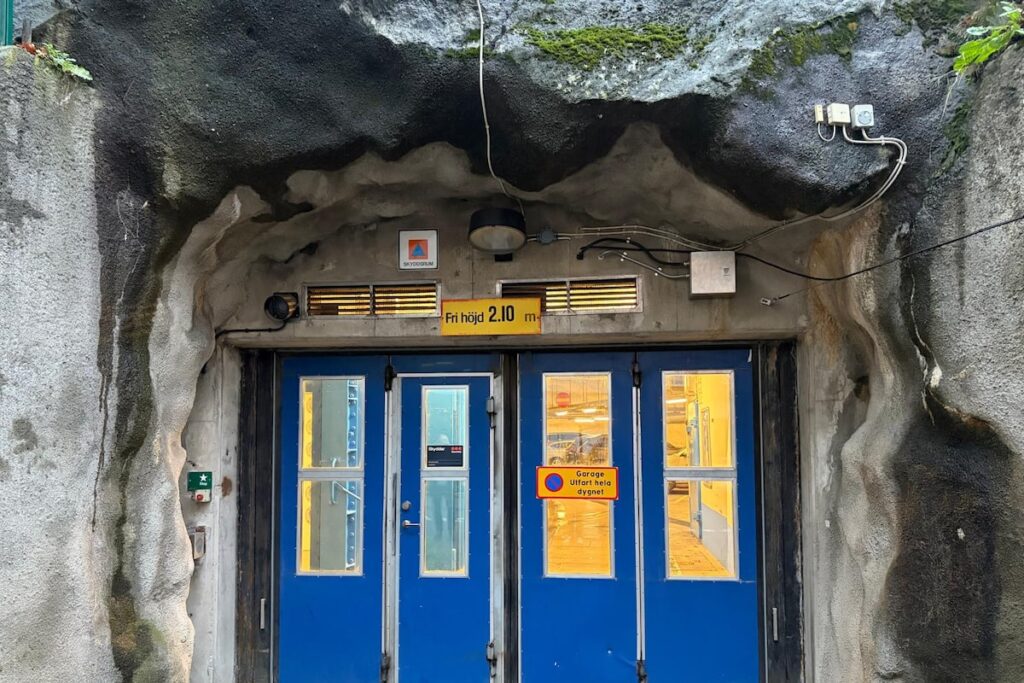
The shelter is lined with reinforced concrete and carved out of a hill of granite that rises about 20 metres above the garage ceiling.Eric Reguly/The Globe and Mail
From the outside, and even from the inside, the “Hedgehog” garage in central Stockholm looks like any underground parking facility anywhere in Scandinavia.
A closer inspection reveals it’s a dual-use creation – parking during peacetime, emergency shelter during war or other life-threatening situations, including extreme weather events. The cavernous garage, once the cars are removed, is designed to hold 1,200 people and suffer little damage even if a 250-kilogram bomb were to detonate within five metres of the shelter wall. It is part of Sweden’s “total defence” strategy, which encourages all civilians to be able to cope with a crisis within a few hours.
The strategy has picked up momentum – and government funding – since Russia’s full-scale invasion of Ukraine in 2022 and recent “hybrid” attacks on some Eastern European NATO countries. They have ranged from airspace incursions by Russian jets and drones to suspicious drone activity over airports and military sites.
NATO’s eastern flank is deploying a new weapons system to defend against Russian drones
Supreme Commander of the Swedish Armed Forces General Michael Claesson has said that Russia may soon attempt to test NATO’s collective defence clause – Article 5 of the North Atlantic Treaty – which says that an attack on one NATO member state is considered an attack on all.
Henrik Larsson, the director of the Department of Rescue Services and Civil Protection at the Swedish Civil Contingencies Agency, took The Globe and Mail on a tour of the Hedgehog garage to point out its emergency systems, none of which were apparent at first glance.
Once the cars are removed, the garage is designed to hold 1,200 people and withstand a 250-kilogram bomb detonating within five metres of the shelter wall.The Globe and Mail
The shelter is lined with reinforced concrete and carved out of a hill of granite that rises about 20 metres above the garage ceiling. Its backrooms house generators and tanks that can hold enough water and diesel fuel for three months. Charcoal filters can remove most of the toxins from the air after a bomb or missile attack. Two rows of wall-mounted, one-way valves are designed to release internal air pressure when the ventilation system kicks in during an air raid.
“Sweden has 64,000 air-raid shelters and Stockholm has 15 big, reinforced ones like this one,” Mr. Larsson said. “We can put seven million people in shelters really fast, within a few hours.” (Sweden’s population is 10.6 million.)
From the outside, and even from the inside, the ‘Hedgehog’ garage in central Stockholm looks like any underground parking facility anywhere in Scandinavia.Eric Reguly/The Globe and Mail
The vast majority of the shelters are integrated into the subterranean infrastructure of existing buildings. Cities and towns are filled with air-raid sirens that are tested four times a year.
The big deficiency in the Hedgehog shelter and others like it? They contain no food supplies, so people have to bring their own to stay alive if trapped inside for more than a few days.
But Swedish civil defence authorities even have a food plan for families facing potential emergencies. “In case of crisis in war,” an updated brochure published by the Swedish Civil Contingencies Agency and distributed to every household recommends “building up your emergency storage by simply buying one or two additional items when doing your regular shopping.” Among the suggested top-up products are pasta, tinned fish, peanut butter, protein bars, dried fruit and, because Swedish cuisine is important even underground, rosehip soup.
A pilot with the Blekinge Wing of the Swedish Air Force sits in the cockpit of a JAS 39 Gripen fighter.Tom Little/Reuters
The country’s civil defence strategy dates back to the First and Second World Wars (Sweden was neutral in both wars; its immediate neighbours, Norway and Finland, were invaded). The program expanded during the Cold War, when dozens of volunteer civil-defence associations were formed, then lost momentum in the decades since.
Since the start of the Russia-Ukraine war and Sweden’s entry into NATO last year, the civil defence programs and recruitment have re-emerged on the national agenda.
“When Russia went into Ukraine, we saw a big increase in our membership,” said Louise Bibbing, a board member of the Swedish Blue Star volunteer association. “We’ve had a little bit of a revival.”
The shelter is part of Sweden’s ‘total defence’ strategy, which encourages all civilians to be able to cope with a crisis within a few hours.Eric Reguly/The Globe and Mail
When she spoke to The Globe, Ms. Bibbing was taking care of the 19 horses in the Royal Stables, which provide ceremonial transportation for the royal family during state visits and festive events. The Blue Stars started in the First World War as an animal welfare association. Its members, mostly women, took care of horses used by the military as well as livestock on farms left short of labourers during the mobilization of their male owners and workers. The association also started animal hospitals that are still in operation.
The Blue Stars were especially active in the early stages of the Second World War, when Finland was invaded by the Soviets. They even launched an ambulance service for wounded horses.
Sweden’s Saab offers to build entire GlobalEye military surveillance plane in Canada
Zelensky ditches NATO ambition as U.S. envoy Witkoff sees progress in peace talks
Today, the association trains its members to take care of domestic pets and farm livestock during a crisis, vaccinate animals and evacuate them from burning barns. Blue Stars can even help farmers keep their farms – and the country’s food supplies – going in case of war. “The Blue Stars are an example of our total defence approach that involves almost everyone in society,” said Hakan Hedlund, the master, or crown equerry, of the Royal Stables.
Sweden today has some 18 civil defence organizations, whose staff and volunteers specialize in radio communications, search and rescue, flying services using private pilots, training courses for bus and truck drivers and other areas. Collectively, the groups can call on several hundred thousand volunteers in times of crisis or war.
Canada has no similar civil defence program, nor does it plan to create one.
Supreme Commander of the Swedish Armed Forces General Michael Claesson has said that Russia may soon attempt to test NATO’s collective defence clause.GINTS IVUSKANS/AFP/Getty Images
The Swedish government wants to pump more money into its program. In a recent statement, it said the coalition parties will propose a bill in 2026 to create “a new package for stronger civil defence.” The funding – about US$1.2-billion between 2026 and 2028 – would pay for the renovation of protective shelters and building food reserves, among other areas.
Registration for military service for men and women is compulsory, though in practice only about 10 per cent are drafted because the standing army is fairly small. But those not in uniform can be called for national duty in times of emergency or war, filling roles in everything from health care to energy supply to keep civil services operating.
Last year, the government said “security in Sweden’s neighbourhood has deteriorated dramatically in recent years,” so it is “carrying out the most sweeping modernization of Sweden’s total defence since the end of the Cold War.”