
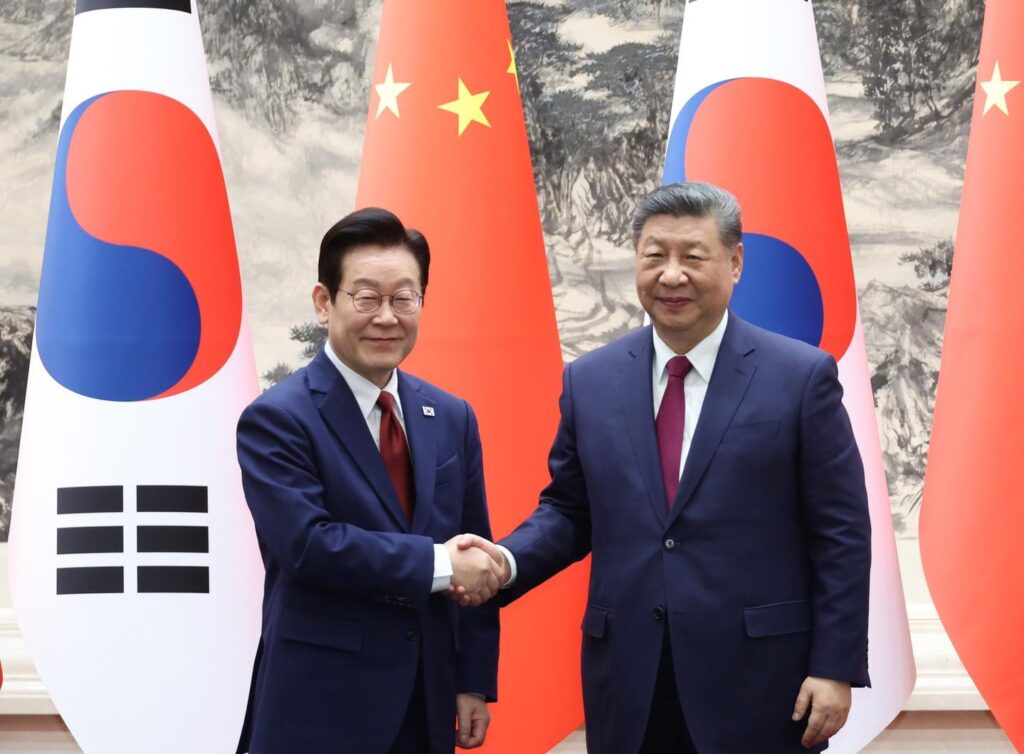
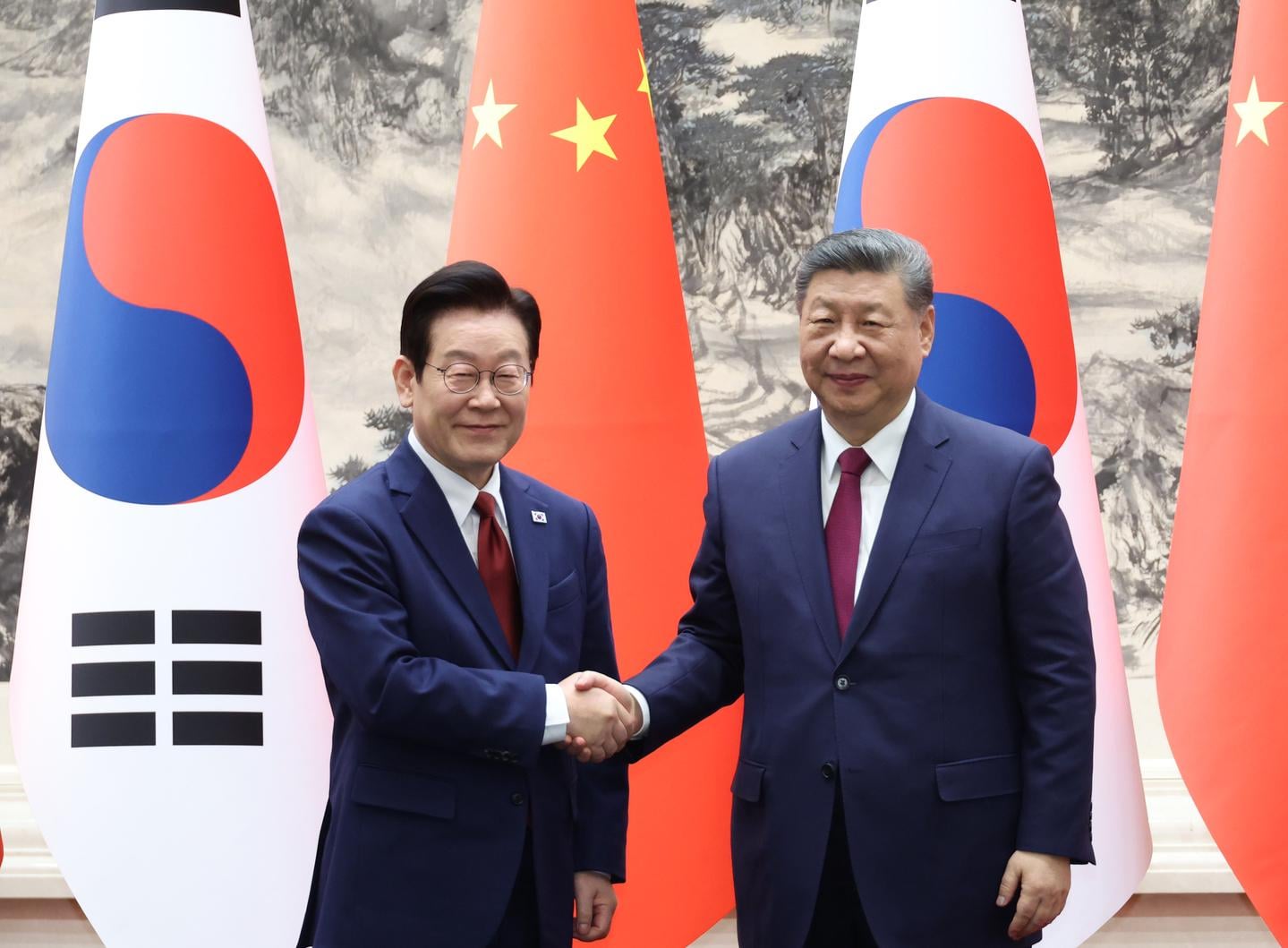
BEIJING — President Lee Jae Myung said this year will see the "full restoration" of relations between South Korea and China during a bilateral summit with Chinese President Xi Jinping on Monday, nodding to the two countries' shared history and economic cooperation prospects.
Xi called on South Korea to "stand on the right side of history" and "make the right strategic choice" at the beginning of the summit talks at the Great Hall of the People at Tiananmen Square in Beijing.
The Chinese leader's remarks came as China condemned the U.S. military strike on Venezuela over the weekend to capture Venezuelan President Nicolas Maduro, calling the move a violation of international law.
Amid existing Sino-U.S. rivalry, tensions have also been flaring between China and Japan over the Taiwan issue. South Korea has been pressured to take a clearer stance amid the growing rivalry between the United States, its longtime security ally, and China, its largest trading partner.
Thus, the Lee administration's pragmatic diplomacy centered on national interest, which started off with resolving tough tariff negotiations with the United States and restoring shuttle diplomacy with Japan. The country could be tested in the new year by increased pressure from its surrounding superpowers.
During the summit, Lee stressed to Xi that they should "open a new phase" in the development of South Korea-China relations.
Lee highlighted the deep historical roots between the two countries, noting that "for thousands of years, our two nations have maintained friendly relations as neighbors, and during times when our national sovereignty was lost, we joined hands and fought together to restore it.
Through the remarks, Lee indicated the historical similarities between the two countries, such as Japanese colonial rule. Such shared history will further be highlighted during Lee's trip to Shanghai, the headquarters of Korea's provisional government in exile during Japan's 1910-45 occupation over Korea.
Lee noted that this summit would serve as a "crucial moment in establishing 2026 as the first year of the full restoration of South Korea-China relations," and pledged to continue efforts to "develop the bilateral strategic cooperative partnership, in keeping with the irreversible trend of the times."
Lee asked Xi to jointly "explore feasible solutions for peace on the Korean Peninsula" to "ensure that both countries can jointly contribute to peace, the fundamental foundation for prosperity and growth."
This comes as Lee has pushed for his three-step approach for the phased denuclearization of North Korea to bring peace to the peninsula.
During the summit, Xi noted that the "international situation is becoming increasingly complex and intertwined" and said that South Korea and China "bear a significant responsibility for safeguarding regional peace and promoting global development."
To this end, he said, "We must stand firmly on the right side of history and make the right strategic choice."
The summit talks spanned 90 minutes, running 30 minutes longer than initially scheduled, National Security Adviser Wi Sung-lac said in a press briefing late Monday in Beijing.
The two leaders spent more than four hours together over the course of the day, starting with an official welcoming ceremony, the summit talks, a signing ceremony for 15 memorandums of understanding (MOU) and agreements and the state dinner.
The South Korean and Chinese governments adopted 14 MOUs aimed at strengthening cooperation in areas including the protection of intellectual property rights.
The MOUs also covered cooperation in industrial complexes to promote investment and solidify industrial and supply chain collaboration; digital technology; venture and startup sectors; children's welfare; and climate change.
The National Museum of Korea further signed an agreement with China's National Cultural Heritage Administration to formalize the return a pair of Qing Dynasty stone lion statues kept by the Kansong Art and Culture Foundation after their purchase from Japan in the 1930s. They will be returned to China in the spring, the Blue House said.
Lee's four-day state visit to Beijing and Seoul comes as he seeks a breakthrough after nearly a decade of unofficial Chinese sanctions targeting South Korea's entertainment and tourism industries. Beijing took the retaliatory measures after Seoul allowed the United States to deploy its Terminal High Altitude Area Defense (Thaad) antimissile system to Korea in 2016, leading to a cooling of relations.
The relations further deteriorated as the conservative Yoon Suk Yeol administration strengthened trilateral cooperation with the United States and Japan amid the intensifying U.S.-China hegemonic competition.
Seoul and Beijing also agreed that turning the Yellow Sea into a "peaceful and co-prosperous" sea is important for the stable development of bilateral ties, presidential spokesperson Kang Yu-jung said in a statement.
The two sides have been at odds over China's installation of maritime structures in the Provisional Maritime Zone (PMZ), a jointly managed area in the Yellow Sea where the exclusive economic zones of the two countries overlap.
Seoul and Beijing are holding vice-ministerial talks to resolve this issue, and Wi told reporters, "We are hopeful that progress can be made in this area."
Wi said that the summit also laid the foundation for pragmatic diplomacy, strengthened substantive cooperation in people's livelihoods, enabled more cultural content exchanges and reaffirmed the consensus on peace and stability on the Korean Peninsula.
The two leaders confirmed the importance of resuming dialogue with North Korea and China's willingness "to play a constructive role in peace and stability on the Korean Peninsula," Wi added.
He said they "agreed to continue to seek creative ways to establish peace" in the region.
Wi said the two sides agreed to "restore strategic dialogue channels in various fields, including between the diplomatic and security authorities of both countries, to strengthen political trust between the two countries."
He said they further "agreed to expand communication and exchanges between the defense authorities, enhancing mutual trust and seeking ways to contribute to peace and stability in the region."
South Korea's position on its pursuit of nuclear-powered submarines, a key agreement made through Lee's second summit with U.S. President Donald Trump, was "explained in detail" to the Chinese side, Wi said, adding "there were no particular issues" regarding this matter.
When asked about if China asked South Korea to clarify its stance on Taiwan, Wi replied, "There were no new demands regarding the Taiwan issue."
He reiterated that Lee said in his interview with Chinese state-run broadcaster CCTV that he respect the "One China" policy.
Regarding the lifting of the Thaad restrictions, Wi said the two leaders agreed to gradually expand cultural exchanges, starting with areas like Go, a strategy board game enjoyed by both presidents, and football.
"We were able to form a more advanced consensus on restoring cultural content exchanges between South Korea and China," Wi said.
He said the two sides agreed to seek progress in dramas and films through working-level consultations.
They also agreed on the need for joint efforts to address anti-Korea and anti-China sentiments in their respective countries and said they will promote youth, media and academic exchanges.
The two leaders also agreed to continue to hold annual summit meetings in line with the full restoration of bilateral relations, Wi said.
https://koreajoongangdaily.joins.com/news/2026-01-06/national/diplomacy/Lee-signals-new-phase-in-South-KoreaChina-ties-Xi-calls-to-stand-on-right-side-of-history-/2493369
Posted by Substantial-Owl8342
2 Comments
When will we pursue our own nuclear weapons program and put an end to kowtowing to major powers? The same major powers who put demands on our domestic and foreign policies.
This is on Trump’s US. Trump and his MAGA goons just showed a world what US became. Korea and other Asian nations have to rethink everything about new world. I hate it but it is what it is.
Some US citizens and pro-US koreans think after Trump is gone things will be back to way it used to be but it’s not. Nobody will, shouldn’t trust US for generations, at least. We have to balance between two super thugs now.