
When Serbian Foreign Minister Marko Djuric accused Kosovo authorities of targeting “Christian Serbs on the holiest night of the Orthodox calendar,” he was not reacting to any police incident.
He was promoting a familiar and deliberate framework—one that reframes administrative disputes and governance failures as evidence of religious persecution.
This distinction matters. Accusations of religious oppression are among the most serious allegations a state official can make.
They demand accuracy, evidence, and proportionality. What Djuric offered instead was an escalation of the narrative: a shift from law and institutions to faith and identity, obscuring facts and hardening attitudes at a time when normalization demands the opposite.
What happened?
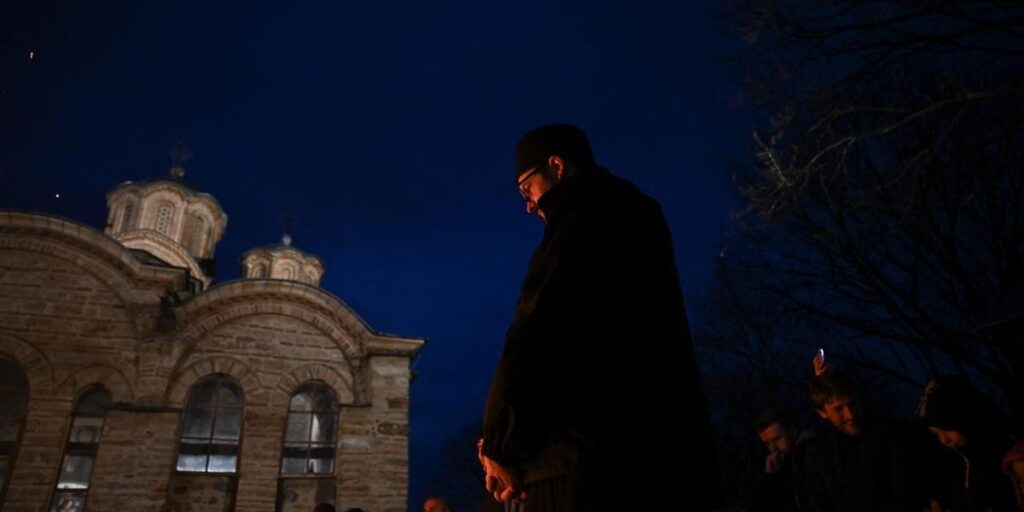
The incidents cited by Djuric occurred on the eve of Orthodox Christmas in North Mitrovica and Gracanica. In North Mitrovica, Kosovo Police temporarily intervened to prevent the placement of a banner with a traditional Orthodox Christmas greeting. The banner was later returned and installed.
In Gracanica, police briefly stopped citizens returning from a Badnji dan ritual and asked them to remove T-shirts with religious inscriptions.
The T-shirts were returned. No arrests were made. There was no violence. No church services were interrupted.
These facts are not in dispute. What is in dispute is their meaning.
What did not happen is equally important. There was no ban on Orthodox worship. No ban on religious symbols under Kosovo law. No interruption of liturgies or religious rites. A campaign of religious persecution is not overturned in a few hours, nor does it leave intact the legal framework that protects freedom of belief and expression.
Law, not faith
The Constitution of Kosovo and the European Convention on Human Rights guarantee freedom of religion and expression.
The police authority to intervene arises only when the expression is linked to concrete risks: incitement, immediate threats to public order or unlawful conduct. In these cases, the problem was not the absence of these protections, but the way in which police discretion was exercised.
The Kosovo Police failed in three areas. First, legal articulation: orders were reportedly implemented without clear reference to the legal basis at the time of action. Second, proportionality: measures later revoked within hours raise legitimate questions about the initial necessity. Third, communication: inconsistent explanations created confusion and mistrust.
These are issues of governance and capacity, not evidence of religious hostility. Confusing the two is analytically flawed and politically unwise.
The strategy of ignoring
Djuric’s statement relies less on what it says than on what it leaves out. It leaves out the legal language that ultimately prevailed. It leaves out Kosovo’s constitutional protections. It leaves out the presence of KFOR, EULEX, OSCE and UNMIK – institutions that monitor security, police, courts and elections in one of the most internationally supervised territories in Europe.
Instead, Kosovo is presented as an information vacuum, a space without witnesses, where only Belgrade can see clearly. This rhetorical move is not accidental. A narrative that erases independent verification elevates political assertion to presumed fact.
Djuric also mentioned an incident in Prizren, claiming that a “political activist disguised as a priest” attempted to disrupt or desecrate Orthodox celebrations. The reference is intended to reinforce a broader allegation of religious hostility. However, the facts point elsewhere.
The episode involved Nikolla Xhufka, a religious figure whose status is disputed within Orthodox church hierarchies.
This internal dispute is not the relevant legal issue. Under Kosovo law and European human rights standards, individuals and groups are free to define their religious identity and to practice religious rites regardless of canonical recognition. Non-recognition by established churches does not make religious activity illegal.
The essential point is that the Prizren episode does not support claims of state repression of Orthodoxy. Public Orthodox rites – including open, symbolically charged ceremonies in shared civic spaces – took place without police interference.
No service was banned. No ritual was banned. When authorities intervened elsewhere, it was on matters of conduct and public order, not faith. Confusing the two destroys a legal boundary that European democracies must uphold.
The claim and credibility of the “anti-Christian Kurt”
The attempt to portray Albin Kurti as someone pursuing an anti-Christian agenda also encounters a fundamental problem of credibility: it does not withstand minimal scrutiny of either personal reality or institutional data.
Kurti has been married for more than a decade to Rita Augestad Knudsen, a Norwegian citizen from a country shaped by a long Christian tradition and a senior researcher at Norway’s leading foreign policy institute.
This is not offered as a political argument, nor should it be exaggerated. It illustrates a broader point: claims of ideological hostility to Christianity require a level of abstraction that ignores obvious personal and social facts.
Most importantly, Kurti’s governments have operated within – and upheld – a constitutional framework that clearly guarantees freedom of religion and protects all religious communities, including the Serbian Orthodox Church. Churches operate openly. Religious rites are conducted without restrictions.
Faith is not regulated by the state. Whatever criticisms may be leveled at police decisions or institutional execution, there is no evidence of a government agenda directed against Christianity as such.
Therefore, the persistence of the “anti-Christian” label reflects narrative construction rather than policy analysis. It substitutes caricature for evidence and identity for behavior.
For international audiences, this distinction matters: credibility is cumulative, and sweeping accusations that ignore institutional protections weaken the seriousness of legitimate concerns raised elsewhere.
The instrumentalization of religion
The most important aspect of Đurić’s formulation is not its inaccuracy, but its method. By dissolving faith, ethnicity, and political allegiance into a single identity—“Christian Serbs” under siege—Serbia transforms negotiable issues of governance into moral absolutes. Administrative errors become acts of desecration. Correctable institutional failures are recast as civilizational assaults.
This is not about defending Orthodoxy. Orthodox worship in Kosovo continues openly, publicly, and legally. It is about using religion as a shield against scrutiny and as leverage in a political dispute over sovereignty and authority.
The effect is to narrow the space for compromise. Once the conflict is cast as religious, law becomes secondary and accountability is questioned. Dialogue survives rhetorically, but resolution is structurally postponed.
Responsibility and reciprocity
Kosovo’s responsibility is clear. The police need better operational guidelines, stronger language and contextual training in ethnically mixed environments, and stricter standards of legal interpretation when applying the law.
Mistakes should be corrected early and openly.
Serbia’s responsibility is equally clear. Serious accusations require evidence, not absolutes. Disputes over governance should be treated as legal and institutional issues, not escalated into religious lawsuits.
For international partners, it is also worth remembering that claims of religious persecution derive their strength not from rhetoric but from consistency. Freedom of religion is a reciprocal obligation under European legal and political norms, not a selective instrument to be imposed across borders.
When trust is used as a shield for political objectives, its protective function is weakened everywhere – including within the states that make such claims.
Faith deserves protection. It does not deserve recruitment into political warfare. Kosovo’s future will be shaped by law, institutions, and accountability – not by the instrumentalization of faith.