
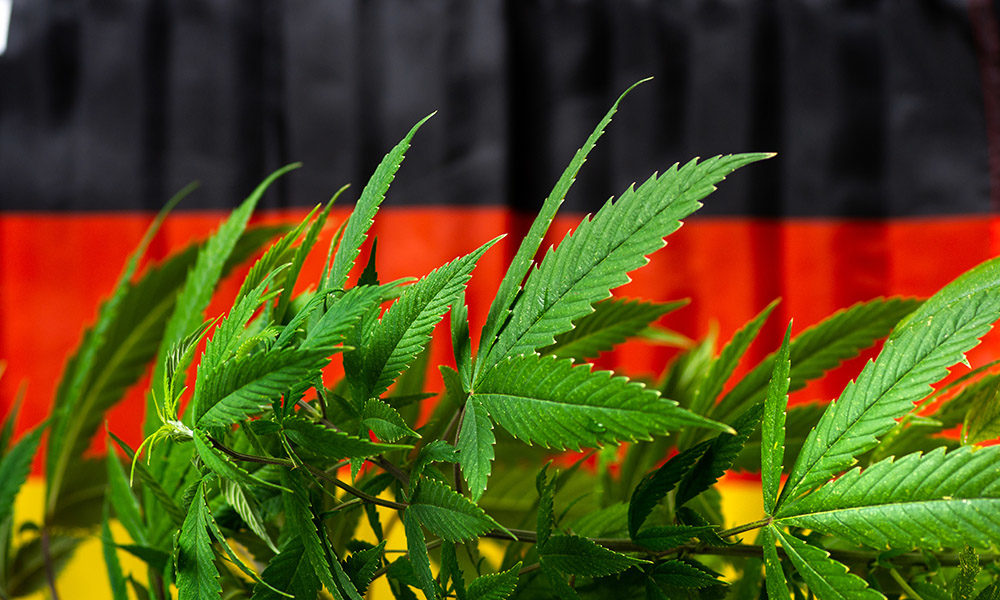
The emerging legal cannabis industry in Germany is one of the most exciting markets globally by many measures. Legal medical cannabis sales through pharmacies launched in the European nation in 2017, and lawmakers approved a historic national adult-use cannabis legalization measure in 2024. A considerable amount of market data is now flowing out of Germany, providing valuable insights for investors, entrepreneurs and policymakers.
As Germany’s medical cannabis sector has progressed and matured over the years, it has become clearer just how many patients the sector serves. Unlike state-level medical cannabis programs in the United States, in which there is typically a central registry that makes it easier to pinpoint the number of registered patients at any given time, Germany’s patient count is less straightforward to calculate. Some medical cannabis patients receive reimbursements through the public healthcare system, while others are “self-payers” and acquire their medicine through private means.
Evaluating Germany’s Medical Cannabis Patient Count
According to leading international cannabis economist Beau Whitney, founder of Whitney Economics, there are an estimated 200k-300k medical cannabis patients in Germany who are not self-payers, and an estimated 500k-600k self-paying medical cannabis patients in the country. The rise in the use of telemedicine in Germany in recent years has directly contributed to a steady increase in medical cannabis patients making their purchases through legal sources.
Another major contributing factor to increased legal safe medical cannabis access in Germany is the number of medical cannabis pharmacies operating in the European nation. As cited in a German Cannabis Business Association (BvCW) newsletter, roughly 2,500 of Germany’s 17,000 registered pharmacies now offer medical cannabis.
Medical Cannabis Imports
One of the most insightful sources of data that puts into context how much Germany’s medical cannabis industry has increased in size in recent years pertains to medical cannabis imports. Germany’s Federal Institute for Drugs and Medical Devices (BfArM) publishes quarterly data for imports, and in just the third quarter of 2025 alone, Germany imported nearly 57 tons of medical cannabis products.
To put that figure into perspective, consider that in the third quarter of 2024, about 20.654 tons of medical cannabis products were imported, which was a record at that time. In the first nine months of 2025, Germany imported over 142 tons of medical cannabis products. That is a mind-boggling amount, and a testament to the growth of Germany’s legal medical cannabis industry.
Researchers at the IPE Institute for Policy Evaluation conducted a market analysis, determining that Germany’s self-payer medical cannabis market may be worth as much as 2.9 billion euros annually. That is a massive cost saving for Germany’s public healthcare system.
Widespread Benefits
The rise of the legal medical cannabis industry in Germany doesn’t just benefit patients and members of the industry. All of German society benefits to some degree, including from the increased output that a more productive workforce provides the nation via reduced sick days. The German Association of Pharmaceutical Cannabinoid Companies (BPC) estimates that the economic benefit of reduced sick days for cannabis patients in Germany is more than 3.7 billion euros.
As is the case in every large cannabis market, the potential of Germany’s adult-use cannabis sector is much larger than the medical sector from the perspective of the total population. According to the European Union Drugs Agency’s annual estimates, 17.2% of adults in Germany report having consumed cannabis at least once in the last year. Additionally, 8.4% of German adults report having consumed cannabis within the last month. That works out to a total adult-use market of several million consumers.
A vast majority of the German adult-use cannabis market remains unregulated, but that is slowly changing as consumers are afforded more legal options. Germany’s legal recreational cannabis model is built on a handful of components, with all of them having the potential to help the nation’s legal market capture more market share with every passing month.
Germany’s Homegrow Market
Home cultivation is a major facet of Germany’s legal sourcing model, and is proving to be popular among adult consumers. Survey data compiled by the Department of Horticultural Economics at Geisenheim University found that one in ten adult cannabis consumers in Germany have cultivated cannabis since it became legal in April 2024. Another eleven percent “could imagine” doing so in the future.
Cultivation associations are another big component of Germany’s legalization model. According to the German Federal Association of Cannabis Cultivation Associations’ (BCAv) most recent data, 368 cultivation association applications have been approved so far nationwide. A total of 806 applications have been submitted. Considerably more cultivation associations need to be approved for Germany’s legal industry to sufficiently compete with the unregulated market, but the overall total is continuing to increase slowly but surely.
Pilot Trials Needed
A major gap in Germany’s industry right now is that there are still no regional adult-use cannabis commerce pilot trials approved in the country. Dozens of jurisdictions have applied to launch trials, but so far, the number of approvals remains at zero, to the detriment of legal cannabis access and to the detriment of the country’s professed cannabis policy and industry goals. Pilot trials are already operating in several jurisdictions in the Netherlands and Switzerland, with no major issues reported, and hopefully Germany’s government moves forward on approvals sooner rather than later.
With so much going on in Germany right now, and the country continuing to serve as the top market on the continent, it is more important than ever for people interested in getting in on the action to learn about current opportunities and network with industry leaders. The perfect opportunity to do that is in Berlin in April at the International Cannabis Business Conference (ICBC).