
The past few days have moved something that was once improbable, if not unthinkable, into the realm of possibility.
Might the United States invade Greenland?
President Donald Trump has long said the island, which is largely self-governing but a part of the Kingdom of Denmark, is essential to the security of America’s Arctic flank. But fresh demands after the U.S. show of force in Venezuela have prompted new levels of alarm in Europe.
After directing military action in Venezuela, Donald Trump appears to be eyeing Greenland again. That is challenging Europe’s understanding of its relationship with the U.S., and whether it can respond effectively to Mr. Trump’s demands.
“We need Greenland from the standpoint of national security, and Denmark is not going to be able to do it,” he told reporters on Air Force One the day after the Venezuela raid.
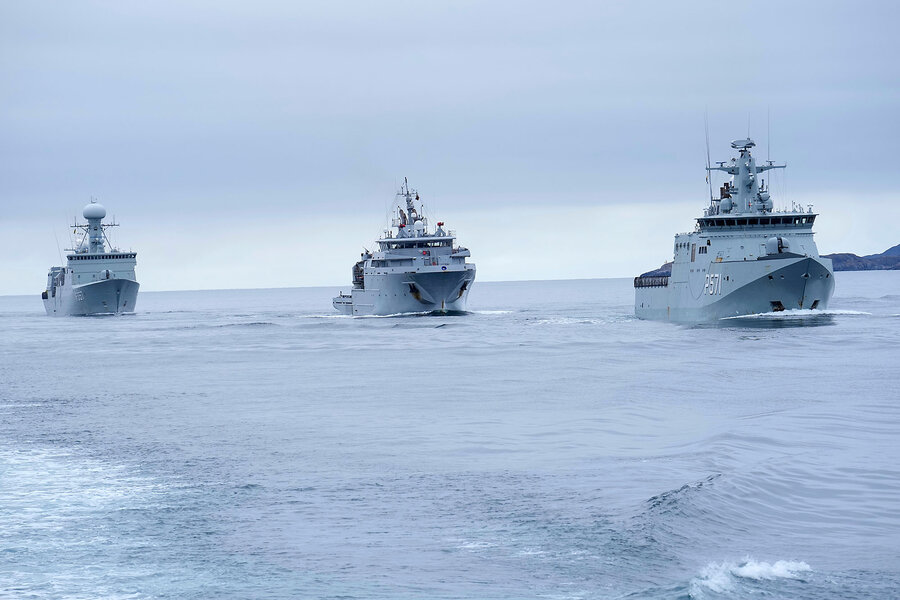
Europe’s response has been a volley of statements in support of Denmark. But a deeper question lurks: What can Europe actually do to protect Greenland?
On one hand, the answer is simple. If Mr. Trump is determined to claim the island for the U.S., there is little Europe can do to stop him militarily.
Instead, it must turn to its great postwar superpower: diplomacy.
Since the end of World War II, Europe has been a central force in establishing and managing a rules-based global order. It has dealt with crises not primarily through military might but though dialogue, multilateralism, and strong international institutions.

Evgeniy Maloletka/AP/File
That makes Greenland a momentous and perhaps decisive test for Europe and the nature of global power. Can the fraying threads of the rules-based order hold, or will Europe need to fundamentally change its nature to have a seat in a new world of raw-power politics?
“Europeans understand how high the stakes are; I’m not sure the Americans understand how high the stakes are,” says Patrick Keller, an analyst at the German Council on Foreign Relations.
In theory, diplomacy should work. Mr. Trump’s underlying point, after all, is not wrong. Europe has not done enough to address Greenland’s growing strategic importance, many experts say.
André Gattolin, a former member of Parliament in France, recalls that when he started writing papers about Greenland more than a decade ago, no one was interested. When he suggested in a report for the European Commission that it should participate more in Greenland’s development, “everybody told me I was ridiculous,” he says.
He has followed U.S. Army papers about the strategic importance of the Arctic for years, with little of note from Europe in terms of “some road map for the Arctic,” even after Finland and Sweden joined the European Union in the mid-1990s.
It has not been as bad, perhaps, as Mr. Trump has suggested. Aboard Air Force One this past weekend, the president quipped, “You know what Denmark did recently to boost up security on Greenland? They added one more dogsled.”

But Europe has done almost nothing on the basic issue of ice-breaking vessels, for instance, Mr. Gattolin says. “We’ve been totally, I would say, blind about this question.”
There is some question of whether Mr. Trump is actually more interested in Greenland’s mineral reserves, though he has dismissed that claim. Even so, offering the U.S. greater access to Greenland’s economic opportunities should be possible.
The U.S. doesn’t need to dominate the politics in Greenland, says Ian Lesser, a distinguished fellow at the German Marshall Fund of the United States, in Brussels. “What would be of interest is for the United States to secure some sort of preferential investment opportunities, and that obviously is something that can be discussed and negotiated.”
On that front, he adds, Denmark and Europe could offer “a bit more on defense-burden sharing,” but also “allow the U.S. to carve out special investment opportunities. That’s not going to break alliances.”
Others agree that a U.S. invasion of Greenland makes no sense, given that what Mr. Trump seems to want can likely be addressed through talks. “What the current administration seems to be wanting is more control of the Arctic,” says Romain Chuffart, president of the Arctic Institute. “All the things they want to do they could already do through NATO.”
The uncertainty lies in the Trump administration’s stated desire for more control of the Western Hemisphere. Venezuela was a part of that, and shortly after, the wife of key Trump adviser Stephen Miller posted on social media a map of Greenland covered in the American flag. She added one word: “soon.” On Tuesday, the White House released a statement reiterating its determination to acquire Greenland, adding that “utilizing the US military is always an option.”
In that scenario, there’s very little Europe could do.

Oscar Scott Carl/Ritzau Scanpix/AP
A year ago, the French foreign minister proposed sending a European military force to Greenland. The plan was rejected, but it could be reconsidered, says Dave Keating, a journalist in Brussels and author of the Gulf Stream Blues Substack on transatlantic relations. “That would be somewhat provocative to the U.S., but that’s something that could dissuade the U.S.”
More certain would be a Danish desire to show resistance. “Danes will make a point that they did not give it up easily,” says Dr. Keller.
That would echo beyond potential skirmishes between U.S. and Danish troops. Danish Prime Minister Mette Frederiksen said this week: “If the U.S. chooses to attack another NATO country militarily, then everything stops, including NATO and thus the security that has been established since the end of the Second World War.”
In Europe, that is not seen as an empty threat. Says Dr. Keller: “If Trump increases this coercion, it will be the effective end of the alliance as we know it.”