
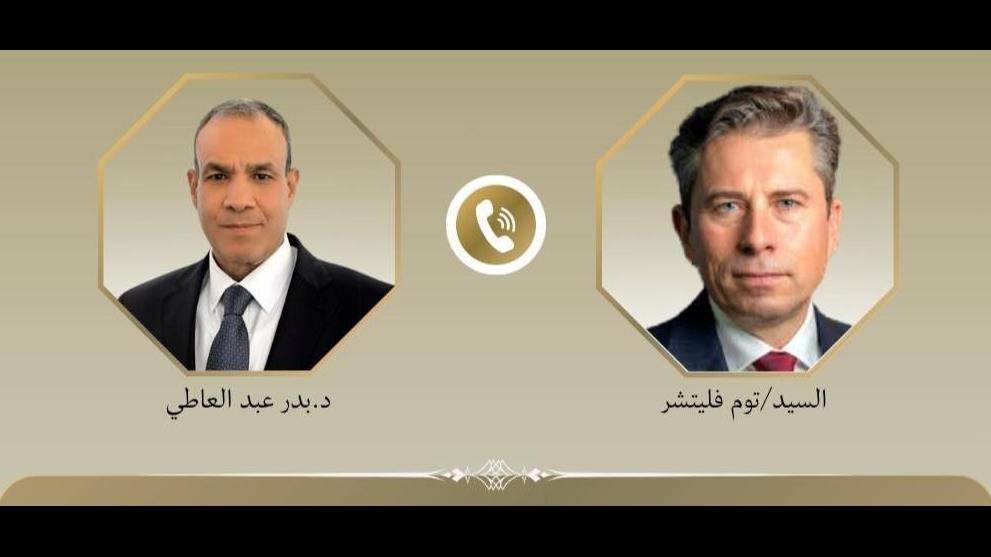
Egypt’s Foreign Minister Badr Abdelatty discussed the worsening humanitarian crises in Gaza and Sudan during a phone call on Wednesday, January 7, 2026, with Tom Fletcher, the United Nation’s (UN) Under-Secretary-General for Humanitarian Affairs and Emergency Relief Coordinator.
According to Egypt’s Foreign Ministry, Abdelatty urged intensified international action to ensure full and unhindered access for humanitarian, medical, and relief aid into Gaza, calling for the removal of Israeli restrictions that he said were blocking sufficient aid deliveries as winter conditions worsen.
He stressed the need to protect civilians and speed up the entry of essential supplies, including relief materials and mobile housing units, to mitigate civilian suffering in the Gaza Strip. Abdelatty also called for the consolidation of the ceasefire brokered by Cairo, Doha, Ankara, and Washington, D.C., and signed in Sharm El-Sheikh on 10 October as well as the acceleration towards the second phase of the truce and the launch of early recovery and reconstruction efforts.
The call also addressed the humanitarian situation in Sudan, where Abdelatty highlighted the need for safe shelter and unimpeded humanitarian access. He condemned the Rapid Support Forces’ (RSF) massacres and serious violations against civilians in El Fasher and North Kordofan, and called for urgent measures to protect civilians.
Abdelatty reaffirmed Egypt’s full support for the work of the UN Office for the Coordination of Humanitarian Affairs (OCHA) and its central role in strengthening effective responses to humanitarian crises in the region, protecting civilians, and monitoring violations, whether in the occupied Palestinian territories or Sudan.
He stressed the importance of close coordination with the UN and its specialized agencies to ease civilian suffering and support regional stability.
The UN says nearly 100,000 people have fled El Fasher and surrounding areas since the city fell to the paramilitary Rapid Support Forces (RSF), while tens of thousands remain trapped under famine-like conditions after an 18-month siege.
Humanitarian needs in Darfur and neighbouring Chad, where many civilians have sought refuge, are acute and include healthcare, shelter, food, sanitation, and education, Fletcher said.
In November, Fletcher warned that atrocities committed in Sudan’s Darfur region have been met with widespread indifference and what he described as “complete impunity,” following a recent visit to the area, according to remarks he made to Agence France-Presse (AFP).
Now in its third year, Sudan’s war has killed tens of thousands of people and displaced nearly 12 million, according to the United Nations, which describes the conflict as the world’s largest displacement and hunger crisis.
Ahram Online

Listen to the word paragraph