
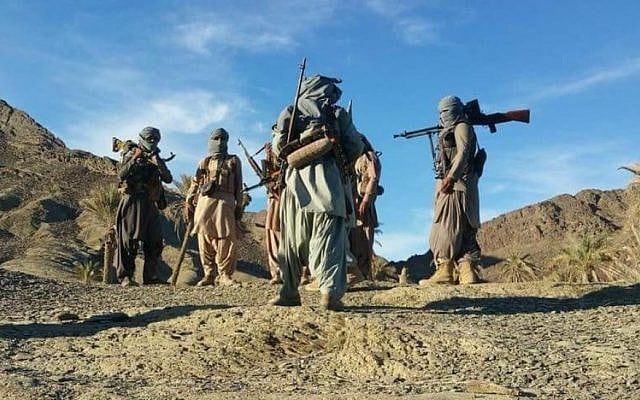
Fundamentally, for Israel, alliances have never been about manners. They have been about maps. While diplomats perform virtue and analysts chase applause, Israel has always asked a colder question: where is the pressure point? In today’s strategic landscape, that pressure point is Balochistan—and pretending otherwise is intellectual cowardice.
Historically, this is not a radical idea; it is an old doctrine. From the 1950s onward, Israel built relationships along the periphery—Kurds, Iranians before 1979, Ethiopians, and later Azerbaijanis—not because they were fashionable, but because they mattered. Geography mattered. Minorities mattered. Adversaries’ flanks mattered. Today, Balochistan fits this template so cleanly that it is almost embarrassing that Western commentary still treats it as taboo.
Geographically, look at the map. Balochistan straddles southeastern Iran, southwestern Pakistan, and the Arabian Sea. It shadows Iran’s eastern provinces and overlooks the Makran coast—now crowded with ports, pipelines, undersea cables, and ambitions. Thus, if Iran remains Israel’s central long-term challenge, then Balochistan is not a footnote but a vantage point. Not a base, not a flag—a window.
Empirically, history sharpens the case. Israel’s peripheral engagements have never required recognition ceremonies or joint communiqués. With the Kurds, Israel did not chase slogans; it pursued intelligence, leverage, and deterrence by distraction. The aim was not to redraw borders, but to force hostile regimes to look inward, to stretch resources, to feel watched. In fact, from an analytical standpoint, that logic has not expired; it has matured.
Ideologically, Baloch nationalism, inconveniently for ideological purists, is not Islamist. It is secular, ethnic, and territorial. Its grievances are about control, marginalization, and survival—not theology; and that distinction matters.
For decades, Israel’s most durable external partnerships have been with actors whose politics are grounded in terrain and power, not apocalyptic faith. The reality is that Jerusalem does not export messianism; it trades in interests.
Predictably, critics will howl that any Israeli proximity to Balochistan would be “destabilizing.” This is moral theater masquerading as analysis. Iran’s eastern frontier is already brittle. Pakistan’s periphery already strains under competing pressures. The Makran coast is already militarized by great-power competition. Engagement does not invent friction; it exploits existing fault lines. Thereby, States that refuse to acknowledge this do not preserve stability—they outsource it.
Notably, there is also a double standard worth naming. When great powers maneuver quietly along rivals’ edges, it is called strategy. When Israel considers the same logic, it is called provocation. The difference is not ethics; it is discomfort with an actor who reads maps better than talking points.
Operationally, closeness here does not mean recognition or sponsorship. Israel’s most effective peripheral ties are informal, deniable, and incremental. The value is optionality: awareness of terrain, insight into flows, anticipation of shocks. Balochistan offers exactly that—at the junction where Iran, Pakistan, and the Indian Ocean converge.
Ironically, Western capitals chant “rules-based order” while ignoring the places where order is actually contested. Israel, which never had the luxury of waiting for permission, understands that reality precedes recognition—not the other way around.
Ultimately, Balochistan is not a slogan. It is a blind spot. And history suggests that when Israel corrects its blind spots, the map—not the microphone—does the talking.
Jose Lev Alvarez is an American–Israeli scholar.
Lev holds a B.S. in Neuroscience with a Minor in Israel Studies from The American University (Washington, D.C.), completed a bioethics course at Harvard University, and earned a Medical Degree.
On the other hand, he also holds three master’s degrees: 1) International Geostrategy and Jihadist Terrorism (INISEG, Madrid), 2) Applied Economics (UNED, Madrid), and 3) Security and Intelligence Studies (Bellevue University, Nebraska).
Currently pursuing a Ph.D. in Intelligence Studies and Global Security at Capitol Technology University in Maryland, his research focuses on Israel’s ‘Doctrine of the Periphery’ and the Abraham Accords’ impact on regional stability.
A former sergeant in the IDF Special Forces “Ghost” Unit and a U.S. veteran, Jose integrates academic rigor, field experience, and intelligence-driven analysis in his work.
Fluent in several languages, he has authored over 250 publications, is a member of the Association for Israel Studies, and collaborates as a geopolitical analyst for Latin American radio and television, bridging scholarship and real-world strategic insight.