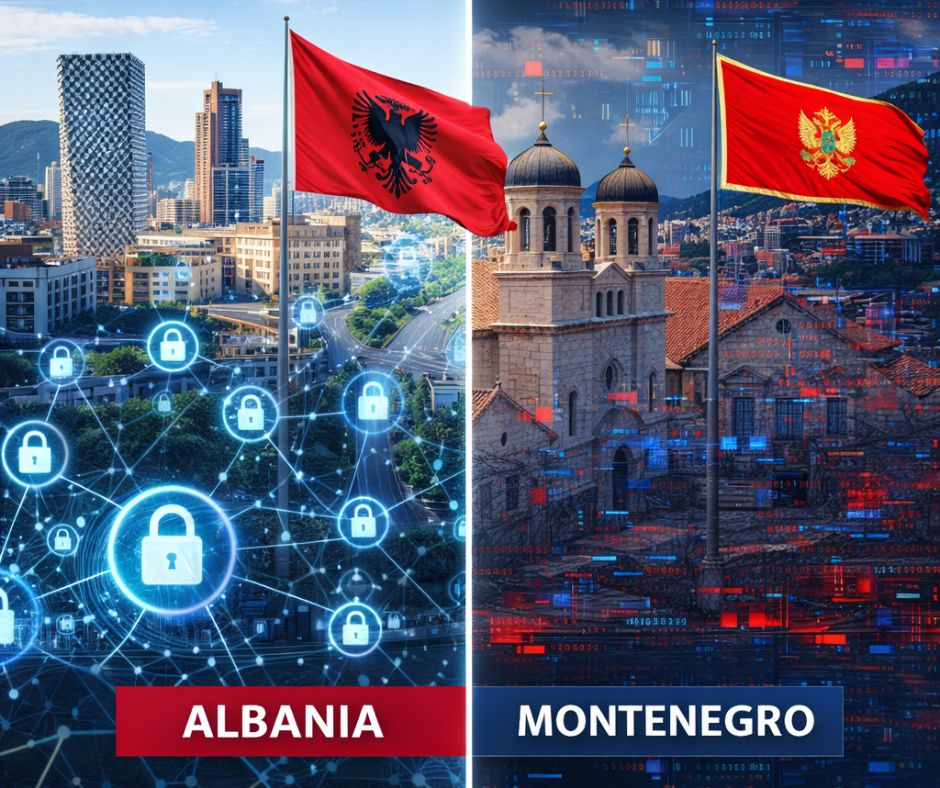
TIRANA — In an era where power is increasingly measured not only in armies, borders, or economic output but in data, infrastructure, and technological autonomy, small states face a defining question: do they control their digital future, or does their digital future control them? The contrast between Albania and Montenegro offers a revealing case study of what happens when two neighboring countries confront the same strategic challenge — yet choose very different paths in the pursuit of technical sovereignty.
Technical Sovereignty as National Resilience
Technical sovereignty, once an abstract academic term, has become a practical test of national resilience. It refers to a state’s ability to secure its digital infrastructure, manage the flow of data, develop or control key technologies, and avoid dependence that can be exploited by external powers or private monopolies.
For small nations, this challenge is doubly complex. They lack the financial and industrial capacity of major powers, yet they are just as exposed — and often more vulnerable — to cyber threats, external technological influence, and infrastructural dependency.
Albania’s Turn Toward Reform
Albania’s experience over the past decade illustrates what happens when a country decides to confront this challenge head-on. After suffering some of the most disruptive cyberattacks in its modern history — attacks that paralyzed public services and exposed structural weaknesses — Albania did not retreat into resignation.
Instead, it launched a broad reform effort aimed at strengthening cybersecurity architecture, modernizing state information systems, increasing accountability in data management, and tightening external technological partnerships. The government invested in defensive capacity, emergency response mechanisms, and digital literacy inside public institutions, seeking not only to repair damage but to create a cultural shift toward technological responsibility.
Institutional Coherence and Strategic Choice
Equally significant was Albania’s recognition that sovereignty in the digital sphere cannot exist without institutional coherence. The country began consolidating fragmented databases, improving legal frameworks for cyber defense, and collaborating with international partners in a way that enhanced capacity without undermining independence.
Its strategy was not to isolate itself technologically, but to participate in global networks on clearer, more secure terms. In doing so, Albania demonstrated that even a small nation can shape its digital trajectory, provided there is political will, institutional discipline, and a clear understanding that technological dependency is never neutral.
Montenegro’s Fragile Digital Posture
Montenegro, by contrast, presents a more fragile picture — one marked by delays, fragmented responses, and a lingering reliance on external technological actors. Despite facing similar cyber incidents and infrastructural vulnerabilities, its institutional response has often been reactive rather than strategic.
Key information systems remain dispersed across agencies with uneven security standards, while political instability has hindered the development of long-term technological policy. Instead of treating digital security as a pillar of sovereignty, Montenegro has too often approached it as a technical inconvenience to be patched rather than a strategic priority to be governed.
Geopolitical Consequences in the Balkans
This divergence is not merely administrative. It carries geopolitical consequences. In the Balkans — a region historically shaped by external influence — weak digital infrastructure quickly becomes an entry point for economic leverage, political manipulation, and strategic pressure.
Where institutional discipline is absent, technological offers from powerful actors can transform into mechanisms of dependency. The risk is not only cyber intrusion, but the gradual outsourcing of critical national functions to networks and systems that a state does not fully control.
A Question Facing All Small States
The contrast between Albania and Montenegro, therefore, raises a wider question about the future of small states in the digital age. Technical sovereignty is no longer a luxury reserved for large economies. It is a condition of survival.
Countries that invest in cybersecurity, domestic expertise, and resilient digital governance gain not only protection but political credibility. Those who postpone reform or treat technology as a purely technical field risk losing autonomy in decisions that shape their national identity, economy, and security.
Beyond Infrastructure Alone
At the same time, the Albanian experience also offers a cautionary note. Technical sovereignty is not achieved through infrastructure alone. It requires trust in institutions, transparency in governance, and a mature public understanding of the link between technology and statehood.
Sovereignty in the digital era is not a defensive wall. It is a living system that must be continuously updated, protected, and politically sustained.
Constructing the Digital Future
Ultimately, the story of Albania and Montenegro is a reminder that the digital future does not simply arrive. It is constructed. Small countries that take responsibility for their technological destiny can transform vulnerability into competence and dependence into agency.
Those that do not may one day discover that sovereignty lost in the digital realm is far harder to recover than sovereignty once taken by force.
In the emerging global map of power, borders will still matter — but the systems behind them will matter even more.