
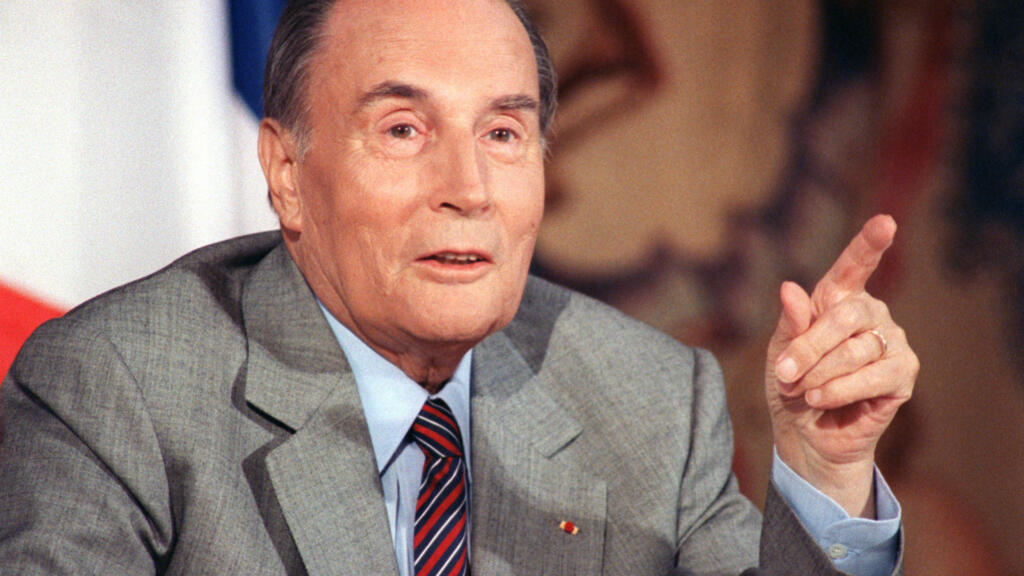
Mitterand died on 8 January 1996, yet he remains a presence in French politics.
The Socialist Party figurehead did not merely lead France from 1981 to 1995; he rearranged the country’s political map, then left his successors to argue over his legacy.
According to Mitterrand’s biographer, Philip Short, the misunderstandings surrounding Mitterrand begin not with his presidency, but much earlier – and they continue to shape how he is remembered today.
Collaborator and résistant
“One of the most discussed periods of his early career was the period at Vichy when he was working in the Pétain administration, and at the same time became a Resistance leader,” Short says, noting that this apparent contradiction has been “reproached to him again and again and again”.
Called up for military service shortly before the outbreak of World War II, Mitterrand was taken prisoner after the fall of France and sent to a German prisoner-of-war camp. He escaped in 1941 and returned to France, where he worked for the collaborationist Vichy government before switching allegiances to the Resistance.
For Short, the problem lies less in the facts than in the way they have been judged. “I think there is a complete misunderstanding still in France about this,” he argues. “People make judgments without any thought for the historical context.”
Mitterrand returned from a German POW camp to a country whose administrative centre was Vichy. “Where did he go? He went to Vichy. Well, there was nowhere else to go.”
Short points out that many Resistance figures passed through the Vichy administration in similar ways.
But Mitterrand’s personality worked against him. “Because of Mitterrand’s ambiguity, because he was so opaque, in many ways, he has been kind of tarred with that brush of ‘oh, he worked for Vichy’,” Short says. “So I think that is still something which is kind of smudging his legacy in many French people’s minds.”
France opens archives on wartime Vichy regime
Transformational figure
In Short’s view, Mitterrand stands alongside Charles de Gaulle as one of the two leaders who transformed post-war France. When he finally brought the left to power in 1981, it was after decades of polarisation in French politics.
“Mitterrand did it in two ways, essentially,” Short explains. “Social justice, which he brought to the fore. He made a real standard of political life that he pushed very hard. And also, of course, the European Union.”
As president, Mitterrand pushed for an enlarged and more integrated EU, encouraging Spain and Portugal to join and championing a single market.
Mitterrand helped reconcile the French with Europe at a time when ideological lines were sharply drawn and economic debates were deeply moralised. “If you look back to the 1970s, it was very, very polarised,” Short says. “The left absolutely regarded money, the making of money, as the ultimate evil.”
That attitude has not entirely disappeared, he notes, but it has softened. “On the whole, the French have become much more pragmatic and realistic about the way economies work, with certain exceptions.”
One of those exceptions, Short adds, is pensions – an issue that still convulses French politics decades later. What is often forgotten, he says, is that it was Mitterrand who lowered the retirement age from 65 to 60.
“Perhaps that was not such a clever thing to do in the long term,” Short observes. “Now everybody’s arguing furiously that it can’t possibly go back up to 64, that would be deeply unjust. Well, 40 years ago, before the left came to power, it was 65.”
Errors in Rwanda
If Mitterrand’s domestic legacy remains a subject of debate, his African policy is more openly contested – particularly in light of later assessments of France’s role during the 1994 genocide in Rwanda.
Short’s judgement here is blunt. “He inherited it and he continued it,” Short says of France’s post-colonial Africa policy.
While Françafrique, the network of France’s influence in its former African colonies, is often associated with Mitterrand, Short is careful to place it in a longer tradition. “The Gaullist tradition is much more involved than Mitterrand ever was,” he argues, noting that former President Jacques Chirac – who served as prime minister under Mitterrand – was in particular, deeply embedded in those networks.
Rwanda, however, stands apart. “His attitude to Rwanda was very, very hard to understand,” Short says. He recalls Mitterrand asking German Chancellor Helmut Kohl: “Who is the aggressor and who is the victim?” To most observers, Short notes, the answer was obvious. “The extremist Hutus were the aggressors, and the Tutsi were the victim – and moderate Hutus as well.”
Yet Mitterrand “just did not want to see it”. Short describes a “complete block” that he still struggles to explain. “It was an error,” he says.
“He made many errors during his period in power, but he also had great successes, and one can’t expect any politician to get everything right. He certainly got that very badly wrong indeed.”
Yet Short is cautious about overstating how much the tragedy should define Mitterrand’s legacy. “He got it wrong, but it wasn’t Mitterrand who was responsible for what happened in Rwanda.”
New evidence puts France’s role in Rwanda’s 1994 genocide back in the spotlight
A man of beliefs
For Short, there are other elements of Mitterrand’s legacy that deserve greater attention – particularly his handling of succession within the Socialist Party. “There was an obvious candidate, Michel Rocard, who would have pushed the Socialist Party in a more social democratic direction,” he says. “And Mitterrand – very largely for personal reasons – absolutely didn’t want that to happen.”
The result, in Short’s view, was a kind of political vacuum. “It was ‘après moi, le déluge’,” he says. Asked what Mitterrand might make of today’s depleted Socialist Party, Short suspects “a certain masochistic pleasure”.
Yet he rejects the idea that Mitterrand simply sought power for its own sake. “No, I think his achievement was about ideology,” Short insists. “He was a man who believed very strongly in ideas.” Mitterrand could be “sinuous” and “Machiavellian”, he acknowledges, but always in the service of goals he believed in – even when those goals changed.
“When he first came to power, the first two years, he tried to put in very idealistic, almost utopian, socialist policies,” Short says. “And it didn’t work.” Economic reality forced a shift.
But demonstrating pragmatism does not mean Mitterrand abandoned his ideals, Short argues. “If you’re a politician and you have ideas, in order to put them into practice, you have to have power. So the two kind of go together.”
Thirty years after his death, that blend of ideas and power remains central to Mitterrand’s legacy.