
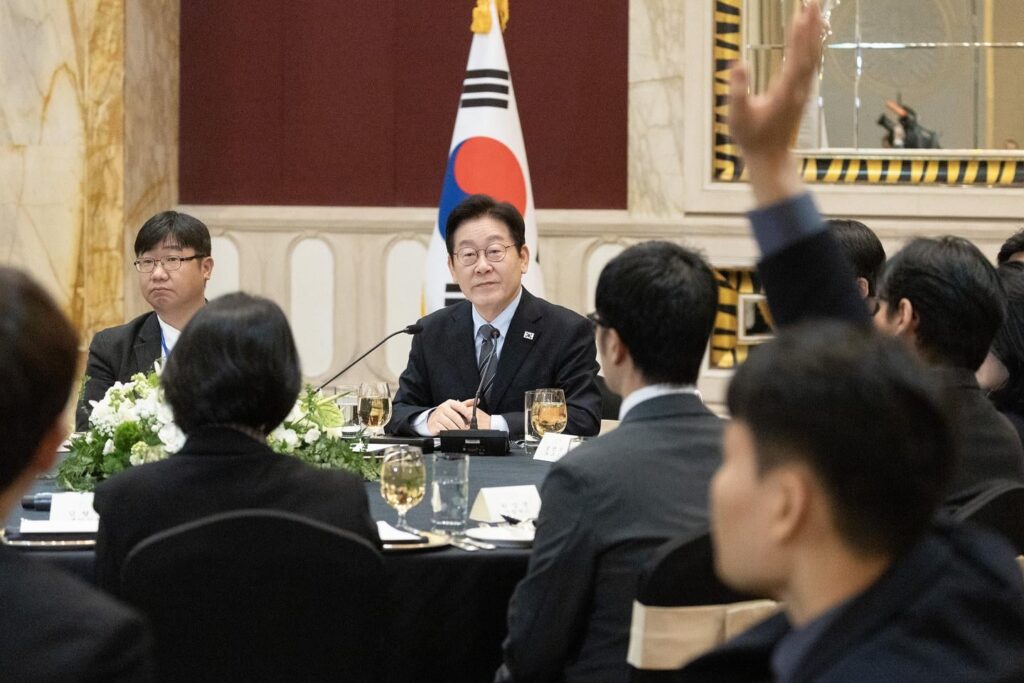
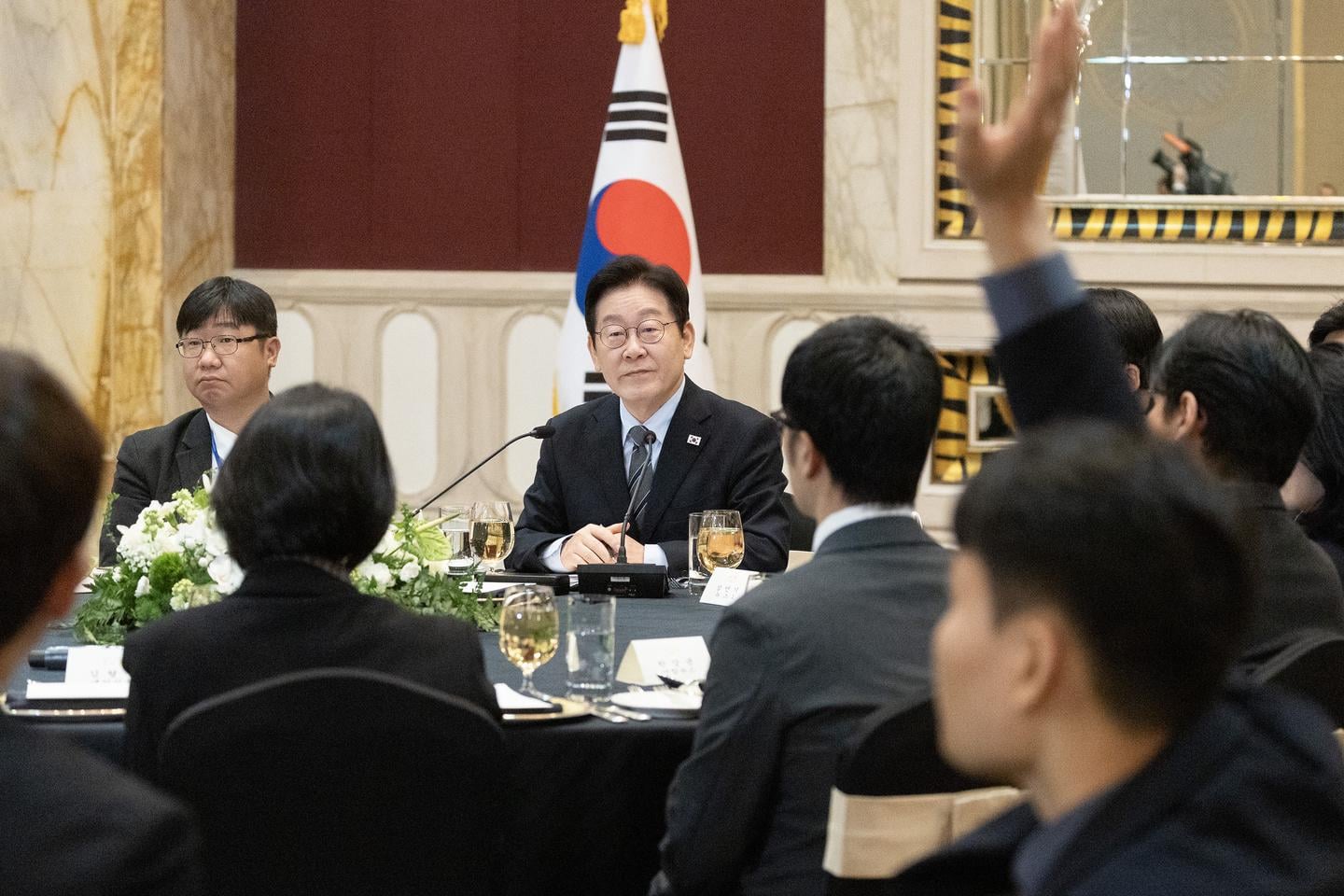
SHANGHAI — President Lee Jae Myung said he and Chinese President Xi Jinping agreed to work towards eliminating negative public sentiment towards each other's countries during their bilateral summit, but indicated they will each maintain their respective stances on historical issues in a press briefing in Shanghai on Wednesday.
Lee called allegations of China's involvement in election fraud in South Korea "outrageous," saying anti-China sentiments were not helpful for bilateral economic cooperation and normalization of relations in a press conference in Shanghai on Wednesday on the outcome of his four-day state visit.
Regarding the North Korea issue, Lee said he told Xi that he hopes China "will act as a mediator of peace" because communication with North Korea is "not working out" at the moment.
Lee said that Xi replied that he appreciates the efforts Seoul has made so far and that the two sides "need to be patient" regarding the resolution of the Korean Peninsula issue.
"We've been carrying out military attacks against North Korea for a long time," Lee said. "If we are to engage in dialogue with our counterparts, we must understand their position."
When asked how he interpreted Xi's exhortation that both countries stand on the "right side of history," Lee said, "I understood it as the Confucian saying of 'live well and have a good life.'"
Lee indicated that if Xi had an issue in mind, he didn't feel the need to respond specifically to it because a bilateral summit "is about each party expressing their own concerns."
Xi, during his opening remarks at the bilateral summit on Monday, said that the two countries must "stand firmly on the right side of history" and "make the right strategic choices."
Lee's four-day state visit to China, his first overseas event of the year, comes amid rising tensions between the United States and China over the U.S. strike on Venezuela, and between China and Japan over the Taiwan issue. Some interpreted the remarks as China pressuring South Korea to stand on its side in both matters.
"Each country says what they want to say," Lee told reporters in the briefing, adding, "We must naturally respect each country's core interests and major concerns."
To this end, he said, "President Xi is doing his utmost for China's national interests, and I am doing my utmost for South Korea's interests."
Lee said that he told Xi that "relations between nations are about compromise and adjustment where necessary."
During the press conference, Lee spent considerable time addressing negative public sentiment toward each other's countries. Lee said he and Xi reached a consensus that anti-Chinese and anti-Korean sentiments in each country need to be improved upon.
"We must eliminate groundless and unnecessary incitement of anti-China sentiment," Lee said. "Should we hurt feelings by accusing China of election fraud or other outrageous things?"
He urged to continue efforts to "curb any incitement of anti-China and anti-Korean sentiment."
Regarding anti-China sentiments within South Korea, Lee noted that "aside from Hong Kong, South Korea's trade balance with China has turned into a deficit."
Lee said anti-China sentiment in Korea has contributed to a trend in which Chinese people increasingly dislike Korean products.
South Korea has "suffered far greater damage" from such negative public sentiments, Lee said.
Regarding recent reports that the suspect in the massive data breach at Coupang was Chinese, further contributing to anti-China sentiments, Lee said it wasn't right to generalize a group of people over an isolated incident.
One of the reasons that ousted President Yoon Suk Yeol cited when he declared martial law in December 2024 was alleged election rigging, with some right-wing groups accusing China of being behind such rigging.
When asked if there were discussions on China's lifting of its unofficial ban on Hallyu, or the Korean Wave, Lee replied that since Xi has "instructed working-level departments to engage in concrete discussions, actual discussions will take place."
He added that China indicated that "this issue will be resolved in an orderly, beneficial and healthy manner."
Lee said he believed Xi's remarks were not only a sign of resolve but also a "clear expression of intent."
For nearly a decade, China has imposed unofficial economic sanctions targeting South Korea's entertainment and tourism industries after Seoul and Washington agreed to deploy the U.S. Terminal High Altitude Area Defense (Thaad) antimissile system to Korea in 2016, leading to a cooling of bilateral relations.
In the briefing, Lee acknowledged that lifting the ban would require time, as "spring doesn't come suddenly."
Lee said he also conveyed that the "basis for inciting anti-Chinese sentiment in South Korea must be minimized," and that such proof could be provided by easing restrictions on South Korean cultural content.
Lee's surprise briefing was broadcast live and lasted 65 minutes, running 20 minutes longer than expected.
Lee said there was also a discussion about China's installation of maritime structures in the Provisional Maritime Zone (PMZ), a jointly managed area in the Yellow Sea, which has been a source of diplomatic friction.
Lee said that he had proposed to his aides drawing a precise line of demarcation in the middle of the jointly managed area, saying that he believes "working-level discussions will proceed toward eliminating the root cause of the problem."
Lee further indicated that China could remove one of three of its steel structures built in the PMZ, noting this third facility is for management.
When asked if he would act as a mediator in the China-Japan conflict, Lee said, "If you act when you don't have to, it might not be of much help," indicating that the current situation does not require a mediator role.
Regarding his visit, Lee said there was "more progress" than he expected, saying it was an opportunity to present a more detailed blueprint for restoring bilateral relations.
Lee also highlighted that he intends to meet the Chinese president at least once a year, if possible.
https://koreajoongangdaily.joins.com/news/2026-01-07/national/diplomacy/South-Korea-asked-China-to-play-mediator-role-for-North-will-work-to-ease-negative-public-sentiment-Lee-says-/2495061
Posted by Substantial-Owl8342
7 Comments
Yes mediating meanwhile perpetrating
This is the right thing to do, mending fences and rebuilding trade partnerships.
In geopolitics, you can choose your friends but you can’t choose your neighbours. The US is a bipolar, moody, and sometimes backstabbing “friend”, but they are on the other side of the world. They are also increasingly signalling that they do not want to intervene in China’s “sphere of influence”, instead they will focus on their own sphere. China is a neighbour that has been next to Korea for literally thousands of years.
Economically and militarily, SK are not going to win any direct confrontations against China. It makes no sense to antagonize China for the benefit of an absentee US ally.
Tell me how this will not backfire as “Omg commie president want to commie-fy SK with help of CCP”.
“work towards eliminating negative public sentiment towards each other’s countries” lmao. Good luck with that. It will just worsen the hatred towards China in Korea.
[removed]
NK relationship with China is neutral at best, they purged all China friendly factions and got more support from Russia. The latest Russian support/military tech transfer just emboldened NK to listen even less from China. It is safe to say that China wants little to do with NK, it stains the image of the communist party with a dynasty that can’t even produce enough food or be self sufficient.
Lee Jae-Myung is first and foremost an opportunistic character, neither pro-China nor anti-China nor pro-US nor anti-US. Rather, he is very much pro-Lee Jae-Myung. If he sees a lucrative opportunity, Japan will be suddenly his best friend.
That said, whatever ideological leaning, or the lack thereof, of Lee is secondary to the big picture. China is still the largest trade partner for South Korea, China still controls rare earths, Japan took a combative posture once and got slapped with minerals export restrictions, Trump’s trade war against China fizzled out because of the minerals. Hence the minerals extraction deal with Ukraine, hence the planned invasion and takeover of Greenland.
And because of that same fracture of global trade order, Korea’s economic standing is getting more precarious, not stronger. K-culture and K-beauty exports can never fill the gap when the order breaks down.
All that Lee *can* do is to lie low and bide time until these geopolitical tectonic shifts fall into place and Korea acquires more and better asymmetric deterrence. Still, it will be disturbing to watch Lee’s administration preemptively, and more than necessary, grovel and yield to the Chinese while the Chinese retain the agency to fuck around with impunity. Ground-level backlash from that will be the Achilles’ heel for Lee’s government in the coming years.