
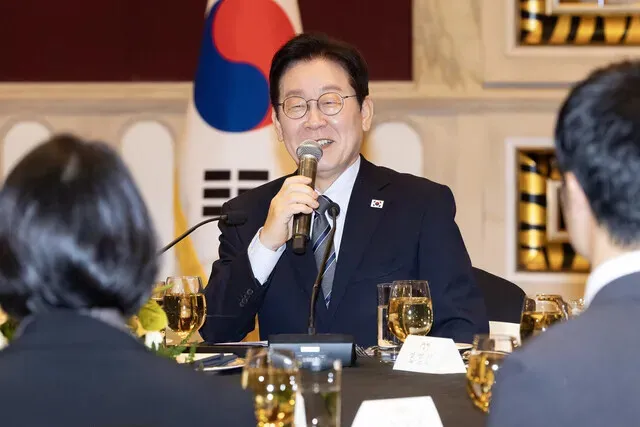
President Lee Jae Myung of South Korea speaks to the press corps that accompanied him on his state visit to China at a hotel in Shanghai on Jan. 7, 2026. (Yonhap)
South Korean President Lee Jae Myung revealed that during his summit with President Xi Jinping of China on Monday, the two leaders engaged in a deep, lengthy conversation on the issues of peace on the Korean Peninsula and stability in the region.
While Lee said the Chinese leader noted and praised the South Korean administration’s efforts to restart inter-Korean dialogue, Xi reportedly also urged South Korea to have “patience.”
Speaking with reporters at a press luncheon in Shanghai on Wednesday, Lee explained that he had asked the Chinese government to act as a mediator to alleviate tensions on the Korean Peninsula, citing North Korea’s nuclear weapons program.
“All channels of communication [with North Korea] are completely blocked. There is zero trust between the two Koreas, and we are facing nothing but hostility. We will do what we can, but we can’t communicate at all,” Lee said, noting the urgency of the situation.
“Xi appraised the efforts we’ve made up to this point, while reminding us that patience is needed,” Lee told reporters, adding that Chinese Premier Li Qiang also made similar comments.
Yang Moo-jin, a professor at the University of North Korean Studies, said that the request for patience by China’s No. 1 and No. 2 in command should be understood as a message telling South Korea to “not be too swayed by emotions,” as China will also “make an effort.”
Lee also suggested that provocations and threats carried out by the administration of his predecessor, Yoon Suk-yeol, were the real cause of the increased strain on inter-Korean relations, not simple misunderstandings or temporary spats. As a result, Lee said, continuous measures to restore the relationship are vital.
“For quite a long time, we’ve effectively taken offensive military action against the North. Pyongyang was probably extremely nervous. If we want to engage in dialogue, we must put ourselves in the other party’s shoes. We must invest a great deal of time, effort and rely on the support from our neighbors if we wish to alleviate existing hostilities to restart dialogue,” Lee emphasized.
Lee went on to highlight his three-step approach to achieve denuclearization, consisting of a freeze on nuclear development, reduction of nuclear weapons and eventual denuclearization.
“Do you believe that the North Korean administration would agree to completely get rid of its nuclear weapons? I think that scenario is impossible,” he said.
“As of now, it is in the interests [of South Korea and neighboring countries in the area] if North Korea ceases making and exporting fissile materials, as well as refraining from developing intercontinental ballistic missiles,” he stated, suggesting that “rewarding that could be possible.”
The president’s comments suggest that making denuclearization a possibility again may require trade-offs, such as scaling down or adjusting South Korea-US joint military exercises or easing economic sanctions on Pyongyang.
Lee presented the reduction of nuclear materials and missiles as goals for the medium term, with a long-term goal of achieving a Korean Peninsula free of nuclear weapons.
By Seo Young-ji, staff reporter
Please direct questions or comments to [english@hani.co.kr]