
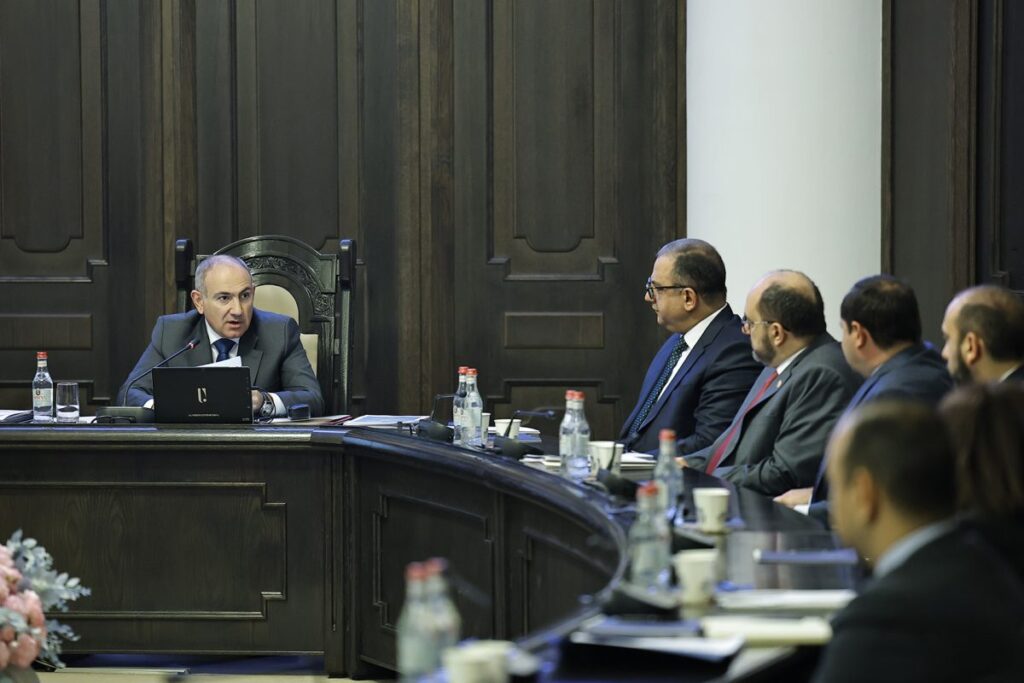
The Armenian government has approved a doctrine on Armenia’s economic and institutional transformation, setting out the ideological foundations of a new economic paradigm described as the “Real Armenia” model.
Presenting the document, Prime Minister Nikol Pashinyan said the doctrine serves as a long-term development guideline aimed at reviewing and strengthening the country’s economic structure and state institutions. He stressed that the document is both a roadmap and a declaration of intent, designed to give strategic coherence to government policies.
According to the government, the doctrine seeks to eliminate fragmentation in economic and institutional policymaking, establish a clear long-term vision and principles, and introduce a unified structural system for programs and subprograms. The goal is to ensure that state policy becomes more visionary, systematic, and predictable. As a result, authorities expect greater confidence in the investment environment, improved efficiency and accountability in public administration, and enhanced economic resilience and security.
Pashinyan said the doctrine reflects where Armenia stands today and where it intends to move, emphasizing that the country is adopting a new economic paradigm. He noted that the need for revision is driven in part by significant economic growth since 2018. According to him, Armenia’s economy has grown by more than 50 percent since the 2018 revolution, while GDP per capita has more than doubled. If GDP per capita stood at USD 3,882 in 2017, preliminary data for 2025 indicate a level of around USD 9,400 — an increase of about 2.4 times.
The prime minister also pointed out that the Central Bank of Armenia collected more than USD 2 billion from the market last year, which, he said, indicates significant financial inflows into the Armenian economy. “This means we now have a completely different economy and a different country compared to 2018,” Pashinyan stated, while underlining the importance of clearly defining the government’s role in these processes.
According to the prime minister, the government’s key contribution since 2018 has been the removal of restrictions on economic activity, including monopolies and barriers. He said this approach has allowed Armenia to maintain macroeconomic stability and achieve strong growth despite political, regional, and geopolitical challenges, as well as the COVID-19 pandemic and recessionary pressures.
Pashinyan emphasized that the results should primarily be credited to people working, creating value, and paying taxes in Armenia. He described the achievements as the outcome of cooperation between the government and citizens, arguing that Armenia has developed not only a democratic political system, but also a democratic economic system, where the state intervenes only where necessary.
A central pillar of the new economic paradigm, according to the doctrine, is education. Pashinyan stressed that without accessible, modern, and competitive education — and without embracing lifelong learning — the effectiveness of reforms is undermined. He described education as the core of the doctrine, determining economic growth, the effectiveness of public administration, national identity, and the long-term sustainability of the state.
The prime minister also said the doctrine reflects Armenia’s intention to shape its economy in the context of regional stability and peace. He noted that the country is adapting its economic and institutional model to a changing regional and foreign policy environment, emphasizing that peace and its institutionalization remain among Armenia’s top priorities.
Under the doctrine, the state assumes a more active and responsible role in critical infrastructure sectors, including energy, transport, water, and digital security, while ensuring transparent and economically justified privatization in areas where it promotes competition and efficiency. The document also addresses education reform, artificial intelligence, digitalization, agriculture, energy development, and intensive farming.
Summing up, Pashinyan said the doctrine is based on a core principle: the state is a continuous institution, while governments change, and economic policy logic must remain stable and predictable. “The foundation of all this is the idea of the state’s continuity and the understanding that economic development is the state interest,” the prime minister said, adding that without economic growth, no national agenda can be sustained.