
Taoiseach Micheál Martin and Tánaiste Simon Harris have confirmed that Ireland will vote tomorrow against the Mercosur free trade agreement between the European Union and a number of South American countries.
Mr Martin said that while progress had been made around safeguards on imported beef from four of the countries, the Government did not have sufficient confidence in these measures.
Speaking in Shanghai, Mr Martin said that despite the amendments made to Mercosur, the Government has to be confident that food production standards for Irish and European farmers “are not undermined by food production systems that are not as carbon efficient, and that don’t have the same stringent standards”.
“So in the round, acknowledging that progress has been made in terms of the market safeguards and pesticide issue … the basic issue around the obligations and standards for Irish farmers, our sense is that we don’t have confidence that they won’t be undercut …so the Government will be voting no,” he said.
Asked if it was hypocritical that he is in China trying to promote trade, while opposing a free trade deal, Mr Martin said that every market is different.
“It does jar with our farmers that there is a significant gulf in terms of standards and carbon efficiency, and we just don’t have sufficient confidence, notwithstanding the progress that has been made, that there won’t be an undermining of that.”
We need your consent to load this rte-player contentWe use rte-player to manage extra content that can set cookies on your device and collect data about your activity. Please review their details and accept them to load the content.Manage Preferences
Mr Harris said that it cannot be taken for granted that the European Parliament will ratify the agreement when it goes to a vote there in the coming weeks.
He pledged that Irish MEPs would seek to have more safeguards included in the agreement.
The Tánaiste said that tomorrow’s vote of European ambassadors will be important, but so too will be the parliament vote.
Speaking at Government Buildings, Mr Harris said the Government engaged intensively on the Mercosur issue and made it clear in the Programme for Government that it would not be in a position to support it in its current form.
“While some progress has been made in terms of additional safeguards and the likes … it is now clear the agreement, even as modified and with additional safeguards, is not adequate enough to address the concerns of Irish farmers or of the Irish agri-food sector.”
The Mercosur trade deal: All you need to know
Sinn Féin leader Mary Lou McDonald said the Government’s decision to oppose the Mercosur agreement is “simply too little, too late”.
Speaking to reporters in Dublin, Ms McDonald said the coalition had multiple opportunities to stop the deal and had “utterly failed” to do so.
She accused the Government of “panicking when the damage was already done”, and said that it was “cynical” of the Taoiseach to suggest, yesterday, that Ireland may have been open to voting in favour of Mercosur.
A number of Independent ministers and TDs within the coalition wanted the Government to continue to oppose the agreement.
France to vote against Mercosur
President Emmanuel Macron confirmed that France would vote against the agreement.
“France will vote against signing the agreement,” he said on X, calling it a deal “from another era” after farmers brought their tractors to Paris to protest against it.
The decision came after “unanimous political rejection” of the agreement in the French parliament, Mr Macron added, despite what he called “undeniable progress” on its contents.
Farmers in France fear being undercut by a flow of cheaper goods from agricultural giant Brazil and its neighbours.
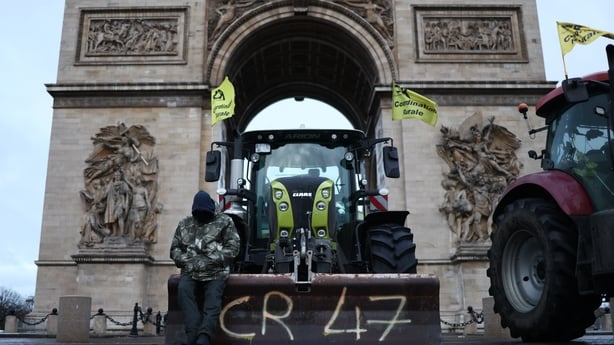
Farmers protest at the Arc de Triomphe in Paris
Mr Macron said the European Commission should be credited for “undeniable progress” after his country’s demands for what he called “a fairer agreement to protect our farmers”.
He said France had helped secure several improvements to the deal, including “an ’emergency brake’ on agricultural imports from Mercosur countries in the event of market destabilisation”, as well as “reciprocity measures on production conditions” for pesticides and animal feed.
“The signing stage does not mark the end of the story,” Mr Macron added.
“I will continue to fight for the full, concrete implementation of the commitments obtained from the European Commission and to protect our farmers.”
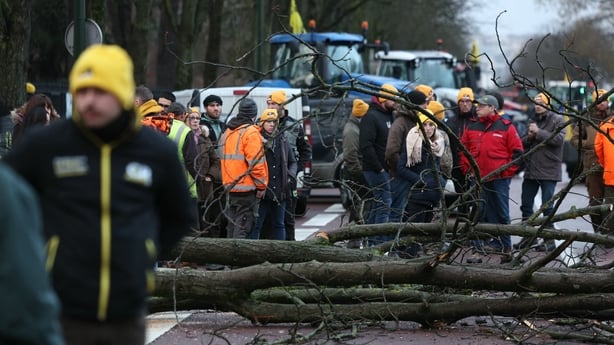
Farmers launched a pre-dawn blockade of roads into Paris and at several of the city’s landmarks.
“We are between resentment and despair. We have a feeling of abandonment, with Mercosur being an example,” Stephane Pelletier, a senior member of the Coordination Rurale union, said.
The farmers overran police checkpoints to enter the city, driving along the Champs-Élysées and blocking the road around the Arc de Triomphe monument, while police surrounded them.
Dozens of tractors obstructed motorways leading into the capital ahead of the morning rush hour, causing 150km of traffic jams, the transport minister said.
Watch: What is the Mercosur trade deal?
We need your consent to load this rte-player contentWe use rte-player to manage extra content that can set cookies on your device and collect data about your activity. Please review their details and accept them to load the content.Manage Preferences
If approved, the agreement would create the world’s biggest free-trade zone and increase EU exports to Mercosur countries – Argentina, Brazil, Paraguay and Uruguay – by up to 39% at a value of €49 billion to the European economy.
This would expand the bloc’s trading partners at a time of volatility in world trade in the face of increased tariffs.
However, the EU decision on the deal was delayed last month in the face of opposition from Ireland, France, Italy and Poland.
Opponents cite the potential to massively distort key agricultural markets if EU farmers have to compete with lower-cost South American beef.
Farmers would have ‘felt let down by any other approach’
Irish Farmers’ Association President Francie Gorman said the Government’s decision not to approve the agreement is the right call.
“There’s a clear commitment in the Programme for Government that our Government would oppose the deal.
“The so-called safeguards put forward by the EU Commission do not give any assurances that Brazilian beef will meet EU standards,” Mr Gorman said in a statement.
He added that farmers would have “felt let down by any other approach”.
“In our discussions with members of Government over the last 48 hours, we restated that opposition to the Mercosur deal was the only credible position the Government could adopt.
“Farmers would have felt let down by any other approach.”
Additional reporting Reuters, AFP