
Photo : YONHAP News
China’s recent ban on exports of dual-use items, including several rare earths, to Japan is also expected to have repercussions on South Korea, as the supply chains of the three countries are deeply intertwined.
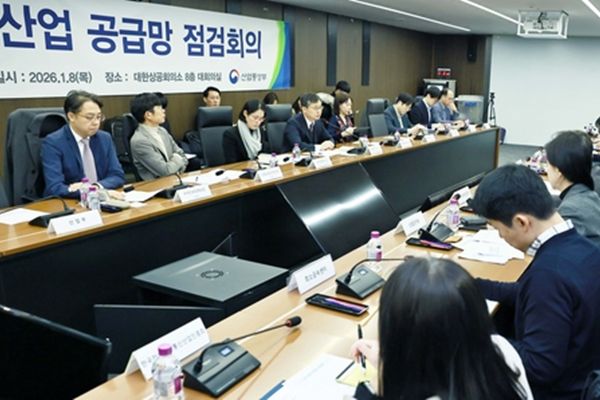
To examine the potential impact of China’s move, the Ministry of Trade, Industry and Resources held an “Industrial Supply Chain Inspection Meeting” in Seoul on Thursday presided over by Yoon Chang-Hyun, Director General for Resources Industry Policy, and attended by related ministries, the Korea Trade-Investment Promotion Agency and associations in the semiconductor, display, battery and automobile sectors.
The meeting comes after China’s Ministry of Commerce announced on Tuesday a ban on exports of dual-use items to Japan that can be used for military purposes.
While not directly aimed at South Korea, concerns are mounting that production disruptions in Japan will spread to domestic finished production lines.
In the East Asian supply chain, China provides fundamental raw materials, such as rare earths and lithium, as well as initial processing, which Japan then refines into specialized intermediate materials that South Korea integrates into advanced finished products like chips, displays, batteries and electronics.
The domestic battery industry, which is highly dependent on Japanese materials, said it’s working to diversify its supply chain, knowing that it will be difficult to avoid getting hit if production disruptions in Japan become a reality.
Meanwhile, the semiconductor and display industries are relatively calm as they’ve expanded localization and diversified suppliers due to years of global supply chain instability, including rare earth supply risks.
The government said it is reviewing countermeasures in preparation for the possibility of supply chain disruptions, focusing on key minerals which have high global production shares.
In addition, the government plans to check on the possibility of expanding domestic production and import substitutions for items related to China’s export controls while it creates support measures for local companies that face supply and demand issues.