
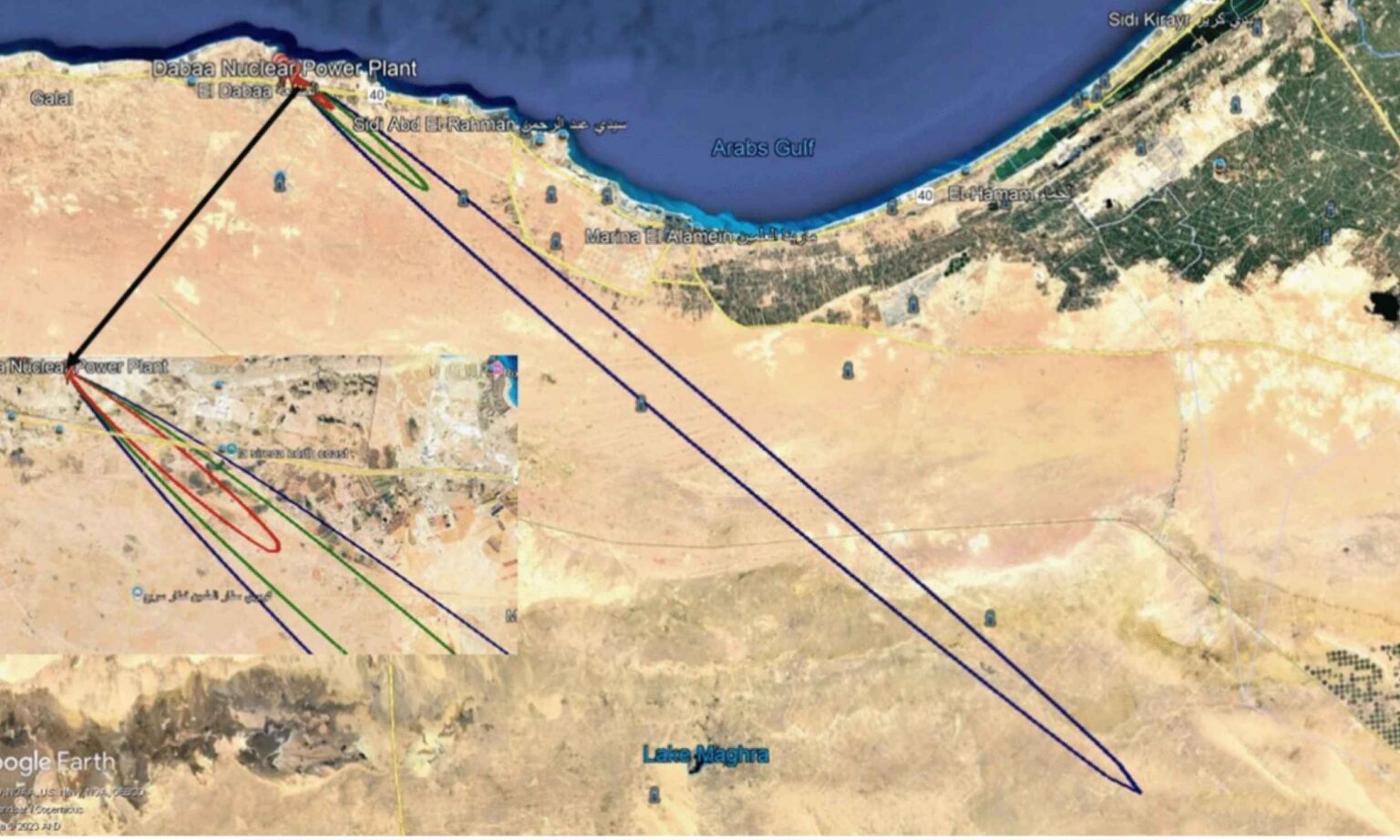
A new study modeled two hypothetical accidents at Egypt’s new El-Dabaa nuclear power plant and found radiation doses could reach extremely high levels – measured at 14 sieverts.
The team tracked how released radionuclides, unstable atoms that emit radiation as they decay, might travel about 50 miles (80 kilometers) downwind.

The work was led by M. Abobakr Mohamed at the Military Technical College (MTC) in Cairo. He studies how reactor accidents spread through air and water and how planners can cut public exposure.
Egypt’s El-Dabaa nuclear reactor is a pressurized water reactor (PWR), a reactor cooled and moderated by pressurized water, on its northern coast at El-Dabaa.
Their simulations focused on Total effective dose equivalent (TEDE), a combined dose measure across key exposure pathways, after a release.
Nuclear hazards at El-Dabaa
The team used HotSpot, a health physics simulation tool for accident forecasts, to test two hypothetical accident scenarios.
In the first scenario, the model uses a steam-line break that lets noble gases, iodine, and cesium escape into air.
The second scenario assumes a cooling failure in the PWR during a loss-of-coolant accident, leaving the core too hot and releases are far larger.
TEDE in the paper adds exposures from inhalation, submersion, ground-shine, and resuspension, dust re-entering air after contamination settles.
Where exposure is highest
For the severe scenario, the highest dose appears within a few thousand feet of the release point, then falls with distance.
The same run predicts ground deposition, radioactive material settling onto soil, water, and surfaces, and that matters for later contact.
In the higher-release accident, inhalation drives most of the early public dose because particles can enter lungs quickly.
At 50 miles, their TEDE estimate reaches 0.002 Sv, so officials still consider protective steps in planning.
How wind shapes plumes
The model tests effective release height, the plume height that sets early dilution, because higher releases spread farther before settling.
When the release starts higher, the projected TEDE drops and less contamination lands near the site in dry weather. The paper compares releases from about 33 feet (10 meters) up to 131 feet (40 meters) above ground.
Elevated wind speeds were found to reduce radioactive harm by dispersing released material more quickly and lowering concentrations near the ground.
Rain and urban effects
Rain increases wet-deposition, rain that washes airborne radioactivity onto the ground, especially close to the release point.
Farther downwind, precipitation matters less because concentrations drop sharply as the plume disperses and decays.
Urban blocks and tall buildings can redirect airflow, raising dose near the source even when average concentrations fall.
That effect can pull the worst zone closer to the plant, complicating quick decisions about sheltering or evacuation.
El-Dabaa nuclear health concerns
Researchers report results in sieverts, a unit that links radiation to health risk, because different exposures affect tissues differently.
Very high doses can injure cells fast, while lower doses mainly raise long-term cancer probability across a population.
The model flags the thyroid because radioiodine, radioactive iodine that the body absorbs, can concentrate there after inhalation.
In their organ breakdown, the thyroid accounts for 46 percent of the long-term inhalation dose, driven by iodine isotopes.
Limits of iodine protection
When authorities recommend it, potassium iodide (KI), a stable iodine that blocks the thyroid from radioiodine, can reduce one specific risk.
Guidance for nuclear emergencies explains that potassium iodide does not act as an antidote to radiation exposure and only protects the thyroid from certain radioactive iodine isotopes.
Timing matters, because taking KI late offers little benefit, and it does not shield lungs, skin, or food.
Public health agencies warn people not to self-dose with KI, since unnecessary use can cause medical problems for some individuals.
Mapping emergency response
Emergency planning uses a precautionary action zone, a preplanned area for urgent action before release, near a plant.
A broader urgent protective action planning zone supports quick decisions based on real-time monitoring. It prepares communities for sheltering or evacuation.
In the Egypt simulations, dose contours divide space into areas where officials might order sheltering, relocation, or other urgent steps.
Those maps work only if local plans match roads, communications, and health-care, and if drills keep them current.
Watching for change
During normal operation, reactors including PWRs release small, permitted amounts, and regulators like the Environment Agency watch for change over time.
In England and Wales, the Radioactivity in Food and the Environment (RIFE) report says about 10,000 analyses and measurements were completed in 2024.
RIFE describes monitoring programs independent of discharging industries, using specialist laboratories and many collectors to sample air, water, grass, and seaweed.
The report also uses habit surveys to estimate dose for those living nearby. These interviews help track local diet and daily behaviors.
Protecting food and water
Food monitoring often targets milk and leafy greens, because animals and plants can absorb deposited radionuclides quickly.
Water agencies test drinking water and coastal seafood, and they can limit harvesting if concentrations rise above action levels.
After the 2011 Fukushima Dai-ichi accident, the RIFE report notes the United Kingdom removed special import food controls in June 2022.
Clear reporting keeps rumors down, and it helps people understand which restrictions are temporary and which signal real risk.
El-Dabaa and nuclear Egypt
In the United States, the Nuclear Regulatory Commission says people receive about 0.62 rem, or 620 millirem, each year.
That same source notes about half comes from natural background, with radon as the biggest contributor from air.
Most environmental radioactivity is natural, yet rules target added human-made sources, since small releases can still accumulate locally.
Routine sampling gives communities hard data, and it gives emergency planners a baseline when something unusual appears.
The study is published in the journal Nature.
—–
Like what you read? Subscribe to our newsletter for engaging articles, exclusive content, and the latest updates.
Check us out on EarthSnap, a free app brought to you by Eric Ralls and Earth.com.
—–