
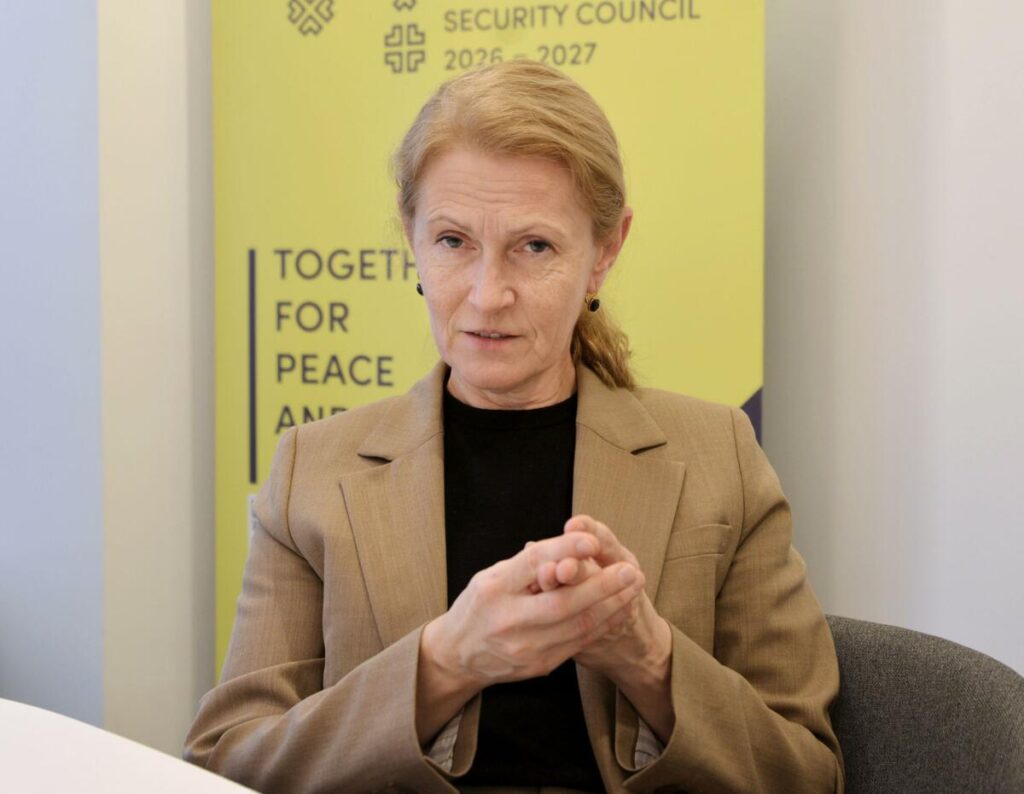
NEW YORK – Latvia’s ambassador to the United Nations expressed concern about a world order in which the strong decide the fate of the weak, saying how Russia’s war in Ukraine ends will determine the future of the global system.
Sanita Pavluta-Deslandes spoke to Kyodo News days before the Baltic country became one of 10 nonpermanent members of the world body’s Security Council in January for the first time. Latvia is serving a two-year term along with four other newly elected members — Bahrain, Colombia, the Democratic Republic of the Congo and Liberia.
“Small countries do know that a world without international law, where might makes right…is not the world we would like to live in,” the ambassador said, noting that standing up for the multilateral system is therefore the “most important priority.”
Along with the two other Baltic states — Lithuania and Estonia — Latvia shares a border with Russia. The three small countries were annexed by the Soviet Union during World War II and regained independence only decades later, in 1991, with the fall of the Soviet regime.
Because of that history, wariness toward Russia, the Soviet Union’s successor state, remains strong in Latvia. Riga also vigorously supports Ukraine in its fight against invasion by its larger and more powerful neighbor.
In Russia’s ongoing war, the world is seeing a war of aggression by a permanent Security Council member wishing to expand its territory and change borders by force, Pavluta-Deslandes said, calling it “a very clear, blatant breach of the U.N. Charter and of the international law.”
Suggesting the war will have significant implications for the future of the multilateral system, she said that “the way this conflict ends will define also what is permissible or not” in relations between countries in the world today.
The ambassador also made it clear that as a Security Council member, Latvia will seek accountability for alleged war crimes perpetrated during the war, including attacks on civilians and civilian infrastructure and abduction of Ukrainian children.
Pavluta-Deslandes said Latvia will also work closely with Japan — a veteran nonpermanent member that has been elected 12 times, more than any other country, most recently for a term spanning 2023 and 2024.
Besides the threat posed by nuclear-armed North Korea to the nonproliferation regime, the ambassador cited cooperation between North Korea and Russia on the latter’s war in Ukraine as an area where the interests of Latvia and Japan converge.
With regard to the 80-year-old world body, whose Security Council will effectively choose the next U.N. chief by around fall, the ambassador expressed hope for a woman becoming the secretary general for the first time.
“We believe that it is time for the organization to have a woman secretary general,” the ambassador said, adding that she will seek someone with diplomatic experience and the “courage” to proceed with U.N. reforms.
She also noted the importance of transparency and fairness in the selection process, such as by ensuring that all the candidates are heard and decisions made at the council are communicated to the wider membership.