
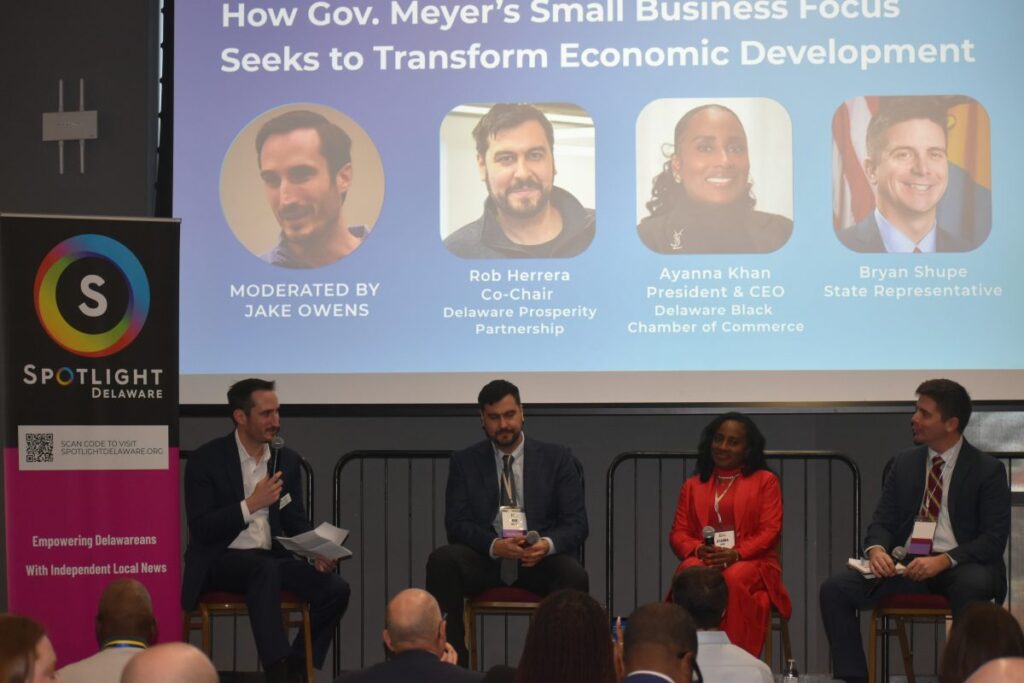
DOVER – Mounting pressures have small businesses struggling to make ends meet in Delaware, according to a panel of business owners at Spotlight Delaware’s Legislative Summit Wednesday.
Delaware employers have been contending with inflation and several new state regulations that have them stretching their dollars and cutting costs. For example, the state opened its paid family and medical leave program which is paid out of a split tax on employers starting this year. In 2025, Delaware also completed its phased increase to bringing minimum wage to $15. Adding to those challenges, higher than expected property and school tax bills have left businesses worried after the statewide property reassessment.
All these issues will be headwinds for businesses this year. Commenting on the tough times in a small business focused panel were Rep. Bryan Shupe (R-Milford) who owns Fur Baby Pet resorts with his wife Sherry; Delaware Black Chamber of Commerce Founder Ayanna Khan-Flowers and The Mill Founder and Partner at 9th Street Development Rob Herrera.
During the conversation, Khan-Flowers said that many small businesses simply cannot afford to foot the increasing bills as inflation and other factors continue to add to the numbers.
“This is kind of death by a thousand cuts. Any program may be well intended, but burden small businesses,” Herrera added.
Those newer initiatives are coupled with rising taxes, regulatory complexity and workforce development challenges as new administrations took the helm at both the state and federal levels.
“The Trump administration is wreaking havoc. I’m sorry, I’m going to keep it real,” Khan-Flowers said.
Small businesses account for roughly 99% of all businesses in Delaware, a point emphasized early in the discussion by Spotlight Deputy Editor Tim Carlin as panelists examined how recent policy changes are affecting entrepreneurs across the state.
Access to capital was also a point of concern for panelists. They touted the SSBCI, or State Small Business Credit Initiative, as a valuable, but sometimes underutilized, tool, recognizing that more support is needed to ensure small businesses can access help when available.
Shupe, Khan-Flowers and Herrera also highlighted incentives that have supported local investment like the long-running Delaware’s Downtown Development District program which has spurred redevelopment, increased foot traffic around the First State and helped small businesses transition from renting to property ownership.
All three panelists highlighted workforce development as an emerging challenge as they and the businesses they represented continue to struggle in finding workers with both technical skills and workplace readiness.
“We have seen a lack of, especially from our younger workers, . . . a lack of social interaction social skills, is a very good way to put it, that we are training on the job and it would be it would be wonderful to not spend the first 30 days getting them up to just having a conversation about not only a customer but also with managers and ourselves,” Shupe said.
There was also shared optimism about vocational pathways and trade careers which have strong earning potential in fields such as HVAC, plumbing and skilled construction. Delaware’s education and workforce pipeline programs were praised as a step in the right direction, although the three said stronger alignment between schools, employers and industry needs is necessary.
Ultimately, Shupe, Khan-Flowers and Herrera said calls for lawmakers to balance fiscal needs with the realities facing small employers are needed.
They emphasized that small businesses play a critical role in job creation, community identity and long-term economic stability across Delaware, so they should remain a priority during the legislative season. Understanding that just under 50% of Delaware’s workforce is involved in small businesses, they said some changes could make a huge impact to entrepreneurs and the economy.
They suggested easing burdens on small business owners by simplifying processes such as licensing, permitting and tax compliance. Predictability and clarity in policy decisions would allow small businesses to plan more effectively and invest with confidence, they explained.
“What we really want is simplicity,” Herrera added.