
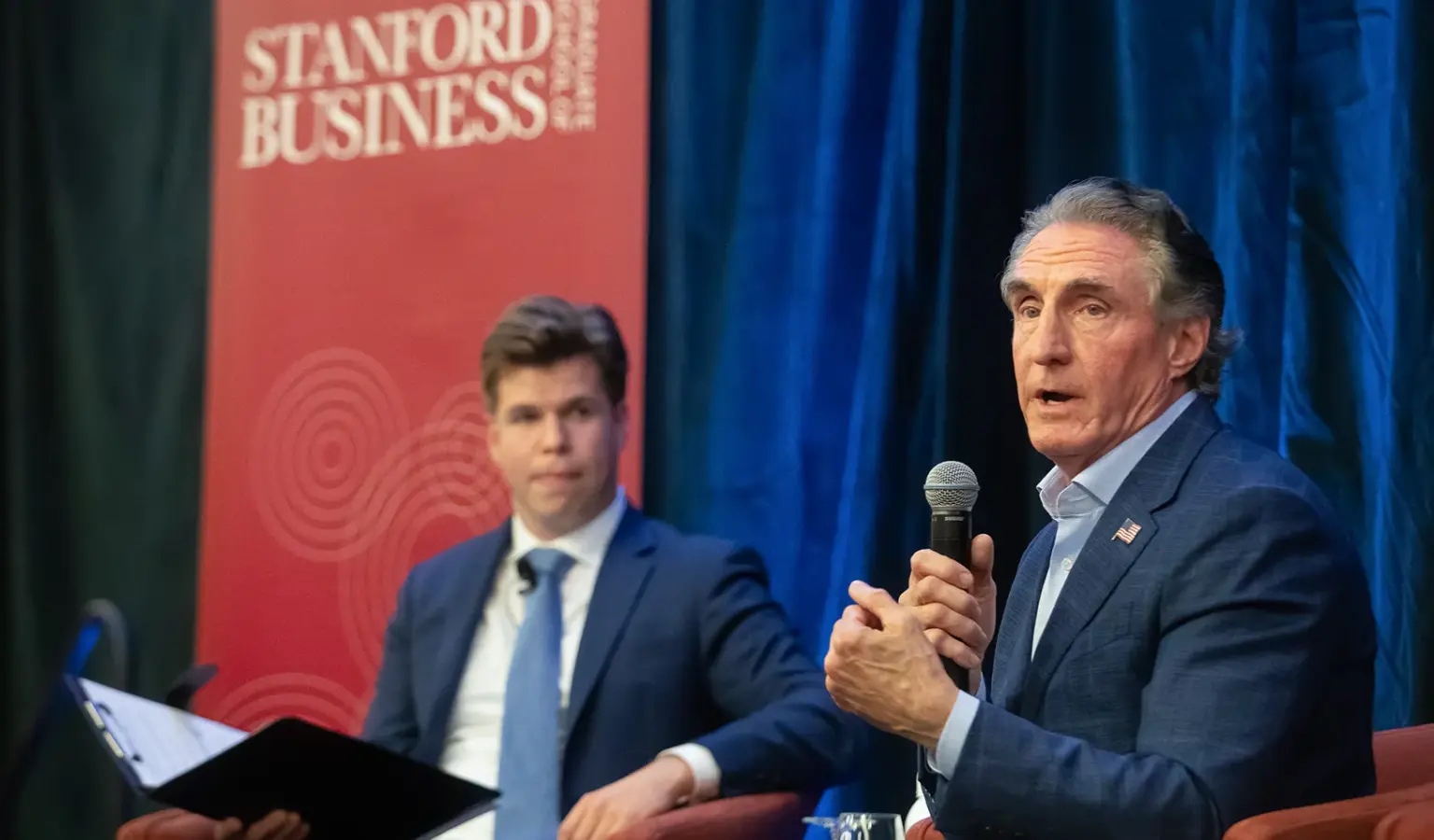
Doug Burgum remembers a road construction project in North Dakota’s Roosevelt National Park that started in 2016, during his first year as the state’s governor. The ribbon cutting ceremony is planned for this fall. Why did the job, which he calls “a short little thing,” take more than eight years to finish? Burgum blames bureaucracy gumming up the process.
Speaking to an audience of over 200 on October 10 at the Stanford Institute of Economic Policy Research (SIEPR), the secretary of the U.S. Department of the Interior recalled the incident to illustrate a larger point: Excessive permitting, environmental analyses, and other requirements create unnecessary delays. “We can’t do that anymore; we’ve got to be able to build great things quickly,” Burgum said, referring in particular to energy-related projects.
Attended largely by students, the event highlighted the importance of the energy industry and was hosted by Stanford Graduate School of Business, SIEPR, Stanford Precourt Institute for Energy, and the Center for Revitalizing American Institutions at the Hoover Institution. The organizers collaborated with the Hamm Institute for American Energy at Oklahoma State University and the American Conservation Coalition as part of its Energy Freedom Tour, a series of events with U.S. Cabinet secretaries promoting energy careers on college campuses. The panel discussion was moderated by Kyle Lottinville, MBA ’26.
Burgum, MBA ’80, repeatedly emphasized the world’s increasing demand for energy and the ability of the U.S. and its plentiful natural resources to meet it. Low-cost energy, whether petroleum, natural gas, geothermal energy, or nuclear power, would benefit the world’s hundreds of millions of people who don’t have access to electricity. “Human flourishing in this world has always been dependent on affordable and reliable energy,” he said, adding that people in areas with plentiful energy have longer lifespans, cleaner environments, better health, and less political and social conflict.
More energy will also drive domestic economic growth, too, as investors are attracted to places with low electricity prices where they believe they might earn a return, Burgum said. Utilities and power companies should locate facilities and other infrastructure near their customers, reducing transmission distances and ultimately lowering costs to businesses and consumers. Wind and solar power may be clean and renewable, but “is it affordable or not?” said Burgum. “That’s what drives Americans.”
Business and society are increasingly using artificial intelligence and demanding more electricity to power AI data centers and the servers, storage devices, and networks within them. “A kilowatt can be converted into intelligence,” Burgum quipped.
Boosting domestic energy production may also benefit U.S. foreign relations by allowing the U.S. to sell more to its political allies and increase their energy security. More international sales would also require the U.S. and other countries to build more infrastructure to transport oil and gas to customers quickly and create an alternative to transporting by ship, Burgum added.
Heron Power chief executive officer Drew Baglino, BS ’04, who joined Burgum onstage, noted that although modeling the operation of power grids is growing more complicated, utilities can automate that task using sophisticated software. That automation “will free up so much human capital both on allocation and interconnection studies and on the dynamic modeling side to do useful things like plan ahead, rather than constantly reactively dealing with Crisis A or B,” said Baglino, whose startup designs electronics for power grids.
A major obstacle to producing more energy, Burgum said, are local townships and municipalities with a not-in-my-backyard opposition to building energy-related projects. “We’ve got to do education” to convey the need for infrastructure and technologies, including those that have fallen out of favor such as nuclear energy, he said. While other countries, particularly China, are developing solar and wind sources, they’re also investing heavily in coal-based energy. For now, renewable sources, which are reliable only when the sun is up or wind is sufficient, can’t produce sufficient energy to meet demand, he said.
Even amid expansion of the energy industry, companies should make full and efficient use of their existing systems and resources, said PG&E Corporation chief executive officer Patti Poppe, MS ’05, who also spoke alongside Burgum. She cited a new 159-acre project to build data centers in San Jose, Calif., to be powered by the utility’s existing transmission lines and a substation adjacent to the land. “We can do that fast; we just need to run a conductor and we can grow with the scale of that site,” Poppe said.
Burgum, Poppe, and Baglino encouraged students in the audience to consider careers in the energy industry, whether in engineering or on the business and finance side. Ultimately, “everything about the new economy is going to require more electricity and if we’re not producing it, it affects everything we do,” Burgum said. “We’re driven by economics and by the necessity of having the power we need.”