
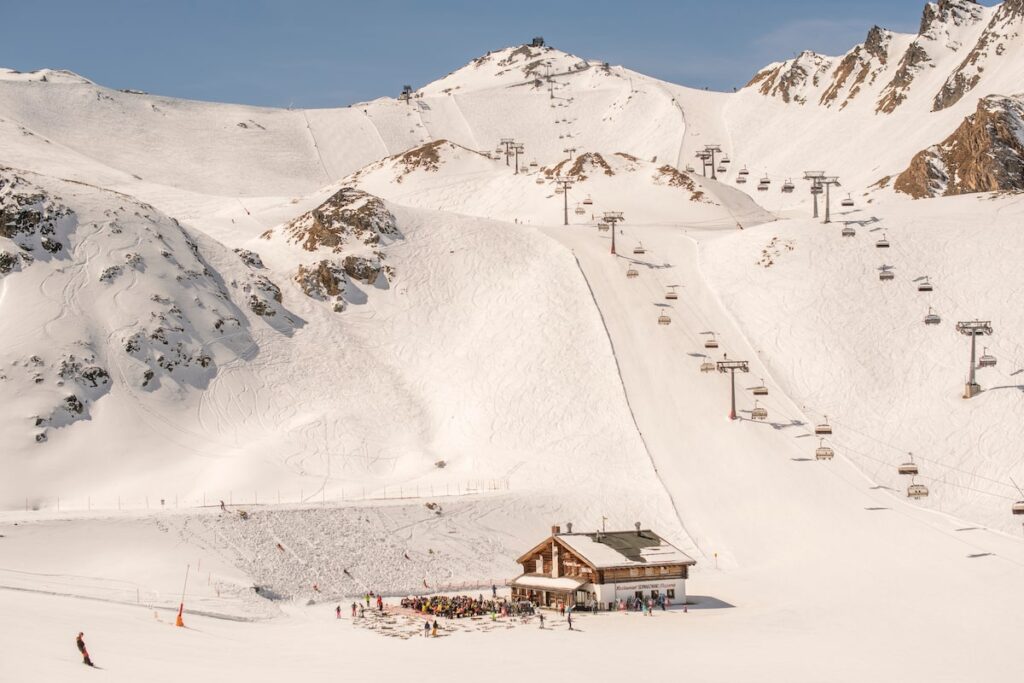
The restaurant Schwarzwand next to the Zeblasbahn and Palinkopfbahn lifts at the Silvretta Arena Ischgl, in Ischgl, Austria.Kari Medig/The Globe and Mail
In 1945, the Second World War had ended but Austria remained under occupation. In the isolated mountain town of Ischgl, tucked just outside the Swiss border, life was pared to its essentials. Food was scarce, money scarcer and survival required invention. Across the ridge lay Samnaun, a small Romansh-speaking village where tobacco, coffee, chocolate and even nylon stockings could still be found.
Under cover of darkness, smugglers hiked through these mountains dodging border police and carrying home whatever they could manage. It was dangerous, necessary work but smuggling became a lifeline between 1945 and 1955, a decade marked by scarcity and uncertainty in the high Alps.
I arrived in Austria, ready to ski one of its most glamourous resorts along the border between Austria and Switzerland. And while the skiing at Silvretta Arena is grand, my most interesting morning was spent discovering this illicit smuggling past on skis.
Guide Gottlieb Jehle skis down the smuggler’s run.Kari Medig/The Globe and Mail
While smugglers made the trek on foot and always under cover of darkness, some I learned, attempted smuggling on skis, and this led to the route being celebrated by the resort. The trails once taken by postwar smugglers are groomed into three ski runs for different ski levels. The routes range from just more than 40 kilometres in length (the easier, “bronze” route) to almost 62 km for expert skiers. Maps for the route can be found at all ski ticket offices in Ischgl and Samnaun, and a guide is not required, although the resort does offer the guided tour I’m on once a week. But it’s in German (and we used Google translate to communicate).
I meet my guide Gottlieb Jehle at the base of the ski hill, and he first takes me to a small stone-and-wood building, a former border police post where crossings were once closely watched. Smuggling allowed people to evade heavy taxation at a time when every coin counted, he says.
Jehle is the son of a smuggler. Now in his 70s, he skis with the elegance of someone decades younger. A jaunty handkerchief is tied around his neck and he’ll soon trade his helmet for a traditional Tyrolean hat. A woolen cardigan and flannel trousers complete the look (his Gore-Tex jacket is his only concession to the modern ski world).
We strap our skis on and glide down the narrow, sunlit track of the shorter smuggler’s run. I follow in Jehle’s tracks, trying to imagine the crossing as it must have felt in the years after the war: the pulse of being on high alert, the star-studded blackness overhead, the precious cargo strapped to my back. The route twists and dips, dropping into steep pitches before easing into a long, generous track. Rugged, snow-capped peaks rise around us and I feel a thrill, as if I, too, am skiing across borders on a clandestine run.
Skiers choose between heading into Austria or Switzerland.Kari Medig/The Globe and Mail
Four hours later, we reach the neighbouring town of Samnaun, which became a duty-free zone in the late 19th century. Here you can head to the shops or wander through the Chasa Retica Museum, which is worth a peek inside to get a sense of what traditional Swiss farming life was like.
After skiing the smuggling run, I return to my hotel at the ski resort via shuttle bus and gondola. Silvretta Arena is laid out in a broad circular design, so no matter which direction you take, every run eventually leads back to the base lodges and ski area entrance. This makes the mountain easy to navigate – even for newcomers – and provides a reassuring sense of orientation amid the expansive alpine landscape.
On the far side of the circle, the terrain drops into long, steep slopes that define the backside of the mountain. Yet despite the dramatic topography, the resort has skiing for all skill levels. “For three days, I can ski blue and red runs,” says local ski guide Mario Zangerl. In Europe, red runs denote intermediate to advanced terrain, steeper than easy blue runs, but less demanding than black.
In Ischgl, every turn on the slopes is a brush with the past. Trails once tread for survival now cradle skiers chasing powder, while the mountains quietly hold the stories of those who came before. Here, the Alps are not just scenery, they are memory, adventure and tradition, all carved into the snow.
Hotel Alderado with modern alpine style rooms, fits in with the charm of the town of Ischgl.Kari Medig/The Globe and Mail
If you go:
Fly into either Munich or Zurich. From the airport, take a train toward Landeck-Zams, the nearest major rail station to Ischgl. The journey is scenic and comfortable, especially as you approach the Austrian Alps. Once in Landeck-Zams, a local bus, shuttle service or taxi can take you directly to Ischgl, which is about 45 minutes away. The Silvretta Arena is on the IKON pass.
If you want to après with your ski boots on, check out the bars on the mountain. You might wander through a barn smelling of farm animals stacked high with Erdinger, Corona and Mohren beer before emerging at Paznauner Taja, a hut at 2,000 metres pulsing with a DJ and dancing crowd.
Après-spa at Silvretta Therme Ischgl, a modern wellness complex featuring panoramic pools, saunas, steam baths. Entrance fees start at €57 ($92) for four hours.
Stay at Hotel Eldorado, a cozy and stylish base that’s a 500-metre walk to the nearest lift. Rooms start at $230 a person a day, including breakfast.
The writer travelled as a guest of Austria Tourism. It did not review or approve the story before publication.