

Senior figures from France’s left-wing La France Insoumise (LFI) movement have reignited debate over France’s place in NATO, accusing the United States under President Donald Trump of actions they describe as blatant violations of international law.
Clémence Guetté, Vice-President of the French National Assembly and an LFI MP, said she would submit a proposed resolution calling for a “planned exit” from NATO, beginning with France’s withdrawal from the Alliance’s integrated military command.
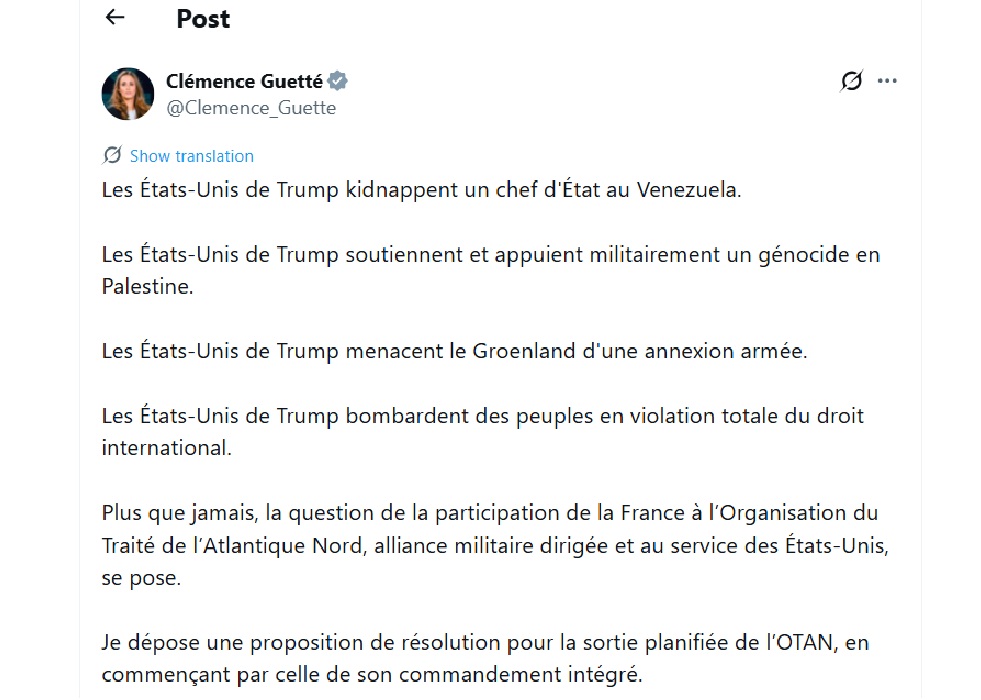
In a statement published on X, Guetté claimed that “Trump’s United States kidnaps a head of state in Venezuela”, supports and provides military backing for what she described as “a genocide in Palestine”, and “threatens Greenland with armed annexation”. She further accused Washington of bombing peoples “in complete violation of international law”.
“More than ever, the question of France’s participation in the North Atlantic Treaty Organisation, a military alliance led by and in service of the United States, arises,” Guetté wrote.
Guetté’s position was echoed by Gabriel Amard, an LFI MP for the Rhône, who argued that France should first leave NATO’s integrated command structure and then withdraw from NATO altogether. Amard called for France to pursue a “non-aligned” strategic line, stating that the country’s nuclear deterrent and diplomacy must serve national independence rather than the agendas of major powers.
The fresh appeals have also brought up old examples. France was one of the first countries to sign the North Atlantic Treaty in 1949. In 1966, President Charles de Gaulle took France out of NATO’s combined military command but kept France’s political involvement in the Alliance. After that, NATO shifted its headquarters from Paris to Brussels, and US military sites in France were shut down. In 2009, President Nicolas Sarkozy brought France back under NATO’s military leadership.
Guetté’s plan is unlikely to cause a quick change in French government policy, but because of her position in the cabinet, it has political weight beyond what is spoken every day. Guetté is a Vice-President of the National Assembly and a significant player in LFI’s program leadership. Many people consider her as a strategic core member of the movement rather than a media-facing soundbite machine. So, her intervention is a clear attempt to bring the NATO issue back into France’s official legislative and state-policy apparatus. She is portraying it as a structured discussion over sovereignty, alignment, and strategic autonomy instead of a short-lived political response.
Within NATO history, Greece is another case of partial disengagement. In the aftermath of the 1974 Cyprus crisis, Athens withdrew from NATO’s integrated military command and halted its operational participation in key NATO military planning mechanisms, arguing it had been left isolated within the Alliance. Greece later reintegrated into NATO’s military structure in 1980, with Türkiye’s approval.