

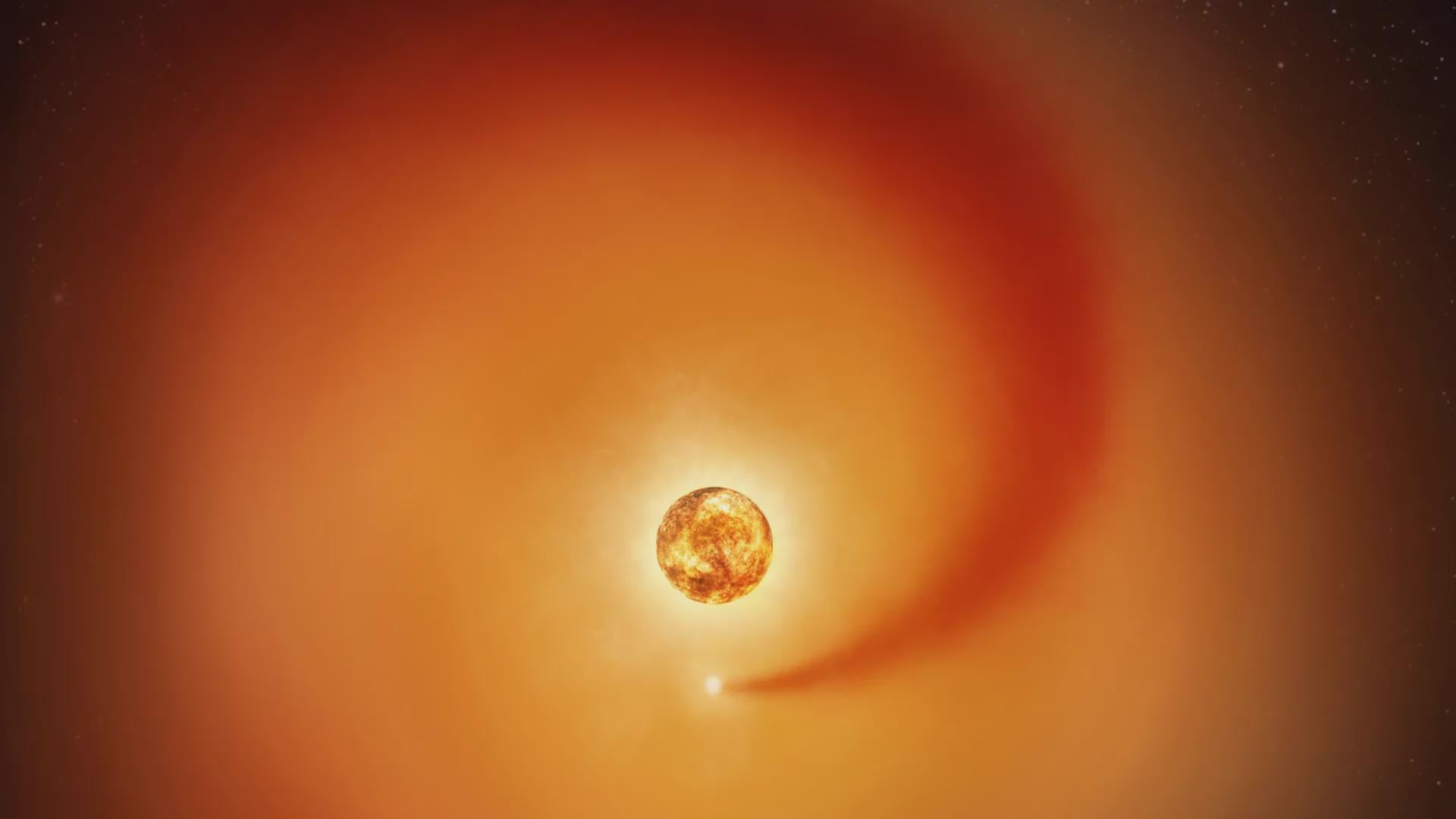
Summary: Astronomers have uncovered the long-hidden cause behind Betelgeuse’s strange behavior: a small companion star carving a visible wake through the giant’s vast atmosphere. Using nearly eight years of observations from NASA’s Hubble Space Telescope and ground-based observatories, scientists detected swirling trails of dense gas created as the companion, called Siwarha, moves through Betelgeuse’s outer layers.
https://www.sciencedaily.com/releases/2026/01/260109235153.htm
5 Comments
should’ve named the companion star Lydia…
Ad the Italians are still sleeping
I was disappointed to learn this, actually, kind of hoping to see it go bang.
Astronomer here! This result is actually NOT as clear as the press release makes it out to be and in fact I’m surprised NASA is doing a press release saying it’s a direct detection when it’s very much not. Heck they don’t even link the paper- [here](https://arxiv.org/abs/2601.00470) it is.
Now, multiple teams have been searching with HST, Chandra, and a bunch of other telescopes to find the companion of Betelgeuse, and have been for a few years now. There are two major teams, one of which got non detections with Hubble that mean “if we didn’t detect it the companion had to be under 1.5x the mass of the sun.” The second team, Howell et al, used a ground based telescope called Gemini North and had a 2.5 sigma detection of a companion- short of the minimum gold standard in science of a [3 sigma](https://kipac.stanford.edu/highlights/how-special-3-sigma) detection used to determine if a signal is real. (This has to do with statistics if you’re not familiar with the terminology- the odds of how real a signal actually is.) the Howell et al team placed a limit of a 2 solar mass companion.
So to be clear- HST is NOT capable of directly detecting Betelgeuse’s companion star. This is VERY misleading in the press release.
Now anyway, the lead author of this paper collaborated with the Hubble non detections group, and gave advice to the Howell group- she is maybe THE expert on Betelgeuse out there. And my understanding is she combined data from Gemini North with some new HST data from further out, and has an *indirect* detection from combining those two data sets. Intriguing, and potentially very cool! However, important detail- **she didn’t cite the previous Hubble or Chandra non detections**. Those *are* direct observations, over a much longer period of time than what happened in this paper (this paper only covers two orbits of the companion star, aka not a long period of time), so they’re pretty darn relevant. And I’m frankly surprised the paper got through peer review without discussing them. Someone’s gonna have to do an analysis adding those data sets together because the lead authors sure didn’t- it may well be a real signal, but I don’t think everyone who studies Betelgeuse would be as confident as her until this happens and more data is gathered.
So is it interesting and a potential indirect way to someday see the companion? Yes. Are we there yet? No! This headline is rather misleading saying it’s a confirmed detection at this stage when none of the individual pieces of data hold up on their own, the lead author is not being responsible when she says it’s a direct detection in the press release when this is the *definition* of an indirect detection.
OP why did you have to say it 3 times…? He’s coming.