
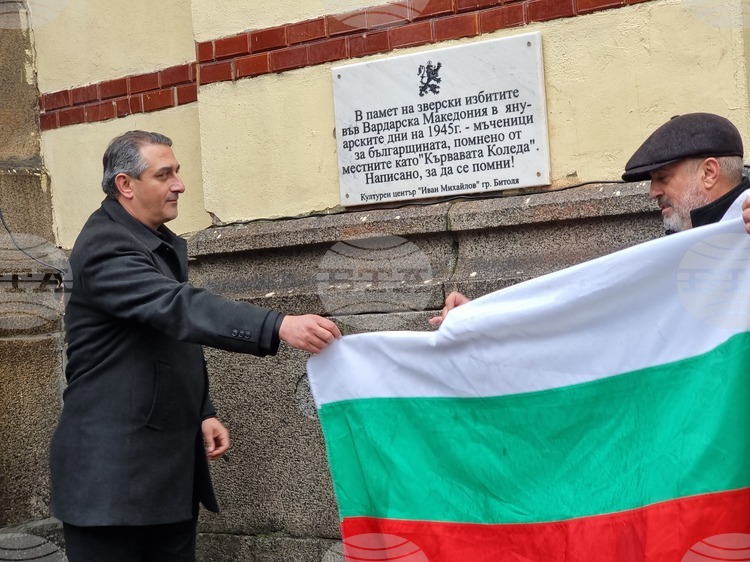
Sofia marked 81 years since the so-called Bloody Christmas, when thousands of people with Bulgarian identity were killed in Vardar Macedonia in January 1945, with the unveiling of a memorial plaque and a memorial service at St. Nicholas Church on Saturday.
The event was organized by the Initiative Committee for Commemorating the Anniversary of the Bloody Christmas. Journalist Milena Milotinova, a member of the committee and author of the film Simply Because They Were Bulgarians, stressed the importance of remembering history, as it continues to shape the present and affects the lives of Bulgarians in the Republic of North Macedonia today. She noted that little is still known about the tragic events of 1945 and called for the opening of the archives of the then-communist State Security. “Opening the archives is part of the agreements recorded in the protocols of the bilateral treaty between Sofia and Skopje, signed in 2017, which forms part of North Macedonia’s EU accession negotiation framework,” Milotinova said.
Following her opening remarks, a speech by President Rumen Radev was read by the Presidential Media Secretary. “The mass killings of thousands of people that began in January 1945 were the culmination of a policy of systematic repression against ethnic Bulgarians in this region and a deliberate campaign to incite hatred against them,” the statement said. The President emphasized that the events of this dark period remain insufficiently documented, as the political climate at the time did not allow for full exposure of the crime, which was disguised as anti-fascist struggle.
Radev also drew parallels to the present day, noting that the rights of citizens with Bulgarian identity in North Macedonia continue to be violated. “The authorities in Skopje refuse to implement the hard-won EU-brokered compromise for the equal recognition of Bulgarians in the country’s Constitution, a step that would open the path for North Macedonia towards European integration,” the President said. He added that today’s commemoration of the innocent victims of the “Bloody Christmas” would strengthen the belief among young Bulgarians on both sides of the border that tragic history must not be forgotten, so it is not repeated.
Prof. Georgi Nikolov, Chairman of the Macedonian Scientific Institute, assured that scholars will undertake thorough research on the events surrounding the Bloody Christmas, noting that descendants of the victims are still alive. “We do not seek revenge or retaliation, but we see no signs of repentance either,” he said.
Former caretaker Prime Minister and ex-ambassador to Italy Marin Raykov emphasized that without justice, there can be no prospects for development, especially not in the European sense. He also called for historical events not to be forgotten.
According to Blagoy Shatorov from the Ivan Mihailov Cultural Center, Bulgarian institutions continue to show support for Macedonian Bulgarians.