
The ceremony took place in front of the Church of St. Nicholas of Sofia.
At the very beginning of the new Serbian/Yugoslav regime in 1945, Macedonia saw the return of some of the most brutal repression and killings targeting Macedonian Bulgarians. A memorial service was held in Sofia today in honor of the thousands of fighters for a free and independent Macedonia who were killed. The commemoration marked the 81st anniversary of the start of the mass executions known in history as the “Macedonian Bloody Christmas,” BGNES reported.
“Today is a sad occasion on which we honor the memory of thousands of Macedonian Bulgarians who were killed. Unfortunately, what happened 81 years ago has not fully stopped even today. People with Bulgarian self-identification are being attacked, subjected to physical and psychological harassment, and dismissed from their jobs. We are here to honor the memory of the martyrs who died then. For thousands of them, we do not even know their names,” said Prof. Georgi Nikolov, chairman of the Macedonian Scientific Institute (MSI).
According to him, what is even more tragic is that the perpetrators of these crimes show no remorse and no effort is made to seek forgiveness for the atrocities committed. “As chairman of the MSI, I am making efforts to uncover the fate of those who were killed. We are publishing numerous materials. Bloody Christmas is one of the most shocking cases, which, regrettably, is virtually unknown in Europe,” Prof. Nikolov added.
He described it as a “bad tradition,” inherited from the communist authorities and their successors today, that the tragedy of the Macedonian Bulgarians murdered during Bloody Christmas continues to be avoided. “This is a matter of historical memory,” he stressed. Journalist Milena Milotinova also emphasized the importance of opening the archives of the notorious secret police (UDBA) of Yugoslav dictator Josip Broz Tito in order to uncover the truth and the full scale of the crimes.
The ceremony took place in front of the Church of St. Nicholas of Sofia, located on Pirotska Street in a Sofia district settled after the wars for national unification by refugees from Vardar and Aegean Macedonia.
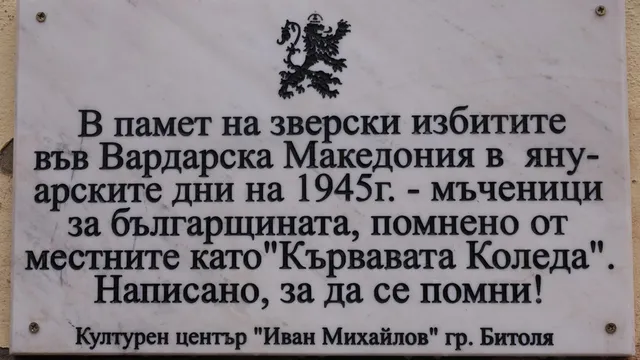
A special memorial plaque was also unveiled in memory of those “brutally murdered in Vardar Macedonia in the January days of 1945 – martyrs for Bulgarian identity, remembered by locals as the ‘Bloody Christmas.’ Written so it will not be forgotten.” The plaque was placed on behalf of the Ivan Mihailov Cultural Center in Bitola.
BGNES’ correspondent in Skopje recalled the beginning of the killings of Macedonian patriots on Christmas Day in 1945.
The list of those to be executed was compiled by Lazar Kolishevski (later known as Lazo Kolishevski), the closest associate of Yugoslav dictator Tito and head of the Communist Party in Vardar Macedonia. Tito’s personal envoy, Svetomir Vukmanović-Tempo, and his right-hand man in Skopje, Mihajlo Apostolski, were also involved in organizing the killings.
Within hours, more than 1,200 people were executed without trial or sentence on accusations that they were “Bulgarians, collaborators of the fascist occupier, supporters of Ivan Mihailov, members of the IMRO, or simply opponents of restoring a new form of Yugoslavia.”
In the Ohrid and Prespa regions, entire families were killed, with their bodies thrown into Lake Ohrid, Lake Prespa, or into the Galichica mountain near the village of Oteshevo. Overall, the massacre of more than 23,000 Macedonians — patriots and intellectuals — has been documented, while another 130,000 were expelled, deported, or sent to various camps. On Christmas Day alone, 63 people were killed in Skopje, 54 in Veles, 48 in Kumanovo, 36 in Bitola, 77 in Shtip, 35 in Prilep, and 330 near the village of Vladimirovo in the Berovo region.
On December 26, 1944, several thousand soldiers and more than 100 officers mutinied in the barracks in Skopje and Shtip, refusing orders from Kolishevski and Tempo to defend Serbia. They demanded to march to Thessaloniki to liberate their compatriots in Aegean Macedonia. The mutiny was crushed in blood. The rebel officers were lured to the Officers’ Club in Skopje, disarmed, arrested, and imprisoned in the basement of the Skopje fortress, Kale. After brief interrogations led personally by Tempo, many were executed within hours. Before each execution, Tempo reportedly told the officers: “You want Thessaloniki — here it is.”
When soldiers learned of the officers’ fate, more than 1,000 marched toward central Skopje, where Serbian officers opened fire, killing over 100 people in the square. The survivors were arrested and imprisoned in Kale, where they were held without food, water, or blankets; most died from hunger and cold.
At the same time, mayors, priests, teachers, and ordinary citizens were killed in streets and homes across Macedonia. Among the victims were prominent intellectuals and scholars, including lawyer Ilia Kocharev of Ohrid, Dr. Dimitar Gyuzelev of Dojran, engineer Dimitar Chkatrov of Prilep, Dr. Konstantin Robev of Bitola, engineer Spiro Kitanchev of Skopje, Dr. Asen Tatarchchev of Resen — brother of IMRO founder Dr. Hristo Tatarchchev — and Roza Koyzaklieva, a teacher from Shtip.
The memorial service in Sofia was attended by numerous public figures, politicians, scholars, and representatives of historic revivalist families from Macedonia, including Raina Drangova, granddaughter of legendary Colonel Boris Drangov; Bulgaria’s ambassador to North Macedonia Zhelyazko Radukov; former prime minister and foreign minister Marin Raykov; former ambassador to North Macedonia Alexander Yordanov; former defense minister Boyko Noev; and many current members of parliament. | BGNES