

10.01.2026. 16:33h
Montenegrin authorities must step up their efforts to win over public opinion in European Union (EU) member states, especially in France, the French ambassador to Podgorica said. Anne Marie Maske, stating that one of Montenegro’s strongest assets in this process is the implementation of demanding structural reforms within the framework of accession negotiations.
In an interview with “Vijesti”, she said that, as with previous enlargements, the accession of future member states could be accompanied by temporary safeguard clauses and transitional periods, but this will be considered at the appropriate time and decisions will be made on a case-by-case basis.
When it comes to the closure of Montenegrin chapters 11 (Agriculture and Rural Development) and 13 (Fisheries), he claims that there was never any talk of a “blockade” by France, “which is also confirmed by the outcome of the talks.”
She emphasized that these are areas of great importance and time is needed to conduct a detailed analysis of the fulfillment of all criteria, “in order to protect European interests and the functioning of common policies, but also to create conditions so that Montenegro, when the time comes, will be able to fully implement these European policies for the benefit of its population.”
Maske said that France, precisely because it recognizes the progress Montenegro has made, supported the formation of a working group to draft its Accession Treaty and “there is no condition aimed at delaying this process.”
Montenegro closed five chapters in its negotiations with the EU at the end of last year. A few days before the intergovernmental conference at which the chapters were closed, chapters 11 and 13 were blocked in the working bodies of the EU Council by France, whose representatives claimed that they were not sufficiently aligned with the acquis communautaire. However, after three days of intensive diplomatic activities by representatives of Montenegro and the member states, Paris gave the “green light” to close all five chapters.
As “Vijesti” reported at the time, France had agreed to form a working group to draft the treaty on Montenegro’s accession to the EU, but, at the request of Paris and with the support of some EU member states and candidate countries, an informal agreement was reached to postpone the start of its work until several conditions were met. “Vijesti” sources said that it was agreed that the working group would convene for the first time when Montenegro “closes a sufficient number of chapters” and when the EU and member states gain insight and provide guidelines “on the future format of the accession treaties”. It remained unclear how many chapters were “enough”.
Why did France briefly block the closure of two negotiation chapters in negotiations with Brussels, and what happened so that the decision was changed and the “green light” was given for the closure of five chapters?
First, let me reiterate our congratulations to Montenegro on closing five more chapters in its EU accession process, at the Intergovernmental Conference held on 16 December last year. We look forward to completing this stage, which confirms the seriousness of Montenegro’s pro-European commitment and the momentum of the reforms being implemented.
After a detailed and objective review of the progress made by Montenegro, we have agreed to close these chapters. Work on the negotiation process continues, because, as you know, enlargement is a very demanding process, based on merit. We owe this level of demandingness both to the candidate countries (and Montenegro has always emphasized that it does not want membership on privileged criteria) and to the citizens of the European Union Member States.
As for the alleged “blocking” by France, things did not unfold in that way – there was never any talk of a “blocking”, which is confirmed by the outcome of the talks. In areas of great importance such as agriculture and fisheries, time is necessary to conduct a detailed analysis of the fulfillment of all criteria, both in order to protect European interests and the functioning of common policies, and in order to create conditions so that Montenegro, when the time comes, will be able to fully implement these European policies for the benefit of its population.
What, specifically, did France get from Montenegro and the member states to change its decision? Did Podgorica question the application of the interstate agreement with France in those talks? If so, how was that resolved?
I will not hide the fact that I found the speculation that spread intensively in the days leading up to and following the Intergovernmental Conference both interesting and disturbing.
Interesting because the search for complex explanations, sometimes bordering on conspiracy theories, is often more appealing than accepting simple ones based on facts. This has unfortunately become a constant in the modern information environment, in which social networks and commentators compete to attract more public attention.
Disturbing because the risk of instrumentalization is never far away, somewhere between the search for external responsibilities and historical references that supposedly point to unchanging patterns in France’s relations with the countries of the region.
Once again, France supports the enlargement process based on the candidate countries’ own merits – this is the position taken by the President of the Republic (Emanuel Macron) and emphasized in his speech at the Globsec conference in Bratislava in 2023, and the Minister Delegate for Europe reaffirmed this position on 16 December last year at the General Affairs Council. This position is clear: there is no room for tactics or compromises.
Which Montenegrin official, in order to enable the closure of five chapters, personally spoke with the President of France?
It seems to me that this issue ultimately has relatively little importance compared to the significance of Montenegro’s European integration process. Again, interesting and disturbing.
Is it true that France has conditioned its support for the establishment of working groups tasked with drafting the treaty on Montenegro’s accession to the EU by postponing the start of their work until a number of conditions are met? What are those conditions?
The aim of the enlargement process is the full and complete accession of candidate countries, once they meet the Copenhagen criteria, in accordance with the principle of own merits, which we support. This is a matter of credibility for the European Union, for candidate countries and for Member States.
Precisely because it recognises the progress made by Montenegro, France supported the establishment of this ad hoc group to draft its accession treaty. The European Council decided to establish this group on 16 December last year and called for the priority of the preparatory activities necessary for the proper functioning of this ad hoc group. There is no condition aimed at delaying this process.
Some observers of the French political scene claim that, despite Paris’s declarative support for EU enlargement, this issue is not currently a priority for your country. In parallel, a Eurobarometer survey published in early September shows that in France, support for Montenegro’s accession to the EU is around 40%, which, together with the same percentage in Austria, represents the lowest level of support among the EU member states. Does France support Montenegro’s early accession to the EU (and why)? When do you think Montenegro should become a member? Why do polls indicate that there is strong reluctance among French citizens towards the EU enlargement process?
France strongly supports the enlargement of the European Union to include the six countries of the Western Balkans, Ukraine and Moldova. This represents a strategic necessity in the current geopolitical context.
On this issue, France is not only providing declarative support. It is active in providing concrete support, both on the political and technical levels – four French experts have been residing in Montenegro for some time now, providing support in the areas of the rule of law and justice, environmental protection, the fight against corruption and strengthening administrative capacities.
Montenegro has already made significant progress towards EU membership, but much remains to be done, particularly in the areas I have just mentioned. France will continue to provide support so that Montenegro can meet the demanding criteria and conditions for EU accession as quickly as possible, both in all chapters that are still open and in those that are provisionally closed. In this context, it is important that the Montenegrin authorities have ambitious goals in order to maintain the exceptional momentum we currently have.
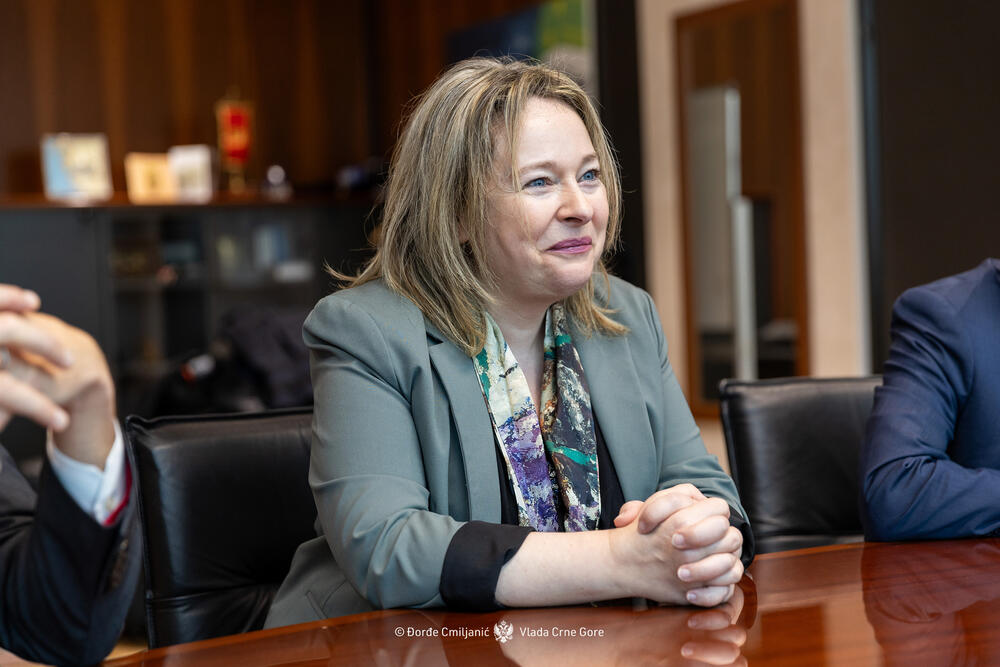
Anne Marie Maskephoto: Government/Djordje Cmiljanic
What does Montenegro need to do to gain the support of France and its public opinion for EU accession by 2028 or 2030? How could Montenegro improve its visibility and image among French citizens?
When it comes to public opinion in the Member States, and in particular in France, which was also mentioned in your previous question, it is essential that the Montenegrin authorities, in cooperation with their French partners, at different levels, are able to play their role in intensifying the necessary work to raise awareness among public opinion and elected representatives.
In my opinion, one of Montenegro’s best assets in convincing both parliamentarians and the public of various member states, in France and elsewhere, is precisely the emphasis on the demanding structural reforms being implemented as part of the accession process.
In addition, the continued strengthening of our bilateral relations can, in this context, only represent a positive element. The French are getting to know Montenegro better and better, of course through tourism, but also through the intensification of our ties, both political – thanks to the increasing number of visits and talks – and economic, with the signing of an interstate agreement in September last year. Also, our cooperation in the field of defense has experienced a significant quantitative and qualitative step forward with the acquisition by Montenegro of two patrol ships currently under construction in France.
These are all arguments that will have a positive significance at the moment of ratification of the Accession Treaty. Let us keep in mind that even raising the issue of ratification encourages enthusiasm, as it shows how far Montenegro has progressed on its European path.
Could the idea of EU enlargement be shelved if right-wing parties win the 2027 French elections? How would a possible change in the political landscape in your country affect its policy towards the Western Balkans?
Let’s not speculate on hypothetical scenarios: there are plenty of other elections scheduled for 2027, and we are at the beginning of 2026… There is no reason why Montenegro should not continue on the path it has set for itself, for its own good.
In all cases, the task remains the same – to convince the French and their elected representatives, but also more broadly – the population of the member states and their representatives – that Montenegro’s accession will make us all collectively stronger, whether in political, economic or security terms.
Does France support the idea of limiting veto rights for future members to avoid a repeat of the “Hungarian scenario” (why)?
I have already said this and I repeat it: the goal of the process is the full and complete accession of candidate countries once they meet the established criteria, in accordance with the principle of their own merits.
As in previous enlargements, the accession of future Member States could be accompanied by temporary safeguard clauses and transitional periods, in order to ensure compliance with the obligations that the candidate countries undertake upon accession to the European Union, and to limit the risks of dysfunctioning the internal market and violating European values. The possible introduction of such measures will be considered at the appropriate time and decisions will be taken on a case-by-case basis.
How do you assess the situation in the Montenegrin judiciary, which the EU has criticized in reports for years, and how do you explain the fact that five years after the change of three-decade-old government, there are hardly any final verdicts in high-level corruption cases?
What we find is that chapters 23 and 24, which represent fundamental areas, require the most work – and I say this fully aware that chapter 27, which relates to the environment, is also extremely extensive.
The implementation of the rule of law is, and I repeat this to all my interlocutors, the cornerstone of democratic maturation, the application of European values and standards – not as an external, imposed prerequisite, but as a path that Montenegro itself has chosen for the benefit of all its citizens – because this is what the vast majority of those citizens want.
Recently, there have been significant positive developments in the judicial system and prosecution, through the establishment of specific procedures, professionalization of case processing, and it is obvious that reforms and capacity building must continue in order to guarantee the transparency, efficiency and independence of the system.
The next stage is the proper functioning of that system, not only for the sake of respecting the membership criteria, but above all so that the population can have checks on the work of judges and prosecutors who should not be exposed to pressure – so that they can prove themselves and provide real results in terms of completing proceedings and passing judgments, not only in the area of high-level corruption, but also in the fight against organized crime and its ramified structures.
The rule of law also includes the preventive fight against corruption, as well as strengthening the capacities of public administration, for the benefit of all citizens. France also contributes to the realization of this goal through a project implemented by the French Development Agency (AFD) and the Anti-Corruption Fund, in cooperation with the Agency for the Prevention of Corruption, the Ministry of Justice and civil society, to strengthen capacities and structures in this area.
Narratives that divide society are also present in other countries in the region and beyond
How do you view the increasingly frequent cases of historical revisionism in Montenegro?
The increasing presence of narratives that aim to divide society is, unfortunately, a phenomenon that is also present in other countries in the region and beyond. In order to counter such phenomena and encourage active reconciliation, I am convinced that a dual approach is necessary, which simultaneously combines positive impulses from the authorities and the upward inclusive action of civil society and youth.
You are probably aware that France is promoting a major project in the region called “Common Horizons”. The aim of this program is to strengthen dialogue and cooperation among young people through sport, the fight against disinformation, the valorization of common heritage and the exchange of ideas. The exhibition “Labyrinth of the Nineties”, supported by the Center for Civic Education and our Dutch partners, which was successfully shown in several Montenegrin cities, presenting in a deconstructed way a decade that influenced the lives of millions of people in the region, was also one of our activities.
Public tender does not guarantee transparency and fairness
How do you see the assessments of a part of the Montenegrin public that interstate agreements, including those signed by the Government with France, bypass tender procedures and favor certain bidders, and that such important tasks are carried out in a non-transparent manner, without public control and accountability?
I would like to mention a few things regarding this issue, which is also important for alignment with the acquis communautaire, not only in theory – through the provisional closure of Chapter 5 on public procurement in 2025 – but also in practice, through the establishment of procedures that allow for truly transparent and fair public procurement procedures. France is fully aligned with European principles and frameworks in this regard.
The first point concerns projects concerning security or national defense, the criteria of which by their very nature should remain confidential and which, for this reason, can legitimately be realized through direct agreements between the parties.
Another issue concerns the relative importance that certain projects wish to attribute to technical criteria, sustainability criteria or compliance with the most advanced European standards (I am thinking in particular of respect for environmental protection). However, certain tender documents still, in a fixed and, unfortunately, unchangeable way, favour financial parameters. In this case, it may be more useful to apply direct contracting in order to obtain a product of better overall quality, although it may not necessarily be the most financially advantageous.
Third, public tendering in itself does not guarantee transparency and fairness. As with the rule of law in general – and it is an integral part of it – there is an ongoing process of maturation towards reliable and transparent practices, in line with European standards.
In conclusion, I would say that awarding projects through direct contracting, within the framework of interstate agreements, is not problematic in itself, provided that special attention is paid to improving the business environment, controlling the risk of corruption and that the legal framework of these agreements is robust. This is the case with the agreements signed by France with Montenegro.
News