
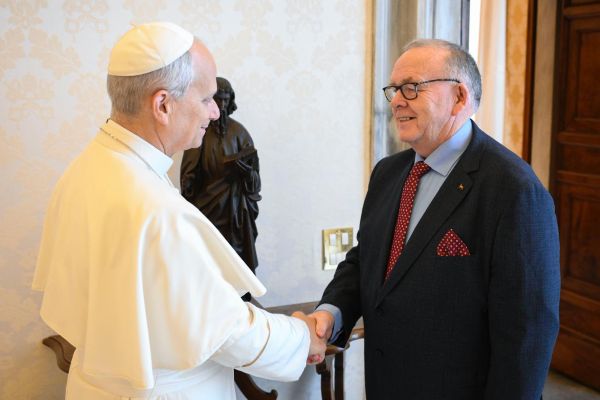
European Economic and Social Committee (EESC) President Séamus Boland held a meaningful private audience with His Holiness Pope Leo XIV at the Vatican today. The discussion centred on critical issues, including the urgent need to eradicate poverty, safeguard democratic values, and promote inclusivity for vulnerable groups across Europe.
“The European Union is one of the wealthiest regions in the world yet 21% of the population remains at risk of poverty and social exclusion,” said EESC President Boland. “We are grateful to Pope Leo for using his powerful voice to spread a message of inclusion and the need to protect the most marginalised. The EU must listen, and we all must do better.”
President Boland underscored the significant challenges and emotional difficulties faced by younger generations, shaped by the isolation resulting from the COVID-19 pandemic and the pressures of social media.
Speaking after the meeting, the President said: “Homelessness, and the housing, cost of living and climate crises are very much felt and feared today, above all by the younger generations.”
“Addressing these, tackling youth mental health and fostering their civic engagement are essential to healing, and we very much welcome Pope Leo’s work in this space, including his call for an emphasis on mental health ministry,“ he added.
During discussions concerning migrants and refugees, President Boland expressed strong alignment with Pope Leo’s call for compassion towards individuals from abroad.
The dialogue also addressed the advancements in artificial intelligence. The President of the EESC underscored that the evolution of AI should not come at the expense of workers’ rights. He reinforced a shared commitment with Pope Leo XIV to ensure that humans, rather than machines, retain authority over decisions that affect lives, emphasising that AI should be used as a tool for empowerment rather than displacement.
Furthermore, the meeting highlighted the essential role of civil society organisations in fostering community connections and combating prejudice and discrimination—principles upheld by both the EESC and the Holy See.
“Faith-based organisations, charities, community groups, and social partners constitute the foundation of our societies, bringing individuals and communities together while building vital bridges,“ said President Boland.
“The path forward is clear,“ he concluded. “If Europe chooses compassion, dignity, and inclusion, we will not only reduce poverty – we will renew hope, strengthen democracy, and build a fairer and better Europe for everyone.”