
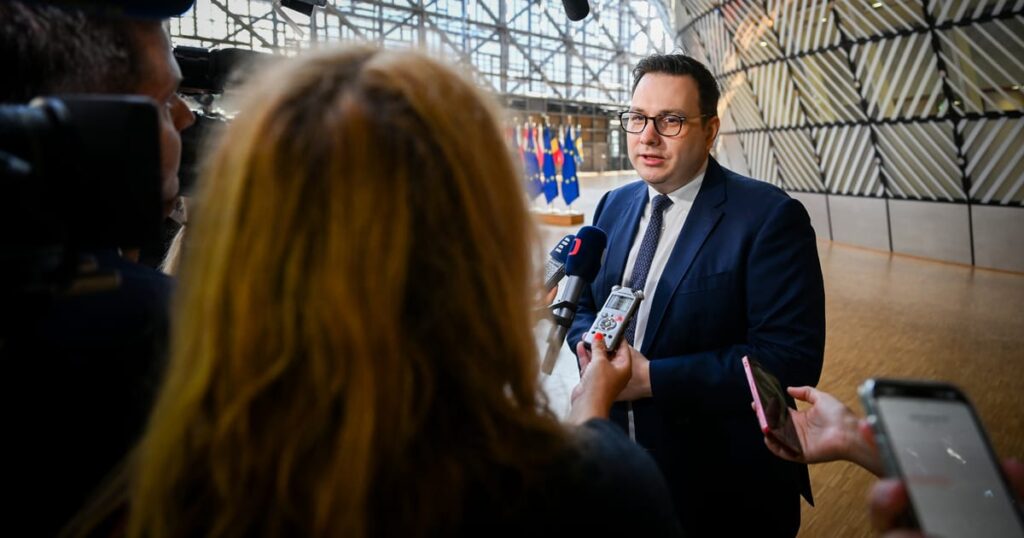

Jan Lipavský (right) and Vít Pohanka|Photo: Vít Pohanka, Radio Prague International
War returned to Europe just weeks after Jan Lipavský took office as Czech foreign minister in December 2021. What had initially been an attempt to recalibrate Czech diplomacy quickly turned into a test of crisis management, alliances, and political resolve. Looking back, Lipavský says his main goal was clear from the start.
“For me, the idea was to bring security back to the Ministry of Foreign Affairs. For many years, Czechia was neglecting the issue of security, and diplomacy was perceived as something that mainly serves companies to sell abroad. But this is not the purpose of diplomacy as such.”

Jan Lipavský|Photo: Barbora Navrátilová, Radio Prague International
That emphasis on security stopped being theoretical in February 2022, when Russia launched its full-scale invasion of Ukraine. Lipavský recalls learning about the attack through urgent calls reporting missiles already in the air.
“I got calls from my people that rockets are flying on. It was a bad dream,” he says, describing the first hours of the invasion. His immediate focus shifted to evacuating Czech diplomats from Kyiv, coordinating with allies, and preparing for emergency meetings in Europe.

President Zelensky and Foreign Minister Jan Lipavský |Photo: X of Jan Lipavský
Under Lipavský’s leadership, Czechia became one of Ukraine’s most active supporters. Beyond early military aid, Prague initiated what later became known as the Czech ammunition initiative — a system allowing allied countries to finance large-scale ammunition purchases through Czech industry and logistics. According to Lipavský, the initiative mattered not only on the battlefield, but also politically.
“We are stopping Vladimir Putin’s imperialistic invasion into Ukraine — and therefore helping our European and Czech security,” he explains. “This initiative also proved to be a great source of prestige for Czechia. At NATO and EU meetings, many countries praised the Czech ammunition initiative. I have never witnessed anything like that.” The initiative, he argues, demonstrated that even a mid-sized European country can play a decisive role if it combines political will with practical know-how.

The war in Gaza|Photo: Ebrahim Hajjaj, Reuters
During his term, Lipavský also had to navigate deeply divisive debates within the European Union — including over Israel and the war in Gaza. While acknowledging the humanitarian tragedy of the conflict, he insists Czech policy was guided by consistency rather than ideology.
“The war in Gaza was brutal, that’s clear,” he says, “but it was Hamas which started it and which was unwilling to resolve it peacefully.”

Jan Lipavský in Israel|Photo: X / Jan Lipavský
Today, Lipavský is no longer in government but remains active in foreign and security policy as an opposition MP. He warns that the war in Europe is far from over — and that Czechia faces a strategic choice about where it wants to stand.
“The question for Czechia is where we will be standing as a country,” he says. “On the side of victory with our European allies — or isolated.”
The full conversation with Jan Lipavský is available in the latest episode of Czechast, Radio Prague International’s podcast in English about all things Czech.