

HKU Geography Research Reveals the “Warming Paradox” of Urban Greenery
A research team led by Professor Yuyu Zhou from the Department of Geography at The University of Hong Kong (HKU) has unveiled a critical “warming paradox” in global urban greening strategies, challenging the universal assumption that vegetation always cools cities and providing a new roadmap for “smart greening” to combat urban heat islands effectively. By analysing high-resolution satellite and climate data from over 700 megacities, the study also demonstrates that in arid regions, urban greenery can actually increase surface temperatures.
Urban vegetation is widely regarded as a key nature-based solution for mitigating heat stress as global warming intensifies. The United Nations and city planners worldwide advocate for expanding green cover to cool urban environments through shade and evapotranspiration (the process by which plants release water vapour).
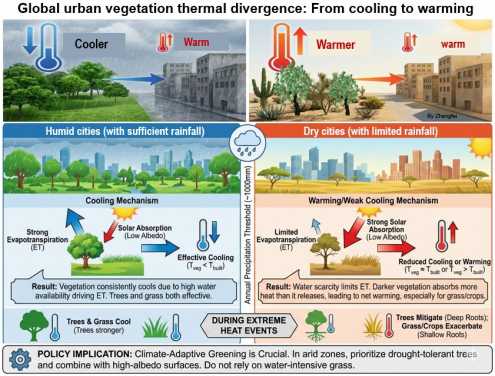
However, Professor Zhou’s team has conducted the first global, city-specific assessment of vegetation’s temperature regulation capability across 761 megacities in 105 countries. The study reveals that the cooling effect of vegetation is not universal. In approximately 22% of the cities analysed – predominantly in arid regions with annual rainfall below 1,000 millimetres – urban grasslands and croplands exhibit higher surface temperatures than nearby built-up areas.
This counterintuitive warming effect occurs because water acts as the “fuel” for cooling. In water-scarce cities, the cooling power of plants weakens significantly. In these environments, the dark colour of the vegetation absorbs more solar heat (low albedo) than the plants can release through evaporation, leading to a net warming effect.
The research further highlights a crucial distinction between types of greenery during extreme heat events. The study identifies trees as “Heatwave Heroes.” Due to their deeper root systems, trees can access soil moisture that shallow-rooted grasses cannot reach. Consequently, trees continue to provide cooling benefits in 75% of cities during heatwaves. In contrast, grasslands and croplands often dry out, failing to cool – and potentially exacerbating heat – in over 70% of cities during extreme conditions.
Key implications of the research:
- The “Warming Paradox”: Challenges the “one-size-fits-all” approach to urban greening, showing that in dry regions, unstrategic planting can inadvertently increase urban temperatures.
- Resilience of Trees: Provides evidence that trees are far more effective than grass at mitigating extreme heat, particularly in water-limited environments, due to superior canopy conductance and root depth.
- Smart Greening: Suggests that planners in water-scarce regions should prioritise drought-tolerant trees and combine them with other strategies, such as high-albedo “cool” roofs and pavements, rather than relying solely on expanding grassland or cropland.
The study, titled “Global urban vegetation exhibits divergent thermal effects: From cooling to warming as aridity increases”, has been published in the prestigious journal Science Advances.
Link to the paper: