
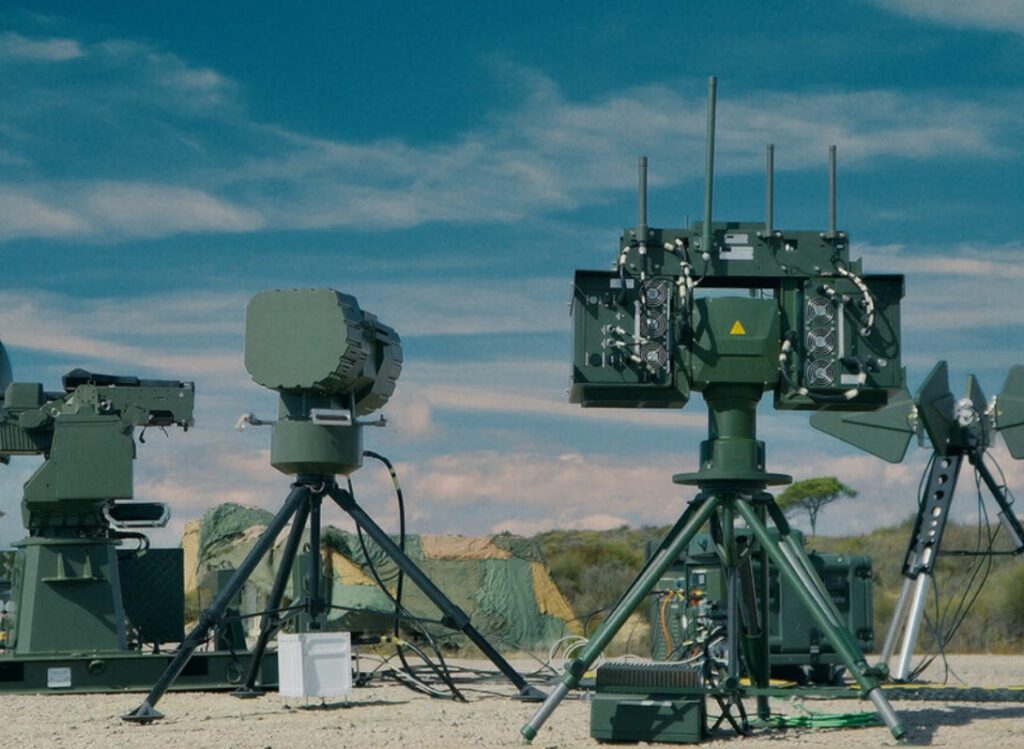

Spain has deployed its Crow counter-unmanned aerial system (UAS) to Lithuania to support the detection, surveillance, and neutralization of drones that threaten military units or critical infrastructure.
The systems are stationed at the Šiauliai Air Base, located in northern Lithuania, where they are operated by the Air and Space Force’s “Lobo” Tactical Unit.
At the base, a nine-member team conducts continuous airspace monitoring, maintaining surveillance and protection along NATO’s eastern flank against unauthorized drones and balloons.
The Crow system combines radar, surveillance cameras, sensors, and electronic warfare capabilities, acting as a smart shield over sensitive areas.
“The consistent decisions Spain makes to advance air defence in the Baltic region is a clear demonstration of political will and NATO’s collective defense commitment,” said Lithuanian Minister of National Defence Robertas Kaunas.
“Such steps taken by the Allies strengthen deterrence, send an unmistakable signal of Alliance unity, and are crucial for the security of Lithuania and the entire eastern flank.”
Spain is also currently leading the 70th NATO Air Policing Mission in Lithuania, conducted under the Rotational NATO Air Defence framework.
As part of this mission, a Spanish Air Force detachment operates F-18 fighter jets from the Šiauliai base to patrol and secure NATO airspace, complementing the protective role of the Crow counter-UAS systems.
Crow Counter‑UAS
The Crow counter‑UAS system features a modular architecture that allows components to be configured for different environments and protection requirements, including fixed sites, semi‑static deployments, and mobile platforms on land or naval units.
At the core of the system is a command‑and‑control component that fuses inputs from multiple sensors and coordinates the selected response.
Data from all connected sensors is processed to generate a single operational picture for operators, allowing them to identify and follow targets in real-time.
Algorithms and classification tools, including AI-based methods, are used to reduce false alarms and assist with threat assessment.
Once a target is identified and tracked, the system can employ different countermeasures.
These include radio frequencies and satellite‑navigation signal jammers designed to disrupt control links, as well as kinetic options such as remote weapons stations.
Other effectors, including lasers and electromagnetic systems, can also be integrated depending on the configuration.