
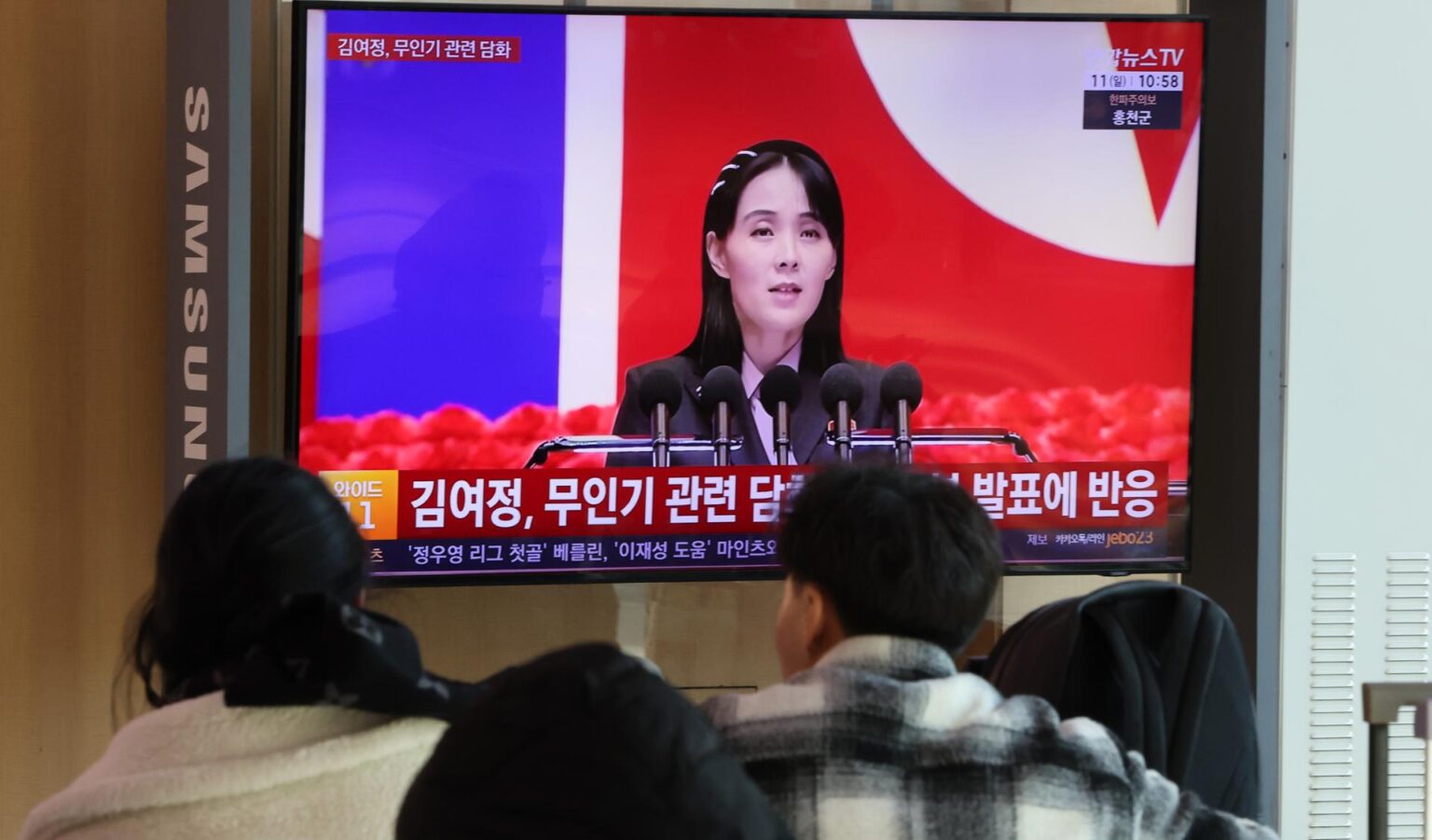

People watch news reports on North Korea’s claim that a South Korean drone violated its airspace on a screen at Seoul Station, Sunday. Yonhap
The South Korean government has launched an intensive investigation into an allegation that a South Korean drone crossed the border into North Korea, presuming that the drone, if really from the South, was launched by civilians and not the military.
The investigation by the Lee Jae Myung administration is focused on showing Pyongyang that it has no intention to provoke, as it has been desperately seeking a breakthrough in stalled inter-Korean talks.
According to the presidential office, Lee ordered a swift and thorough joint investigation by military and police to identify the responsible party, saying that if a civilian drone did indeed enter North Korean territory, it would constitute “a serious crime that threatens national security and peace on the Korean Peninsula.”
In a statement released Sunday, the presidential office reiterated that the government had “no intention to provoke or incite the North in any way.”
“The military will conduct a first-stage probe, which will be followed by a joint examination with the police. The government will make the findings public promptly,” it added.
“The government will continue to take practical measures and make efforts to ease tensions and build trust between the two Koreas.”
The Ministry of National Defense has repeatedly denied any military involvement, saying the drone presented by North Korea does not match any models operated or possessed by South Korea’s armed forces. Defense officials said investigators were examining the possibility that a civilian drone was involved and were working with other agencies to track down the operator and determine whether any laws were violated.
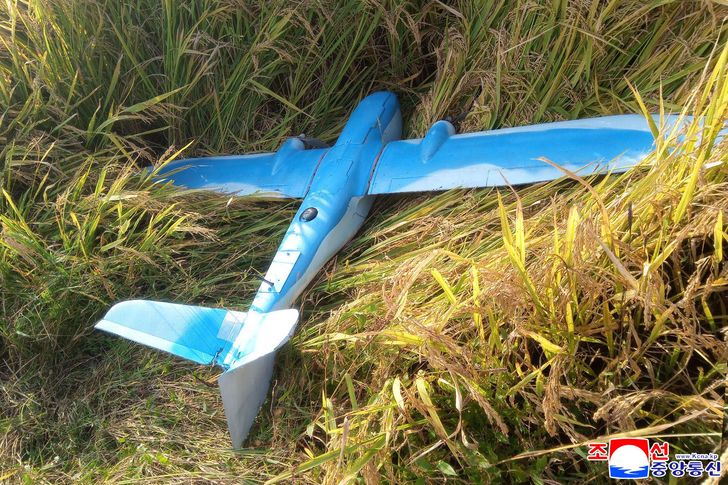
This photo, carried Saturday by the North’s official Korean Central News Agency, shows what North Korea claimed was a drone sent from South Korea on Sept. 27, 2025. Yonhap
Defense Minister Ahn Gyu-back dismissed North Korea’s claim that the South Korean military was responsible.
“It is simply not true that our military flew drones into the North,” Ahn said.
Ahn added that clarifying the facts was essential to preventing unnecessary escalation. “To avoid misunderstandings and further tension, the facts must be established clearly,” he said. “Various options, including a joint inter-Korean investigation, could be considered if necessary.”
The government’s responses came after North Korea claimed on Saturday morning that South Korean drones infiltrated the North twice, first on Sept. 27, 2025, and then on Jan. 4, both times during the Lee administration. In 2024, during the administration of former President Yoon Suk Yeol, the South Korean military flew drones into the North, allegedly to provoke North Korean actions that would help justify Yoon’s martial law imposition.
Pyongyang has partially accepted Seoul’s explanation while maintaining a hard line on demanding responsibility from the South. In a statement, Kim Yo-jong, the influential sister of North Korean leader Kim Jong-un, said Pyongyang was “taking note” of South Korea’s assertion that the military was not involved.
“Fortunately, the South Korean military expressed an official stand that it was not done by itself and that it has no intention to provoke or irritate us,” she said in a statement carried by the North’s Korean Central News Agency on Sunday.
However, Kim warned that the issue would not end there. “Whether it was done by the military or civilians, it is obvious that the drone came from South Korea,” she said, adding that the South Korean authorities “cannot evade responsibility” and “must provide a clear explanation.”
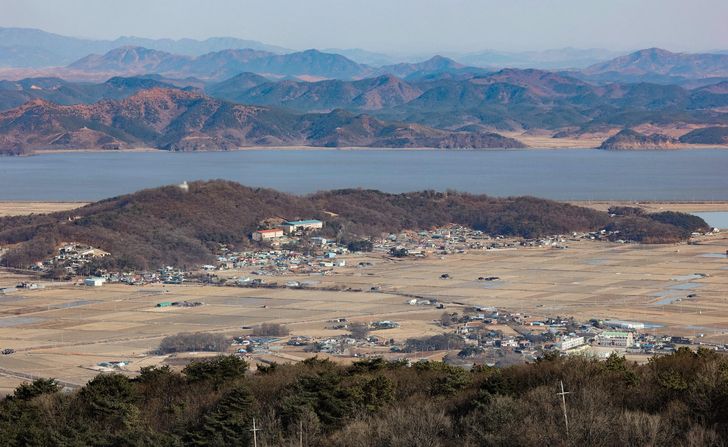
A river separates Songhae, front, a township on Incheon’s Ganghwa Island, from Kaepung District in Gaeseong, North Korea, Sunday. North Korea claims it detected an aerial object moving northward from Songhae on Jan. 4, and forced it to crash in the Kaepung area. Yonhap
Analysts say North Korea’s sharp rhetoric must be understood in the broader context of inter-Korean relations.
Hong Min, a senior research fellow at the Korea Institute for National Unification, said Kim Yo-jong’s statement appeared to be aimed at undermining Seoul’s efforts to restore dialogue.
“This is a preemptive move to block South Korea’s conciliatory approach before it gains traction,” Hong said. “By framing the issue as a clear-cut airspace violation, North Korea is trying to seize the narrative even before the investigation is concluded.”
Lim Eul-chul, a professor at Kyungnam University’s Institute for Far Eastern Studies, said the drone issue could serve multiple purposes for Pyongyang.
“Beyond criticizing South Korea, this messaging helps the North build a justification for future actions and signals dissatisfaction with broader diplomatic trends in the region,” Lim said.
Within South Korea, the controversy has also sparked debate over possible lax border surveillance. If a civilian drone crossed the heavily fortified inter-Korean border without being detected, questions are likely to be raised about the military’s ability to monitor small, nonmilitary aerial objects.
A Joint Chiefs of Staff official said on condition of anonymity that detecting small civilian drones poses inherent challenges. “There are technical limitations in detecting small, low-flying civilian drones,” the official said, adding that the military was reviewing its surveillance and identification systems in light of the incident.
Another military official said that if a civilian drone did cross into North Korea, “it would inevitably prompt a broader review of how the military monitors nontraditional aerial threats along the border.”