
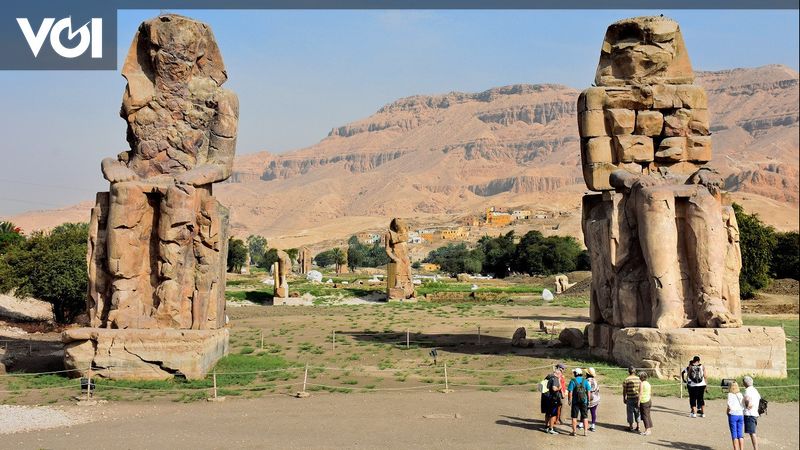
Egypt inaugurated two restored pharaonic statues in Luxor 3,200 years after they were toppled by an earthquake, in the latest archaeological event aimed at attracting tourists to the country.
The giant alabaster statues, known as the Memnon Colossi, were reassembled in a 20-year project. The statues represent Amenhotep III, who ruled ancient Egypt about 3,400 years ago.
“These works are a major achievement in preserving and reviving one of the most important landmarks of ancient Egyptian civilization,” said Tourism and Antiquities Minister Sherif Fathy, as reported by The National (7/1).
“This reaffirms Egypt’s commitment to protecting its cultural and archaeological heritage in accordance with the highest international standards,” he added.
The statues, which stand at the entrance to the mortuary temple of King Amenhotep III, built in the first half of the 14th century BC, cover 39 years of his reign, the Ministry of Tourism and Antiquities said.
It is the largest and most architecturally and structurally rich funerary temple of all the funerary temples. A devastating earthquake destroyed the temple around 1200 BC, and its remains were later used as a quarry before gradually being covered by the Nile River mud layer over time. In the 19th century, many artifacts were taken from the temple ruins by collectors and art enthusiasts.
The unveiling of the statues mid-month marked the culmination of nearly three decades of work under the Kolossi Memnon Conservation Project and the Mortuary Temple of Amenhotep III, one of the most ambitious heritage preservation initiatives in modern Egyptian archaeology.
The project, launched in 1998, is a collaboration between the Supreme Council of Antiquities of Egypt; the German Archaeological Institute in Cairo; Johannes Gutenberg University in Mainz; and international partners including the World Monuments Fund.
Several statues that were once in the temple were found, documented, reassembled and raised as part of this project.
For years, archaeologists have found hundreds of fragments buried under the mud of the Nile River and salty groundwater, which have damaged their structural integrity.
It is known that Amenhotep III, one of the most prominent pharaohs, ruled for 500 years of the New Kingdom, the most prosperous period for ancient Egypt. The pharaoh, whose mummy is on display in a museum in Cairo, ruled between 1390 and 1353 BC, a period of peace known for its prosperity and development, including the temple where the Colossus of Memnon is located.
The statues were fragmented and partially excavated, with their bases scattered. Some parts of the statues were reused in other temples, but archaeologists brought them back to rebuild the colossal statues, said the Ministry of Antiquities.
Mohamed Ismail Khaled, head of the Supreme Council of Antiquities, said that the restoration, documentation, and reassembly of the statues were carried out using the latest scientific methods and international standards for archaeological restoration.
“This ensures the preservation of its authenticity and historical value, and its return to its original location within the burial temple of King Amenhotep III in the West Bank of Luxor,” he said.
The statues show Amenhotep III sitting with his hands resting on his thighs, facing east towards the Nile River and the rising sun. He wears a headdress adorned with a double crown and a pleated royal skirt, symbolizing divine power. Two smaller statues at the feet of the pharaoh depict his wife, Tiye.
The statues – each 14.5 meters and 13.6 meters high – face the entrance to the king’s temple on the west bank of the Nile. The statues are made of Egyptian alabaster from the Hatnub mine, in Central Egypt.
The inauguration comes just six weeks after the long-delayed inauguration of the Grand Egyptian Museum, which is the centerpiece of the government’s efforts to boost the country’s tourism industry and bring cash into its struggling economy. The massive project is located near the famous Giza Pyramids and Sphinx.
The tourism sector, which relies heavily on Egypt’s rich pharaonic artifacts, has suffered for years from political turmoil and violence, following the 2011 protests that forced president Hosni Mubarak to step down.
The sector has been recovering in recent years from the impact of the coronavirus pandemic and Russia’s war in Ukraine – both countries are major sources of tourists visiting Egypt.
The English, Chinese, Japanese, Arabic, and French versions are automatically generated by the AI. So there may still be inaccuracies in translating, please always see Indonesian as our main language.
(system supported by DigitalSiber.id)