
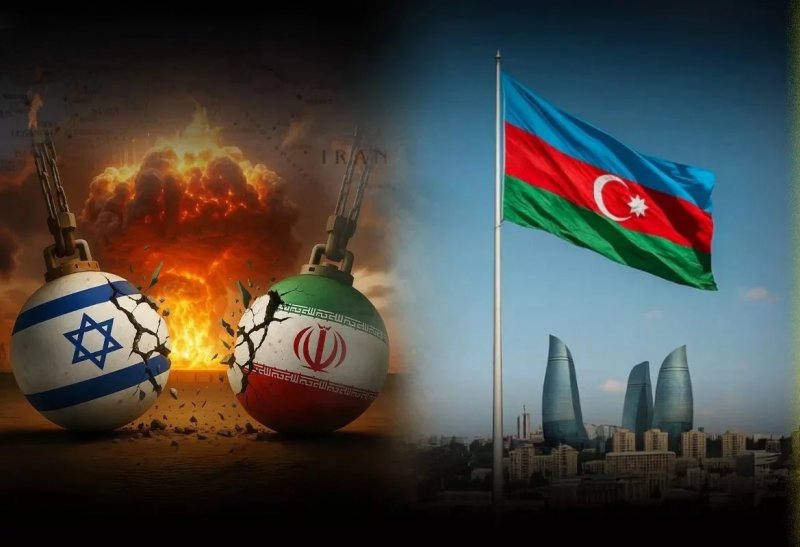
Azerbaijan’s foreign policy is based on a rational approach shaped by complex and often contradictory processes in global politics. Its guiding principles include the protection of state sovereignty, respect for international law, the promotion of regional stability, and the defense of humanitarian values. In recent years, Azerbaijan has reinforced its reputation as a reliable partner in the international system precisely because of this consistent and well-calibrated decision-making. In global affairs, the country seeks to advance a position grounded not in emotional reactions, but in tangible interests, legal frameworks, and strategic balance.
The activity demonstrated by Azerbaijan during its chairmanship of the Non-Aligned Movement, its promotion of peaceful conflict resolution, its support for humanitarian initiatives, and its constructive stance on international platforms show that Baku continues to act as a responsible player in global security processes. This approach also stems from Azerbaijan’s own history. As a country that fought for many years to restore its territorial integrity, Azerbaijan understands well that without respect for international law, neither regional stability nor a just peace is possible.
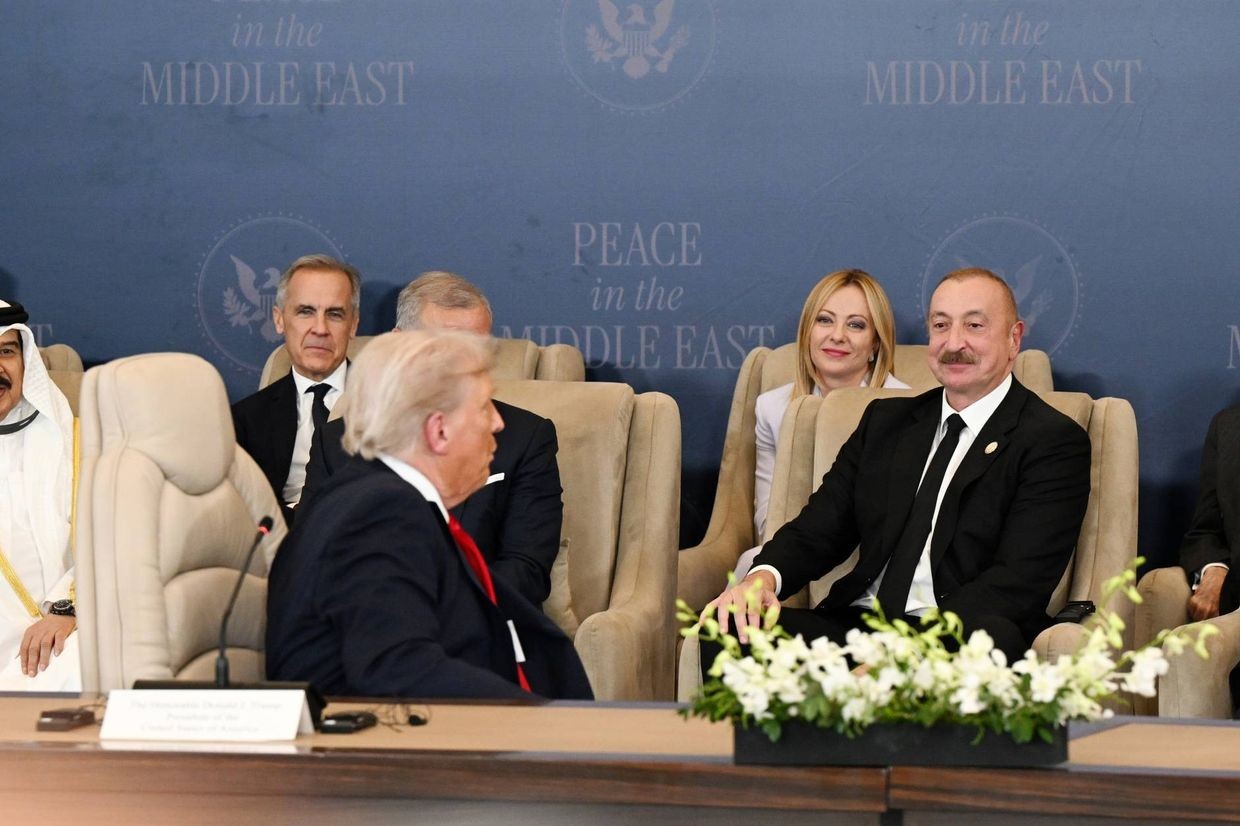
It is precisely this broader political philosophy that shapes Azerbaijan’s approach to events in the Middle East. For Baku, the main principle is not to contribute to the deepening of conflicts, but rather to strengthen dialogue and diplomatic mechanisms for resolution. Azerbaijan’s participation in the Middle East Peace Summit held in Sharm El-Sheikh can also be seen as a continuation of this approach. It demonstrates that the country is not standing aside, but instead supports the expansion of global dialogue as a responsible participant.
Source: AzerTag
Within this framework, Azerbaijan’s position on the Palestinian issue is logical and consistent. For many years, Azerbaijan has supported the establishment of an independent State of Palestine and has expressed this position consistently, particularly on the platforms of the Organization of Islamic Cooperation and the Non-Aligned Movement. The fact that the Embassy of Palestine operates in Azerbaijan by virtue of political will also demonstrates that this approach is not merely formal, but reflects a substantive diplomatic line.
At the same time, Azerbaijan fully understands that resolution of the Palestinian issue is closely linked to the positions of countries in the region, particularly leading Arab states such as the United Arab Emirates, Saudi Arabia, Egypt, and Jordan. Accordingly, Baku does not seek to dictate the process, but rather acts as a partner that promotes dialogue, coordinated positions, and consensus. For Azerbaijan, the primary objective is the achievement of lasting and just peace in the region.
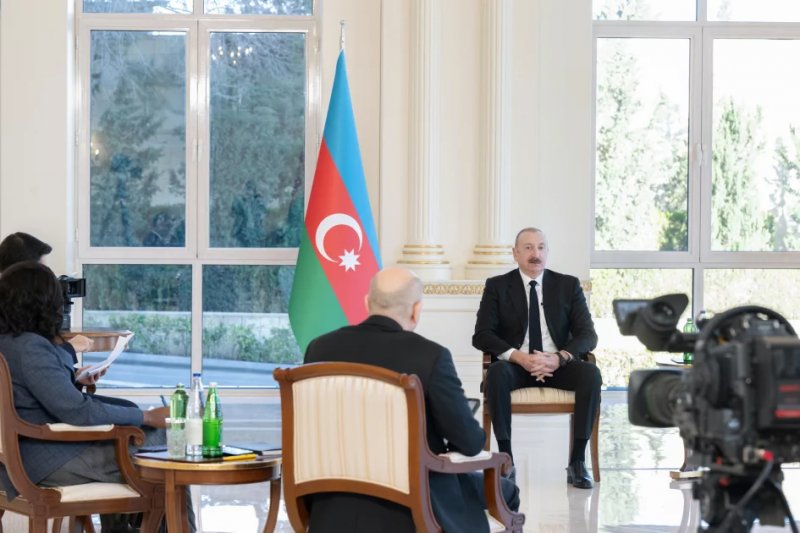
During his interview with local television channels on January 5, President Ilham Aliyev addressed this issue and clearly outlined Azerbaijan’s position.
Source: AzerTag
“My country has suffered from aggression and has endured heavy losses — to a lesser extent in the First Karabakh War, but significantly in the Second Karabakh War. Every Azerbaijani citizen is precious to us. We have no intention of risking the lives and health of Azerbaijanis for the sake of others. When we were in trouble, we were left to our own fate. No one protected us. Moreover, with all due respect and sympathy for Palestine, Palestine did not particularly protect us either. Yes, there were resolutions from the Organization of Islamic Cooperation supported by everyone, and we are grateful for that. Just as Azerbaijan has always supported Palestine and the creation of a Palestinian state in the UN, the Non-Aligned Movement, and the OIC, the Palestinian Embassy operates in Azerbaijan, supported in part by Azerbaijani financial assistance. I have always maintained that the affairs of Arab countries should be resolved by Arab countries themselves. I remain deeply convinced that non-Arab Muslim countries should not rush ahead of themselves. This will lead to no good. There is the Arab League, whose position is quite clear, and we follow it. There are decisions of the OIC; we participated in adopting those decisions and we follow them. Displaying unnecessary activism and rushing ahead is not the best course of action,” President Aliyev emphasized.
Azerbaijan’s approach to the Palestinian issue is an integral part of its overall foreign policy philosophy. The country neither adopts unilateral positions nor takes risky steps driven by emotional appeals.
Matin Mammadli, a department head at the Center of Analysis of International Relations, PhD in political science, told News.Az that Azerbaijan has for many years demonstrated a principled and consistent stance on Middle Eastern issues, particularly the Palestinian problem.
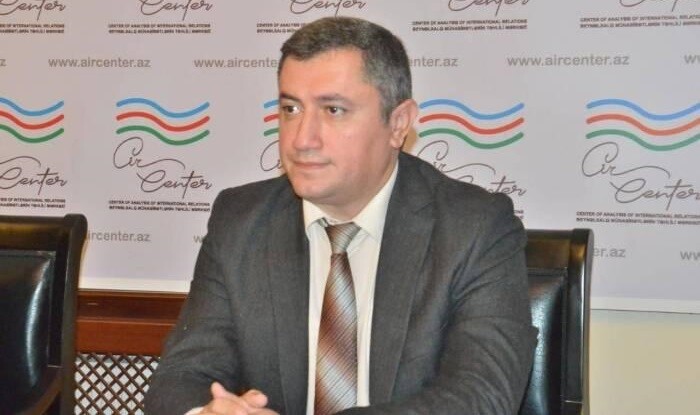
Source: Matin Mammadli, a department head at the Center of Analysis of International Relations, PhD in Political Science
According to him, Baku’s official position has consistently supported the establishment of an independent Palestinian state with East Jerusalem as its capital, based on international law. “This position has been clearly reflected in Azerbaijan’s statements and decisions, particularly within the framework of the Organization of Islamic Cooperation and the Non-Aligned Movement. One of the practical indicators of Azerbaijan’s political support is the operation of Palestine’s diplomatic representation in our country with financial backing from Azerbaijan,” he said, adding that this demonstrates Baku’s approach is substantive rather than merely formal.
Mammadli noted that Azerbaijan has also participated in international platforms addressing the Middle East peace process. “Our country took part in the Middle East Peace Summit in Sharm El-Sheikh, once again emphasizing that dialogue and diplomacy have no alternative. This demonstrates Azerbaijan’s preference for political rather than military solutions in regional conflicts,” he said. At the same time, he stressed that Baku’s official position holds that a real and sustainable settlement of the Palestinian–Israeli conflict depends primarily on an agreed position among leading Arab states.
“In this context, the political will of countries such as the UAE, Saudi Arabia, Egypt, and Jordan plays a decisive role. Azerbaijan is not an initiator in this process, but rather acts as a party that supports consensus and positions formed within the framework of international law,” Mammadli emphasized.
He noted that Azerbaijan does not plan to participate in a military or peacekeeping mission in Gaza at the present stage. “This reflects a careful assessment of risks,” he said, adding that the conflict has not ended and that serious disagreements remain between the parties on many issues. “At the same time, the mandate of any peacekeeping force remains unclear. In the absence of answers to these questions, participation in such a mission would not be appropriate,” he said.
Mammadli added that Baku may contribute in the humanitarian sphere through aid, medical supplies, technical equipment, and support for the civilian population. “This is consistent with Azerbaijan’s humanitarian diplomacy,” he said.
Emphasizing the need for a broader and more objective perspective, the political analyst also noted that historical facts show the Palestinian political movement in the past supported Armenian terrorist organizations, while Yasser Arafat’s demonstrative embrace with Armenia’s president, the fact that one Palestinian foreign minister was an ethnic Armenian, and Palestine’s issuance of a postage stamp related to the so-called “Armenian genocide” raised serious questions in Azerbaijani public opinion. “These facts show that Azerbaijan’s support for Palestine is not emotional or one-sided, but rather a measured policy based on international law while also taking national interests into account,” he said.
He stressed that Baku never adopts positions that ignore its own history, territorial integrity, and national memory.
“Azerbaijan remains committed to international law on the Palestinian issue, prioritizes a humanitarian approach, highlights the role of key Arab actors in the region, and at the same time does not forget its national interests and historical experience. This approach is an integral part of Azerbaijan’s independent, balanced, and pragmatic foreign policy,” he concluded.