
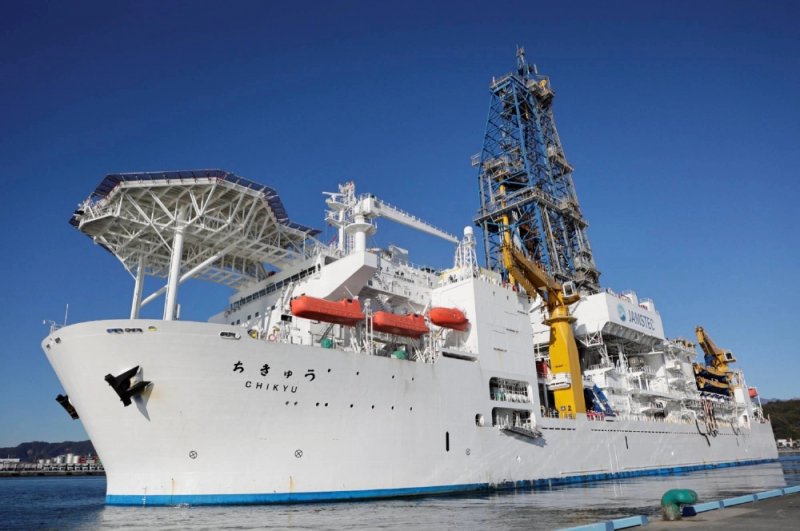
A Japanese mining vessel set off on Monday for a remote coral atoll to explore mud deposits rich in rare earths, part of Tokyo’s push to reduce reliance on China for critical minerals amid tightening supplies.
The month-long expedition of the test ship Chikyu near Minamitori Island, roughly 1,900 kilometers southeast of Tokyo, represents the world’s first attempt to continuously lift rare earth seabed sludge from the deep ocean onto a vessel, News.Az reports, citing Japanese media.
Japan, along with its Western allies, has been actively reducing dependence on China for minerals essential to the production of cars, smartphones, and military equipment, an effort that has gained urgency amid a major diplomatic dispute with Beijing.
“After seven years of steady preparation, we can finally begin the confirmation tests. It’s deeply moving,” said Shoichi Ishii, head of the government-backed project, as the vessel departed Shizuoka Port on a bright, sunny day with a snow-capped Mount Fuji in the background.
“If this project succeeds, it will be hugely significant in diversifying Japan’s rare earth sourcing,” Ishii added, noting that extracting the key minerals from 6 kilometers below sea level would represent a major technological achievement.
The vessel, carrying 130 crew members and researchers, is expected to return to port on Feb. 14.
Last week, China banned exports of items with dual civilian and military uses destined for Japan, including some critical minerals. The Wall Street Journal reported that Beijing has also begun imposing broader restrictions on rare earth exports to Japan.
Japan condemned the dual-use ban but declined to comment on the report of a wider export restriction, which China has neither confirmed nor denied. Chinese state media, however, noted that Beijing was considering such measures.
Finance ministers from the Group of Seven industrialized nations are scheduled to discuss rare earth supply at a meeting in Washington on Monday, according to sources familiar with the matter.
Japan has previously faced Chinese export controls on rare earths. In 2010, China restricted shipments following an incident near disputed islands in the East China Sea.
Since then, Japan has reduced its reliance on Chinese minerals from 90% to 60% by investing in overseas projects, such as trading house Sojitz’s partnership with Australia’s Lynas Rare Earths, and by promoting recycling and manufacturing processes that require fewer rare earths.
The Minamitori Island project, however, marks the first effort to source rare earths domestically.
“The fundamental solution is to be able to produce rare earths inside Japan,” said Takahide Kiuchi, executive economist at Nomura Research Institute.
“If a new round of export controls affects many rare earths, Japanese companies will seek alternatives to China again, but it will not be easy,” Kiuchi added.
For certain heavy rare earths, such as those used in magnets for electric and hybrid vehicle motors, Japan remains almost entirely dependent on China—a significant risk for its vital automotive industry.