
Turkey–European Union relations have faced many ups and downs over the decades, starting from April 14, 1987, when Turkey submitted an official application to join the European Economic Community (EEC), the predecessor of the European Union (EU). Over time, however, this membership bid has become an area of contention, rivalry and complexity, shaped by both elite and public perceptions.
Currently, the membership process has little prospect of completion in the short or long term. Within the EU, member states sometimes employ their veto power to serve domestic or foreign interests. It is in this context that Turkey and Armenia enter the internal dynamics of the European Union. Currently, Hungary may become a decisive factor in Turkey–Armenia relations unless Armenia diplomatically maneuvers toward Greece and Cyprus.
It is understandable for the broader EU to have a skeptical view of Turkish membership. Some scholars, inspired by the term “Euroscepticism” (a political stance based on skepticism or uncertainty regarding the European Union and European integration), have coined “Turkoscepticism,” defined as a perception of Turkey as an Islamic country whose political and social challenges hinder adoption of European values. As such, adherents of this approach assert that Turkoscepticism has created negative feelings within the European Union, based primarily on fears of Islamization. Greece and Cyprus, for example, have been perceived as being “Turkosceptic,” exercising effective veto power in the process of Turkey’s accession.
Turkey and Hungary share a long, complex history, alternating between rivalry, conflict and alliance. From 1526 to 1699, Hungary was a vassal of the Ottoman Empire. Ethnically, Turks and Hungarians are, in essence, cousins, with the former originating from Central Asia and the latter from the northern Ural Mountains. Additionally, while not inherently Turkic, Hungary has pursued deeper ties with Turkey and the broader Turkic world, even becoming an observer state within the Organization of Turkic States (OTS). Following Hungary’s accession to the EU in 2004, Hungary became a primary supporter of Turkish accession.
Armenia–Hungary relations, by contrast, have been plagued by animosity. Tensions peaked after the 2012 release of Azerbaijani army officer Ramil Safarov, who had been sentenced to life imprisonment in Hungary for murdering Armenian army officer Gurgen Margaryan in 2004. Diplomatic relations between Yerevan and Budapest were restored only in 2022. Hungary has also cultivated close ties with Azerbaijan, supporting Baku throughout the Nagorno-Karabakh conflict.

In 2010, Hungary declared its “Eastern Opening” foreign policy trajectory, aiming at improving relations and partnerships with non-European states. The initiative was spearheaded by Viktor Orban, a right-wing populist ideologically aligned with Turkish President Recep Tayyip Erdogan.
However, later developments have changed the nature of Turkey–Hungary and Armenia–Hungary relations. In 2021, following the end of the Nagorno-Karabakh war, Hungary played a crucial role in the repatriation of some Armenian prisoners of war from Azerbaijan to Yerevan. Yet, these positive developments did not prevent subsequent tensions.
Between April and May 2025, Hungary repeatedly vetoed an otherwise unanimously approved $11.35 million aid package to Armenia. Previously, in 2024, Hungary had similarly blocked another $11.35 million aid package to Armenia, until the other EU member states agreed to allocate funding for demining activities to Azerbaijan, as well. Suddenly, on Dec. 17, 2025, Armenia announced that a consensus had been reached within the EU and that the Hungarian ban would be lifted, allowing the allocated aid to be transferred to Yerevan. Hungary had already stated that it had blocked this package while demanding that a similar amount be transferred to Azerbaijan, too.
Here, the primary issue requiring analysis is not why Hungary lifted the ban, but rather when.
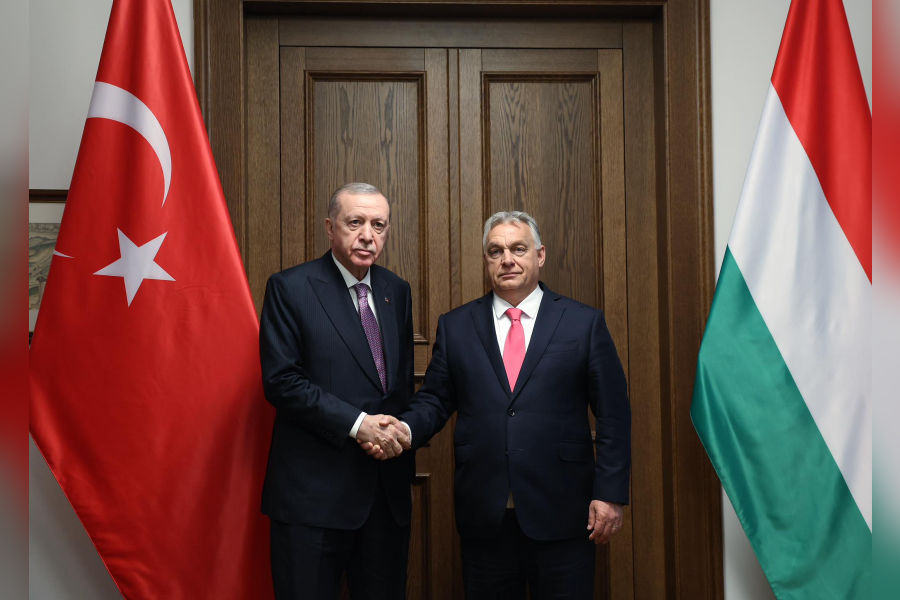
Nine days before the announcement, Orban met with Erdogan in Ankara, highlighting a decade of growing bilateral trade — from around $3 billion to $5.5 billion — and enhanced cooperation within the OTS and EU. In turn, Erdogan said that Ankara would ensure that Russian natural gas is consistently delivered to Hungary, one of the few European states to continuously import Russian gas following the invasion of Ukraine. Furthermore, one day before the announcement, on Dec. 16 2025, President Erdogan announced that in 2026, Ankara would take symbolic steps in the Turkey–Armenian normalization process.
In essence, the shift in Hungary’s stance could be attributed to all these developments. Through its alliance with Hungary, Ankara has the power to ensure that Armenia is reliant on non-EU member Turkey to preserve its interests with the EU. This power imbalance is difficult to circumvent.
However, a similar opportunity may be at hand for Yerevan. Within the EU, Greece and Cyprus have been the staunchest opponents of Turkish membership, previously using their veto power to derail the Turkish accession process or any legislation that may benefit Ankara.
As such, Yerevan has the capacity to attempt to play the same game; however, does it have the same leverage that Ankara has over Budapest? Unlikely.
But even if such leverage were acquired, does Yerevan have the political will to attempt such a diplomatic maneuver? Doubtful, due to Azerbaijani military power and dominance, Russia’s absence from the South Caucasus for the time being and American disengagement from the region, with a sole focus on realizing the Trump Route for International Peace and Prosperity (TRIPP).