
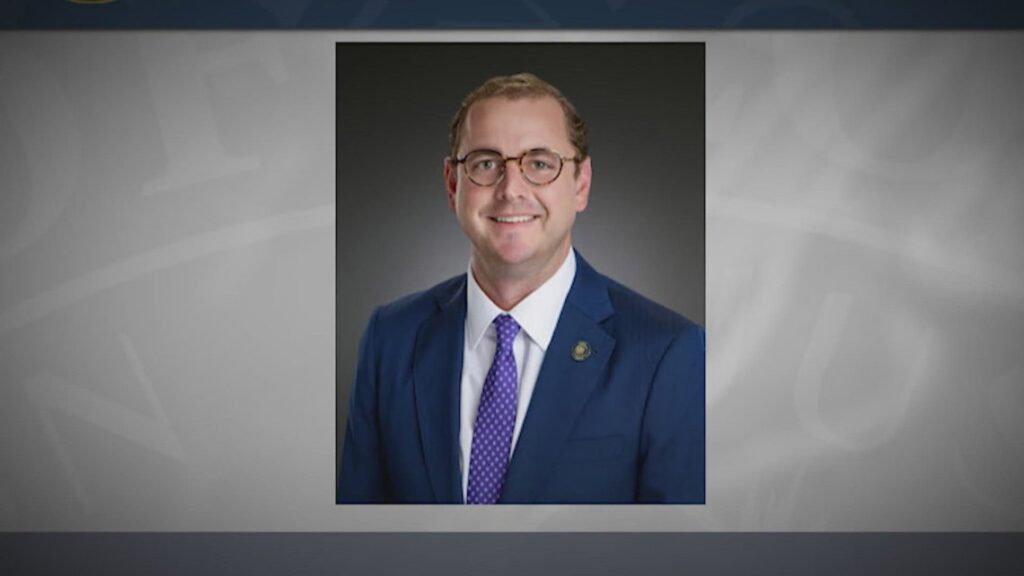
Competitors claim they’ve lost major government and hospital contracts to a company owned by state Sen. Patrick McMath (R-Covington).
David Hammer spent five months digging into this two-part investigation. WWL will air Part 1 Monday at 6 p.m., with Part 2 following at 10 p.m.
For more than four decades, John Jacobs’ family business in Metairie has supplied office furniture to government agencies and health systems across southeast Louisiana, built on long-standing relationships and repeat work.
But in recent years, Jacobs and other established furniture dealers say they have suddenly lost major government and hospital contracts to a relative newcomer.
That rising force in furnishings is Southern Interior Solutions, or SIS — a company owned by state Sen. Patrick McMath, R-Covington, the chairman of the powerful Senate Health and Welfare Committee.
And much of the work SIS is winning is in McMath’s Northshore district and with health systems overseen by his legislative committee.
Public records show multiple government agencies and hospital systems in St. Tammany and Tangipahoa parishes shifted hundreds of thousands of dollars in furniture purchases away from traditional dealers to SIS.
Meanwhile, McMath went on a local podcast, “The Arena Collective,” and described SIS as his “side hustle.” During the interview, McMath said, “If you want to be in business, you have to be involved in politics. … They go hand in hand.”
His comments, combined with his company’s emergence as a major player in the market, have roiled McMath’s competitors.
“It ticks me off a little bit that he thinks it’s funny that he can come in with a phone call and undo what my dad started 43 years ago,” said Jacobs, the only one of six local furniture dealers interviewed by WWL who was willing to go on camera. “All the vendors… have worked these accounts and cultivated (them). And for somebody to make a phone call and say, ‘Hey, we’re gonna change because we were told to do so,’ with no explanation other than that.’ It’s disheartening.”
The principals of four other firms – Melanie Fields of CI Group in Baton Rouge, Paul Maczka of Workplace Solutions in New Orleans, Shelby Russ of AOS Interior Environments and Byron Trosclair of IDI Workspaces in Lafayette – also put out a joint statement:
“Competing with an elected official with oversight of a huge segment of the Louisiana economy openly contradicts industry standards for fairness, places others at a distinct competitive disadvantage and risks putting those regulated entities in potentially compromised positions regarding their own business decisions,” the statement said.
“As small business owners, we expect a level playing field without the optics of or potential for political influence. Louisiana small businesses should not have to compete in the private and public sectors with elected officials who hold legislative or regulatory decision-making over the entities with which they seek to do business.”
McMath said in text messages that his competitors are pushing a “false narrative” because they’re bitter about losing business. He pointed to Louisiana ethics board opinions from before he was elected that say legislators are allowed do business with local governments and political subdivisions — just not directly with the state.
And SIS has avoided direct contracts with the state. However, public records reviewed by WWL Louisiana show that in 2025, the state facilities department purchased nearly $1 million in furniture for Southeastern Louisiana University’s new Robin Roberts Broadcast Media Center through AEW Interiors. AEW owns half of SIS, shares employees with it and uses the same address and phone number in Covington as SIS.
Because SIS itself cannot contract directly with the state, furniture manufacturers with state pricing agreements — all but one of them — have added AEW as an approved broker recently, in time for AEW to qualify for the SLU project.
The state vendor lists show AEW at a Covington address that’s owned by McMath and AEW but turned out to be a law office unrelated to the furniture company. AEW uses a different address in its corporate filings with the Secretary of State and on invoices to government agencies — and that one is the same address as SIS. While signage for SIS was visible at that location, there was no signage for AEW.
An attorney for AEW said it’s a separate company from SIS, with separate bank accounts, and that structure allows AEW to do business with the state.
McMath declined multiple requests for an interview but sent text messages defending his company’s work for local government agencies.
“When these local political subdivisions use state-negotiated … discounts, they’re not signing a state contract, they’re just getting the same pre-set manufacturer pricing any authorized dealer offers,” McMath wrote in one text. “The contract is still local, the price is competitive and the law only cares who signs the deal, not whose discount schedule saves the most money.”
In a separate written statement, McMath said his company “offers a high-quality product with superior service at a competitive price” and added that the reporting “won’t change our commitment to make our customers happy.”
At the Capitol, McMath was elected to the State Senate in 2019 and immediately joined the Senate Health and Welfare Committee. He became its chairman in 2024.
During that same period, public records show SIS began pursuing business with hospitals, including two parish-owned health systems in McMath’s Senate district.
Beginning in October 2022, North Oaks Health System in Hammond spent $1.3 million in public funds purchasing furniture from SIS. That same month, emails show McMath reached out to leadership at St. Tammany Health System, which was building a new surgical center in Covington.
In one email, the hospital’s chief operating officer wrote that McMath offered to sponsor a trip for a project manager to San Antonio to see furniture designs. Records suggest that the project manager did not end up going on the trip. In 2023, the hospital’s COO wrote to the manager again, saying, “Patrick McMath is contacting us to see the status of the furniture for the (surgery center) and is his company going to have a shot.” The manager replied and agreed to add SIS to her usual list of vendors. She then wrote, “I’ll tell you about my meeting with SIS sometime. It was interesting.”
WWL asked St. Tammany Health System if it was normal for a potential vendor to sponsor a trip for a public employee, if McMath said anything about his work as a legislator while pursuing a piece of the surgery center work and what the project manager meant by her comments on her meeting with SIS. The public hospital didn’t respond to those specific questions, instead writing in a statement: “Three separate vendors were used to provide furniture for the St. Tammany Health System Surgery Center according to applicable procedures and policies ensuring the best quality, product price, and in adherence to ethical standards.”
McMath said he is permitted to do business with hospital districts, even though the Legislature exercises oversight over the health care industry.
“There is no prohibition on a legislator having business dealings with certain industries simply because he is a legislator or because he serves on or chairs a committee with oversight authority of the subject matter involving the business,” McMath wrote in a text to WWL.
In recent years, McMath sponsored legislation affecting hospitals, including a law limiting public access to certain hospital records. St. Tammany Health System later cited that law in denying WWL Louisiana access to records showing how much taxpayer money it paid SIS for furniture.
McMath also sponsored a bill limiting liability for nursing home and hospital management firms. The measure failed in 2024 but passed in 2025.
Competitors say they began hearing from hospital contacts that decisions to shift business to SIS were coming from the top.
Jacobs said he’s lost work his family company, DKI, had held for decades. He said his father started selling and maintaining furniture at an area hospital 30 years ago, but recently a contact at the health system told him DKI was being replaced by SIS but not because of any failing or shortcoming by DKI.
“He said, ‘I was instructed to use SIS for this project,’” Jacobs recalled being told. “That crosses a line.”
Private hospital officials say they use a fair, competitive bidding process and rejected any suggestion that SIS received preferential treatment.
McMath declined multiple interview requests over the last several months. WWL attempted to reach him at his Covington legislative office and the State Capitol. On the final day of the 2025 special legislative session, WWL waited outside the Senate chambers and a state spokesperson confirmed McMath was aware the station was there seeking an interview. But then, McMath was a no-show – the chairman of the Health and Welfare Committee was one of only five senators who didn’t show up for a key vote on welfare funding.
In his texts to WWL, McMath noted several of his predecessors who chaired the Senate Health and Welfare Committee owned nursing homes, a medical practice and a pharmacy – health care providers that directly received Medicaid reimbursements overseen by that committee – and none of them were violating the state ethics code.
Ethics watchdog Steve Procopio of the Public Affairs Research Council said Louisiana’s part-time Legislature creates inherent tension when lawmakers simultaneously hold private sector jobs.
“We want politicians and we want good ones in there,” Procopio said. “We don’t want them using their influence to enrich themselves or their friends and family. We want them to use their influence to make Louisiana better.”
Procopio emphasized that Louisiana’s ethics code only prohibits legislators from doing business directly with the state, not with political subdivisions or private entities — a distinction he said reflects a gap between the letter of the law and broader public expectations.
“That’s the legal line,” Procopio said. “That’s not necessarily saying that that is a good thing.”