
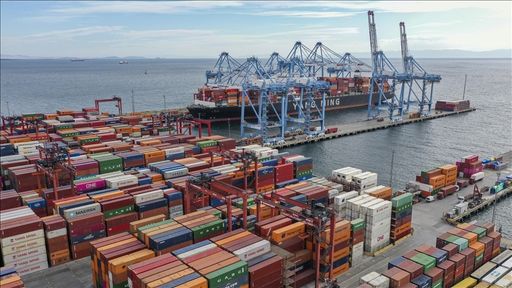
“Investment, production, employment and exports must once again become the locomotive of the economy,” he says. “If exporters are supported, we are confident we can reach our 2026 targets.”
Diversification as a survival strategy
Despite these constraints, exporters have expanded aggressively into new markets.
In 2025 alone, Turkish exporters organised trade missions in 76 countries, participated in 401 international fairs and added nearly 13,000 new firms to the export ecosystem.
Eight sectors and 27 provinces posted record annual exports, while shipments to 65 countries reached all-time highs.
Senior economist Alkin sees this geographic diversification as essential.
“Exporters are fighting not to lose long-standing customers while simultaneously pushing into Latin America, Africa and Southeast Asia,” he says.
“Today, Turkish firms are seriously active in more than 200 markets worldwide.”
Beyond goods, services exports have emerged as a critical stabiliser. Tourism, health services, education and logistics are all posting record earnings, helping to contain the current account deficit.
“Service exporters are delivering extraordinary results,” Alkin says. “They are now as important as goods exporters in managing Türkiye’s external balance.”
One structural advantage, economists and exporters agree, is Türkiye’s reputation as a reliable supplier at a time when global supply chains are being re-engineered.
“European firms increasingly prefer sourcing from nearby, dependable partners,” senior economist Alkin says. “Türkiye can deliver high-quality goods quickly and, crucially, without last-minute disruptions.”
That perception, reinforced during the Covid, has positioned Türkiye as what senior economist Alkin calls a “safe harbour economy” — a status that now translates into guaranteed and trusted orders.
Türkiye’s export boom, then, is both a success story. It reflects extraordinary resilience and adaptability, but also highlights the strain exporters face from costs, currency dynamics and global fragmentation.
President Erdogan echoed this sentiment at the TIM Istanbul meeting.
“Those who turn their face toward Ankara will win.”
For Türkiye’s exporters, the message is clear: the world may be closing in, but for now, the outward push continues — record by record.
In today’s economy, global trade has become more fragmented, politicised and unpredictable than ever before.
Yet Turkish exporters have responded by widening their geographic reach, deepening their role in services and capitalising on Türkiye’s growing reputation as a fast, dependable and disruption-free supplier.
The result is a paradoxical success: exports are rising not because constraints have eased, but because resilience, diversification and credibility have become strategic assets.
Turkish exporters have succeeded under geopolitical and geoeconomic strain, proving that trust and reliability can be as decisive as price competitiveness.