

A new peer-to-peer effort to support overwhelmed Routt County residents and prevent mental health crises will kick off this year as the HOPE Initiative, or Helping Others Through Peer Engagement.
Community members and mental health professionals have been hoping, planning, meeting and fundraising for more than a year to create the initiative to meet a gap in the community for pre-crisis support services.
The HOPE Initiative, expected to go live later this winter or in early spring, will be able to help Routt County residents dealing with anxiety and depression before they become overwhelmed and spiral into a crisis-level situation, said Brittney Wilburn, executive director at The Health Partnership, which is overseeing the program.
The initiative was created through the collaboration of concerned community members and multiple partnering agencies involved in a Crisis Services Stakeholders Coalition across the Yampa Valley. Partnering agencies include UCHealth Yampa Valley Medical Center, Northwest Colorado Health, Health Solutions West, REPS, Warhorse Ranch and Yampa Valley Community Foundation.
The goal of the program is to recruit and train at least 10 peer-support specialists who have a variety of lived experiences in personal, family or professional mental health challenges so they can answer calls on a “warmline” available 24/7 to Routt County residents 18 and older. Peer specialists can arrange to meet with callers in a public place as needed and help individuals navigate and connect with mental health resources.
The HOPE Initiative was created “in response to the growing need for accessible, localized mental health resources for individuals who are struggling but not in acute crisis,” Wilburn said. The program will be similar to successful regional models including the partnership’s existing peer recovery specialists for people fighting substance-use disorder as well as behavioral health support services through Vail Health.
“It’s one more access point for our community,” said Wilburn, a registered nurse with a master’s degree in public policy and management. “How do we create supports that don’t look like traditional supports, and that’s what the HOPE Initiative seeks to accomplish.”
Soniya Fidler, president at Yampa Valley Medical Center, said the 24-hour aspect of the HOPE Initiative non-crisis line will be especially helpful.
“Honestly, I think anybody and everybody can use it, and I would love to see that happen,” Fidler said. “Even if you have a good network, these are the resources that can connect you with the right resources.”
“Routt County, like many mountain and resort communities, continues to experience significant challenges related to mental health access, isolation and stress. While emergency and clinical services remain essential, there is a growing recognition that community-based support, human connection and early intervention are critical parts of preventing a crisis before it occurs.”
HOPE Initiative working group
Christine Hildebrand, support services director at nonprofit REPS, or Reaching Everyone Preventing Suicide, said the fact that the phone line will be staffed by local citizens should be a great asset to a “very tight-knit” Routt County community.
“It’s going to be a very strong thread in the mosaic that is required to support the mental health in the community,” Hildebrand said.
Community member and construction worker Joshua Haddock said he got involved in the HOPE efforts because “there is just not enough pre-support; there is support for crisis and beyond, but how do we reach people before it gets to crisis.”
Wilburn said trained volunteers will be on-call for 10-hour shifts, with a stipend provided. The volunteers will be paid when they take a call on the “warmline” and assist individuals.
“My hope with the HOPE Initiative is that we have a diverse community of volunteers,” to meet the needs of any community member who needs someone to talk with, Wilburn said.
Although many adults in Routt County have friends they might talk with before a crisis happens, Wilburn said those friends generally are not trained to help or to make connections to resources. Additionally, asking a friend for help may be awkward for both people.
“When we are struggling, we don’t know what we need,” Wilburn said. “And we don’t know how our friends are going to respond to us, so just we keep it inside. And on the flip slide, often our friends don’t know how to talk about the really hard things.”
Fidler said the HOPE Initiative “also gives the friend an opportunity to reach out and say, ‘I don’t know how to help my family member or my friend; let’s call this line.’”
“That’s a common theme that we hear is ‘I’m in need, or I have friend in need, and I don’t know where to start. I don’t know who to call,’” Fidler added.
Another goal of the HOPE Initiative is to break down walls blocking conversations about mental health challenges, amplify the understanding of mental health and encourage people to talk openly, Wilburn said.
Traci Hiatt, director of philanthropy at Yampa Valley Community Foundation, said the foundation raised HOPE Initiative funding through private donations from individuals and family foundations and is still fundraising for the final $40,000 needed. The two-year pilot program, with a budget of $424,000, is advertising for a program manager. Those interested in becoming a HOPE Initiative trained volunteer can contact Wilburn at bwilburn@ncchealthpartnership.org.
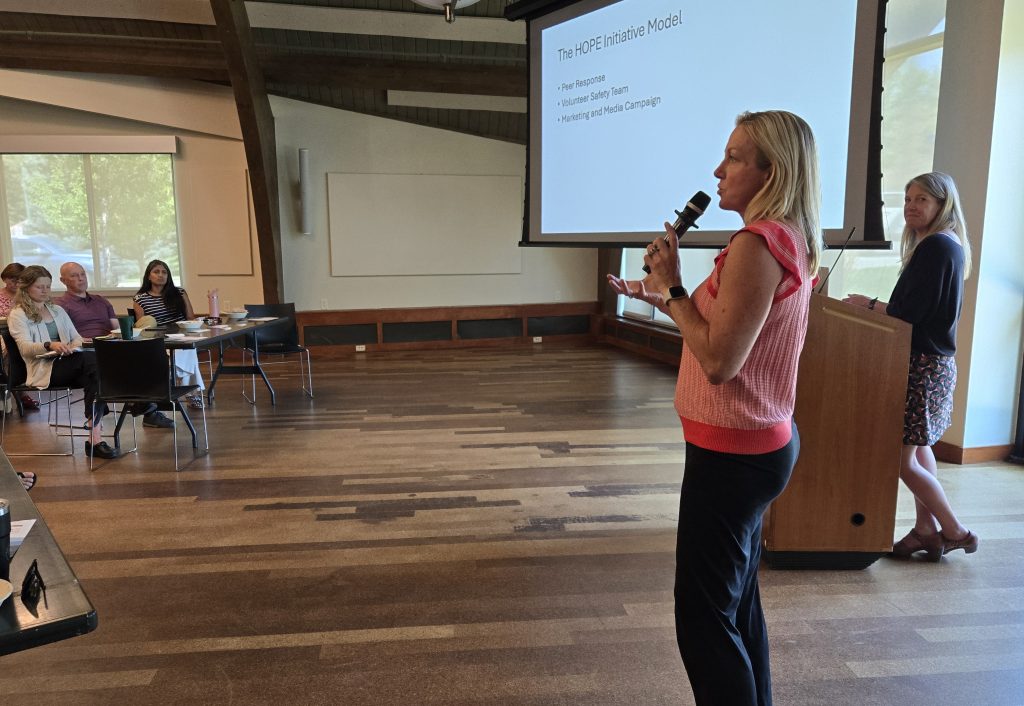 Traci Hiatt with the Yampa Valley Community Foundation explains the formation of a new initiative called HOPE, or Helping Others through Peer Engagement, during an August 2025 meeting of the Yampa Valley Behavioral Health Coalition.Suzie Romig/Steamboat Pilot & Today