
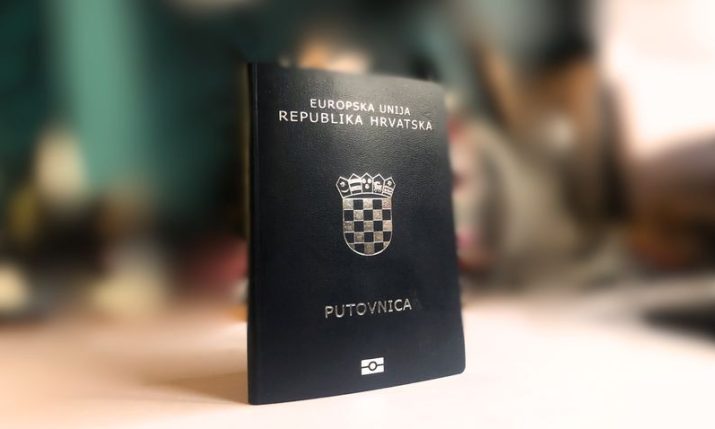
Croatia has once again confirmed its strong global standing, ranking sixth among the world’s most powerful passports for 2026, according to the latest Henley Passport Index.
The Croatian passport provides visa-free access or visas on arrival to 183 destinations worldwide, placing it alongside Czechia, Estonia, Malta, New Zealand and Poland. The ranking highlights Croatia’s continued diplomatic strength and international mobility for its citizens, CNN reported.
At the top of the index, Singapore has retained its position as the world’s most powerful passport, offering access to 192 out of 227 destinations without the need for a pre-arranged visa.
The index, compiled by London-based Henley & Partners using exclusive data from the International Air Transport Association (IATA), shows continued dominance by Asian nations.
Japan and South Korea share second place, each providing access to 188 destinations, while five European countries – Denmark, Luxembourg, Spain, Sweden and Switzerland – jointly occupy third place with access to 186 destinations.
Europe remains highly represented near the top of the rankings. Fourth place is shared by Austria, Belgium, Finland, France, Germany, Greece, Ireland, Italy, the Netherlands and Norway, each offering access to 185 destinations.
Fifth place is held jointly by Hungary, Portugal, Slovakia, Slovenia and the United Arab Emirates, with access to 184 destinations.
Croatia’s sixth-place position reinforces its status as one of Europe’s and the world’s most mobile nations.
The United Arab Emirates recorded the most dramatic long-term rise in the index’s 20-year history. Since 2006, the UAE has added 149 visa-free destinations, climbing 57 places overall. Henley & Partners attributes this success to sustained diplomatic engagement and visa liberalisation efforts.
Declines for the UK and USA
At the opposite end of recent trends, the United Kingdom experienced the steepest year-on-year decline, now offering access to 182 destinations, eight fewer than the previous year.
The United States returned to 10th place, with access to 179 destinations, but has lost visa-free access to seven destinations in the past year alone and has dropped six places over the past two decades.
Commenting on these shifts, journalist and academic Misha Glenny, Rector of the Institute for Human Sciences in Vienna, noted that passport strength reflects broader global influence.
“Passport power reflects political stability, diplomatic credibility and the ability to shape international rules. The erosion of mobility for countries like the UK and the US signals deeper geopolitical change.”
Least Powerful Passports
At the bottom of the index remains Afghanistan, with access to just 24 destinations, followed by Syria (26) and Iraq (29).
Christian H. Kaelin, Chairman of Henley & Partners and creator of the index, highlighted the growing inequality in global mobility.
“Global mobility has expanded, but the benefits are unevenly distributed. Advantages remain concentrated among the world’s most economically powerful and politically stable nations.”
Growing Demand for Alternative Citizenship
Henley & Partners also reported that Americans accounted for 30% of its clients in 2025, reflecting rising interest in alternative citizenship options. At the same time, several European countries are tightening rules around so-called “golden passports” and citizenship by descent.
Top Passport Rankings for 2026 (Selected)
• Singapore – 192 destinations
• Japan, South Korea – 188
• Denmark, Luxembourg, Spain, Sweden, Switzerland – 186
• Austria, Belgium, Finland, France, Germany, Greece, Ireland, Italy, Netherlands, Norway – 185
• Hungary, Portugal, Slovakia, Slovenia, UAE – 184
• Croatia, Czechia, Estonia, Malta, New Zealand, Poland – 183
• United Kingdom – 182
• United States – 179
Other Passport Rankings
The Henley Passport Index is one of several global passport rankings. Arton Capital’s Global Passport Power Rank, which tracks 193 UN member states and six territories, places the United Arab Emirates first for 2026, followed by Singapore and Spain.