
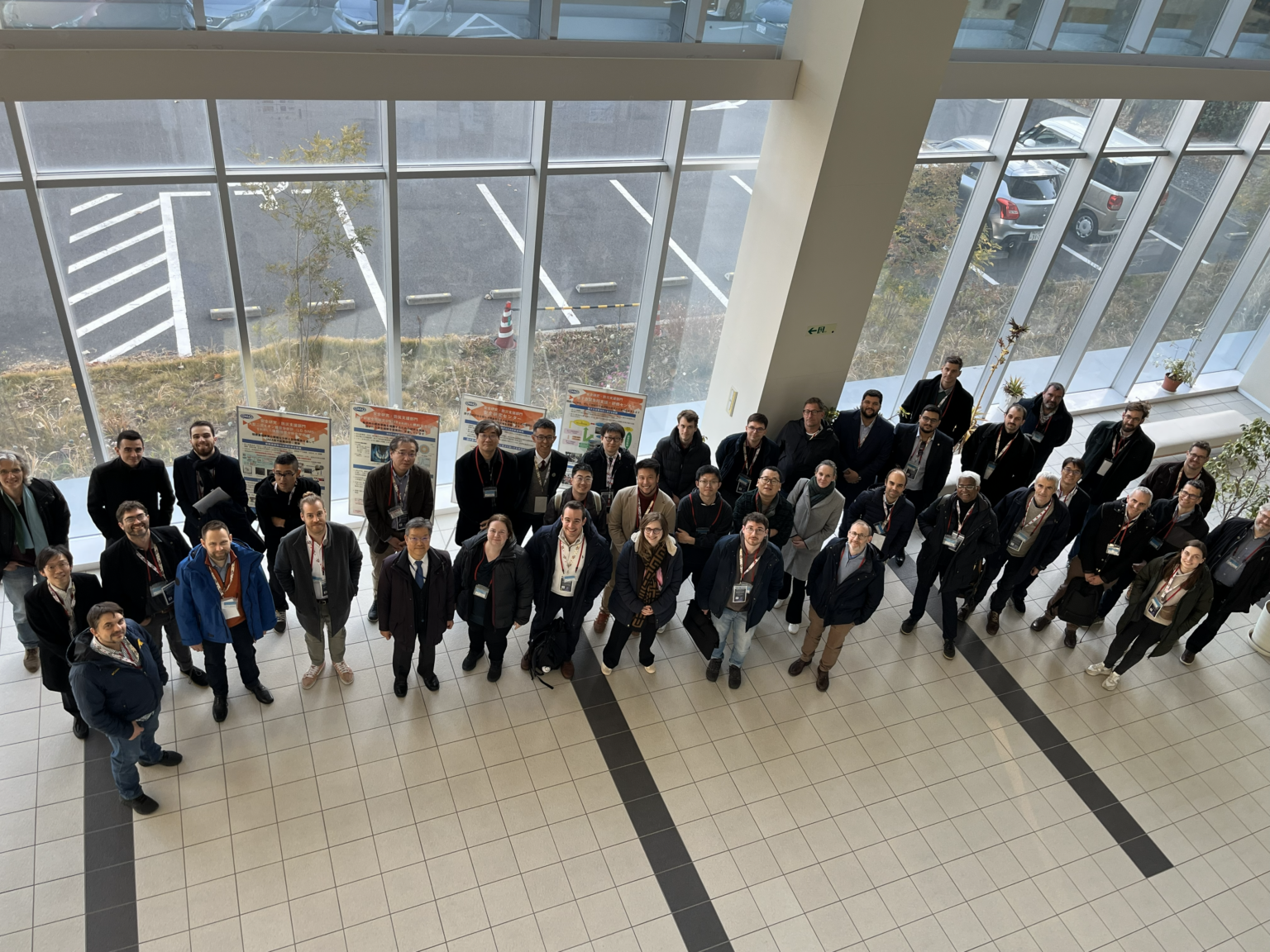
The NEA organised the 10th workshop on Computational Fluid Dynamics for Nuclear Reactor Safety Issues (CFD4NRS‑10) in Mito City, Japan, on 10–12 December 2025, inviting participants to visit experimental facilities of the Japan Atomic Energy Agency (JAEA) in Tokai‑mura. Participants toured the ROSA Large‑Scale Test Facility (LSTF), renowned for integral system tests that reproduce thermal‑hydraulic behaviour in pressurised water reactors (PWRs), the Containment InteGral Measurement Apparatus (CIGMA) for advanced containment experiments, and other separate‑effect test experimental facilities.
Constructed in 1985 under JAEA’s ROSA (Rig‑of‑Safety Assessment) programme following the TMI‑2 accident in 1979, LSTF is a full‑pressure, full‑height, two‑loop model of a four‑loop Westinghouse‑type PWR with a 1/48 volumetric scaling (1/21 for two‑loop PWR). Designed to reproduce system‑level thermal‑hydraulic responses, LSTF became a global reference for investigating abnormal transients and small‑break loss‑of‑coolant accidents (SBLOCAs).


LSTF facility, views from the bottom and the top
Before the NEA ROSA projects began in 2005, more than 180 experiments had already been performed at LSTF, demonstrating its capability to properly simulate conditions close to a reference plant through repeatable scenarios for code assessment with well-instrumented experiments.
Early LSTF campaigns in the late 1980s and 1990s focused on verifying one‑dimensional best‑estimate (BE) codes. The observed phenomena often showed inherently multi‑dimensional behaviour, parallel channel effects, unstable and/or nonequilibrium multi‑phase flows including stratification even under the influence of non‑condensable gases.

WGAMA Chair and ROSA Operating Agent showing the functioning of the LSTF
Spanning April 2005 to 2012 (with a half‑year shift due to the Fukushima Daiichi Nuclear Power Plant accident on 11 March 2011), the NEA ROSA and ROSA‑2 projects used LSTF to address key LWR thermal‑hydraulic safety issues. The programme advanced validation of simulation models and methods across design‑basis events (DBEs) and beyond‑DBE conditions, and increased the level of detail and accuracy in analysing abnormal transients and accident phenomena.
Following the completion of the NEA ROSA-2 project, experiments continued at LSTF through bilateral and national programmes, maintaining momentum and know‑how. Participation in NEA activities such as PKL, ATLAS, ETHARINUS and SYSTHER, including counterpart testings, has strengthened international comparability, highlighted model strengths and weaknesses, and promoted methodological consistency.
The visit highlighted Japan’s contribution to global nuclear safety and the value of sustained international collaboration, from test planning to data curation and open dissemination.
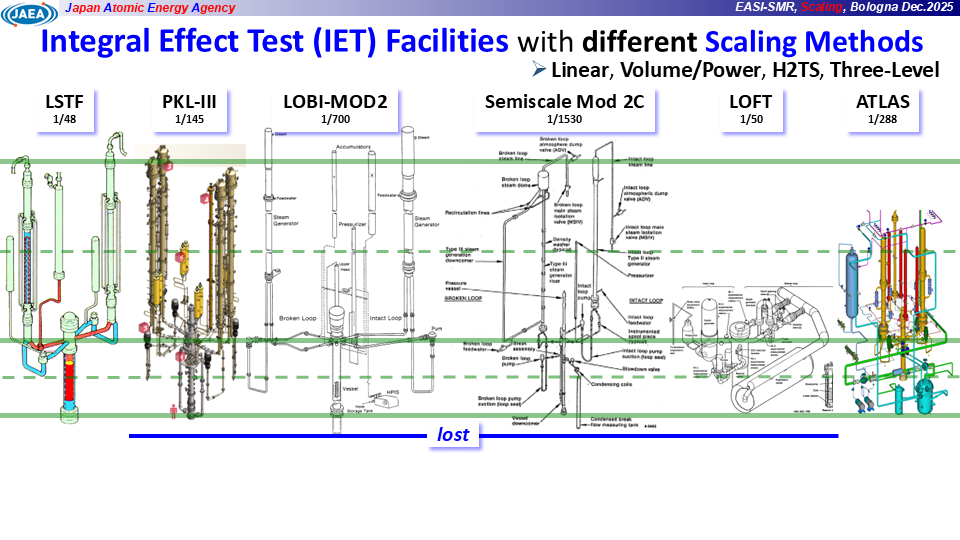 Courtesy of H. Nakamura (JAEA)
LSTF is one of the largest thermal‑hydraulics experimental facilities used for collaborative research. Preserving this capability demands continued preventive maintenance of the facility with high technical support, investment in facility modifications for future simulation, instrumentation and diagnostics, and support for expert personnel.
As the nuclear community advances digital twins, multi‑scale multi‑physics coupling and risk‑informed, performance‑based safety approaches, facilities like LSTF, CIGMA and associated separate‑effect facilities are highly expected to remain essential for establishing model credibility and supporting sound yet crucial decision‑making.
Related reports:
Final Integration Report of the OECD/NEA ROSA Project: 2005-2009
Final Integration Report of the Rig-of-Safety Assessment (ROSA-2) Project (2009-2012)