
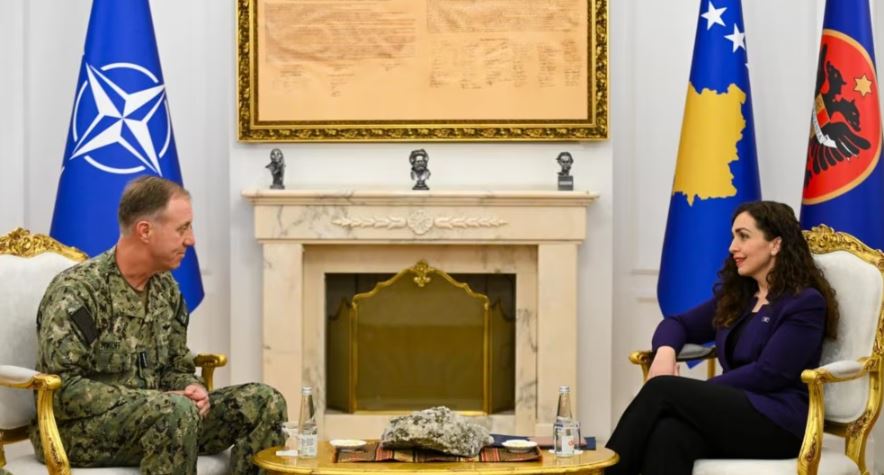
Kosovo President Vjosa Osmani said during a meeting with a U.S. NATO admiral in Pristina on Monday that her country faces “risks from destabilising acts” by Serbia, the Kosovar Presidency said in a statement.
Osmani congratulated George M. Wikoff on assuming his new role as commander of NATO’s Allied Joint Force Command Naples, expressing her “full confidence in his leadership and in the key role this command plays for Euro-Atlantic security, regional stability and international peace.”
Wikoff succeeded Admiral Stuart B. Munsch, who completed his mandate in November last year.
“President Osmani reaffirmed her commitment to continued cooperation with KFOR and stressed that Kosovo remains a reliable, capable and contributing partner for regional security and stability, firmly committed to the values of peace, democracy and the rule of law,” the statement said.
The Presidency did not provide further details regarding the alleged destabilising acts, but Kosovar officials have repeatedly accused Belgrade of such actions.
Tensions between Kosovo and Serbia have remained high in recent years, particularly following a series of incidents in the Serb-majority north of Kosovo.
In an attack on Kosovo Police in the village of Banjska, in the municipality of Zvečan, carried out by an armed group of Serbs, one police sergeant and three attackers were killed.
Responsibility for the attack was claimed by Milan Radoičić, then deputy leader of Serb List, the largest political party representing Serbs in Kosovo, which is backed by Belgrade.
Kosovo has blamed Serbia for the attack and is seeking Radoičić’s extradition, believing he is in Serbia, while Belgrade has denied any involvement.
A year later, an explosion at the vital Ibër–Lepenc water canal caused major damage, disrupting water supplies for thousands of residents and affecting the cooling systems of the country’s two main power plants.