
While Europe focuses on the war in Ukraine and the prospect of pared-back American security assistance, trouble is brewing in the southeast corner of the continent. Three decades ago, in November 1995, the U.S.-brokered Dayton accords ended the Bosnian war, a three-and-a-half-year ethnic conflict that killed roughly 100,000 people and displaced two million. The settlement imposed a complex power-sharing structure on a divided country, promising the state of Bosnia and Herzegovina a new start.
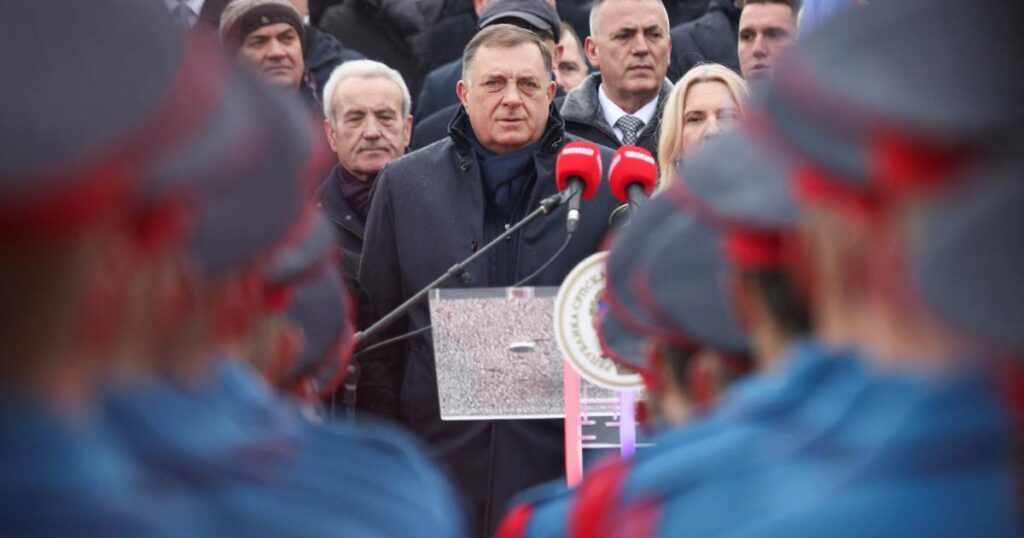
Europe and the United States led the charge to safeguard the carefully crafted peace. Yet that oversight has eroded in recent decades, as both Brussels and Washington turned their focus elsewhere. The absence of international pressure has emboldened nationalists within Bosnia such as Milorad Dodik, a Bosnian Serb leader who has repeatedly called for the secession of Republika Srpska, the semiautonomous region where he served as president. Dodik was banned from holding public office in 2025 and has faced U.S. sanctions since 2022. In late October, however, the Trump administration lifted those sanctions. The decision appeared to be an act of patronage by President Donald Trump: Dodik’s government had hired several Trump associates as lobbyists, including former Illinois Governor Rod Blagojevich, who argued that the sanctions amounted to political persecution. But it also reflected a long-running shift in U.S. policy, with the United States stepping back from the commitments it made to Bosnia three decades ago.
Unless Bosnia’s international partners start paying more attention, Dodik and other nationalist leaders will continue to erode Dayton’s constraints on ethnic autonomy and secessionist ambitions. The United States’ retreat from Bosnia is unlikely to reverse any time soon, so responsibility for the country’s political future now rests squarely with European leaders. If Europe cannot reclaim its role as a guarantor of stability and promoter of reform, it risks watching Bosnia’s fragile balance give way altogether. The failure of the Dayton accords would threaten European security, further damage the EU’s credibility, and legitimize the perception—already exploited by Russia in Ukraine—that borders and agreements can be revised by force.
DIVIDING LINES
The Bosnian war erupted in 1992, when Bosnia and Herzegovina, a multiethnic territory composed of Bosniaks, Croats, and Serbs, declared independence from Yugoslavia. Serbian President Slobodan Milosevic—Serbia was another constituent republic of Yugoslavia—objected to the move. From his perch in Belgrade, he offered political and military support to Bosnian Serb leaders who fought to secure Serb-controlled territory across Bosnia and prevent Bosnian Serbs from falling under the authority of a new Bosnian state. It plunged the country into a brutal war marked by ethnic-based violence and mass atrocities committed against civilians.
Thirty years after the end of the war, the guns have stopped, but, so too, has Bosnia’s progress. The country is riven by divisive identity politics and patronage networks. The economy has stalled, as has Bosnia’s movement toward European integration. Corruption is rampant. Young people leave the country at alarming rates, and Bosnia’s population is smaller today than it was at the end of the war.
Many blame Dayton’s power-sharing arrangement. Every major institution is designed to serve the country’s three main constituent ethnic groups rather than a single Bosnian citizenry. The country therefore has three presidents; two semiautonomous entities, the Bosniak- and Croat-dominated Federation of Bosnia and Herzegovina, which itself is divided into ten cantons split between Bosniaks and Croats, and the Serb-dominated Republika Srpska; and an independent district. Each political entity has its own bureaucracy. It is because of this structure that Bosnia has little coherent national policy; there are, for instance, 13 education ministries within the country. The ethnic power-sharing system was meant to prevent domination by any one group and to force cooperation among former enemies. Instead, it has produced political polarization that paralyzes the country’s development.
The accords also included measures to keep the country from returning to war. Eleven annexes addressed numerous aspects of peace building: refugee return, property restitution, human rights, policing, the creation of a central bank, and even the operation of power grids. Annex ten created a role for an international overseer, the Office of the High Representative, to supervise civilian implementation of the accords. The OHR can impose legislation, remove elected officials from office, and override domestic institutions deemed to be obstructing the peace agreement.
The Dayton system survives, but Bosnia remains in an uneasy equilibrium. Dayton was only a starting point; as the veteran U.S. diplomat Richard Holbrooke, who was responsible for brokering the accords, wrote in 1998, “The results of the international effort to implement Dayton would determine its true place in history.” After the deal was signed, international overseers were meant to steer the country toward reform. But their interest has waned over the past two decades. In their absence, nationalist parties inside Bosnia have learned to pull the strings.
RECKLESS ABANDONMENT
The problems with Bosnia’s postwar transition began with the Dayton accords’ third annex, which required elections within nine months of the agreement’s signing. In practice, this compressed timeline meant that voting took place before communities had begun to reconcile, before those responsible for wartime atrocities had been held accountable, and before civil society groups could organize viable political parties and platforms. Bosnia’s wartime leaders, who still commanded ethnic loyalty and controlled the media, swept back into office in the fall of 1996. Their return entrenched wartime divisions in the foundations of the new state rather than opening the political system to new actors.
The Clinton administration, eager to showcase a foreign policy win in an election year, treated the mere existence of elections as proof of progress, glossing over the slower work of reconciliation and the cultivation of multiethnic parties. For a few years, international engagement papered over the damage. U.S. and European diplomats helped unify Bosnia’s armed forces, establish a state judiciary, create a single currency, and restore property rights to millions of displaced citizens. Bosnia remains one of the few cases in which refugees successfully reclaimed their homes after a war. For a time, the Dayton vision of a functioning multiethnic state seemed as if it might succeed.
But the September 11 attacks and subsequent conflicts in the Middle East halted much of this momentum. After U.S. President George W. Bush launched wars in Afghanistan and Iraq, U.S. attention and military personnel shifted away from the Balkans. In 2004, NATO handed Bosnian peacekeeping operations to the smaller, more cautious European Union Force. Since then, EUFOR, as the force is known, has been reluctant to exercise its authority to arrest individuals or to support the high representative in the enforcement of the Dayton mandate.
Then, in 2006, the British diplomat Paddy Ashdown left the post of high representative. He was the last European envoy willing to use the OHR’s sweeping powers to remove Bosnia’s obstructionist officials and impose laws designed to strengthen the country’s central institutions. Europe took its focus off Bosnia, distracted by the global financial crisis in 2008, by a rise in the number of migrants entering the continent in 2015, and by internal divisions about how to manage Bosnia’s reform process. The country still depended on international actors to consolidate state institutions and enforce compliance with the Dayton framework. But Europe’s disengagement meant that Bosnia’s constituent ethnic groups were never pushed to repair their divisions through the constitutional reform Dayton demanded.
Brussels assumed that even without external enforcement, the lure of EU membership would drive Bosnia’s politicians to take ownership of the reform process. Instead, Bosnia’s political system hardened into one of patronage. Nationalist parties won elections by trading jobs and public contracts for allegiance among voters within their own ethnic ranks, many of whom struggled to earn an income in a country with an unemployment rate that was among the highest in Europe for years, at times exceeding 30 percent. Private businesses continue to rely on government contracts, further entrenching dependence on the nationalists who originally secured positions of authority. One former official in the Organization for Security and Cooperation in Europe described Bosnia as “a three-legged stool,” with each ethnic party propping up the same broadly dysfunctional order that sustains them all. The Berlin-based advocacy group Transparency International has ranked Bosnia as the second most corrupt country in Europe, after Russia.
Responsibility for Bosnia’s political future now rests squarely with European leaders.
Nationalist parties learned to exploit the Dayton framework for their own benefit, using the veto power assigned to the two entities, ethnic caucuses, and individual members of the tripartite presidency to block compromise and paralyze state-level decision making. Neighboring Croatia and Serbia helped fuel exploitation and deepen political divisions by supporting the leaders of Croat and Serb groups inside Bosnia. Zagreb and Belgrade each treat the country as part of its sphere of influence, a dynamic the EU has tolerated in silence, neglecting to use targeted sanctions or enforce conditions on financial assistance to deter cross-border interference.
This isn’t the only leverage the EU is leaving on the table. In 2009, for example, the European Court of Human Rights ruled in favor of Jakob Finci, a Bosnian Jew, and Dervo Sejdic, a Roma activist, who had challenged the legitimacy of Bosnia’s requirement that presidential and parliamentary candidates had to be members of one of the main three ethnic groups. The court found the system to be discriminatory and ordered reform. Almost two decades later, the judgment remains unenforced, and Bosnia faces no repercussions for failing to adjust its political system.
The oversight vacuum has enabled secessionist leaders such as Dodik to take ever-bolder steps. In 2023, for instance, Dodik signed laws nullifying the decisions of Bosnia’s constitutional court within Republika Srpska and blocking the publication of the high representative’s rulings. When the current high representative, the German politician Christian Schmidt, annulled the measures, Dodik ignored him. Last February, Bosnia’s highest ordinary court convicted Dodik of violating the high representative’s authority, handing down a suspended prison sentence and a temporary ban from holding public office.
But Bosnian government agencies did little to enforce the verdict, and EUFOR lacked any mandate to do so. That hesitation further spurred Dodik, who defied the court ruling and, in March, advanced a draft constitution declaring Republika Srpska a “sovereign” entity. The proposed constitution gave Republika Srpska’s laws supremacy over the rule of the central Bosnian government, rejected the authority of state-level courts and prosecutors, and laid the groundwork for a full withdrawal from state-level judicial and defense institutions. Months later, Bosnian institutions finally took action: the Central Election Commission stripped Dodik of his presidency last August.
APPLY PRESSURE
The Dayton accords receive plenty of criticism given the state Bosnia is in today, but the agreement itself is not the problem. Without it, there would be no peace. The real problem is that Dayton was never meant to be self-executing. Its success always depended on outside actors remaining engaged in Bosnia’s reconstruction until the country’s institutions could stand on their own and uphold a single multiethnic state. Instead, international stewardship faltered when Washington changed its priorities and Brussels stood aside. The result is a country still rife with ethnic division, held together by a 30-year-old peace agreement that, in the absence of consistent enforcement, has yielded a political system that benefits the few at the expense of the many.
Revitalizing Dayton’s purpose will require restoring international leverage—particularly that of Europe, which now wields the greatest economic influence over Bosnia. Sarajevo’s dependence on external financing gives European actors, working alongside institutions such as the International Monetary Fund and the World Bank, the power to demand accountability, including a stronger judiciary, proper corruption prosecutions, and enforcement of verdicts by state-level courts. To promote these practices, international donors can reward municipalities that practice transparent budgeting and the effective delivery of services to citizens by channeling funds directly to municipal governments, bypassing the entity- and canton-level authorities that nationalist parties control. Sustained international investment in independent media and civil society watchdogs can also help expose graft and hold leaders accountable.
The high representative has the authority to support fiscal transparency, including by requiring the publication of government spending, audits, and procurement registers. Schmidt’s suspension of budget payments to Dodik’s party, the Serbian nationalist Alliance of Independent Social Democrats, in April 2025, was a welcome example of active oversight, and Schmidt should build on that success by using his executive powers to protect the independence of the Bosnian Central Election Commission and ensure that it is adequately financed. With more resources, the commission can implement electoral integrity reforms ahead of Bosnia’s presidential elections in October. Schmidt is expected to step down from the position of high representative sometime this year, raising the question of whether Europe will sustain or abandon its authority over Bosnia. Dodik has repeatedly called for the OHR to be shut down. But Europe must remain resolute and unequivocally back structures for international oversight. Bosnia’s various political institutions—including the Parliamentary Assembly and the Council of Ministers at the state level, along with entity-level governments—must also pass and enforce long-delayed reforms to Bosnia’s High Judicial and Prosecutorial Council. Doing so will insulate judges and prosecutors from political interference and help meet the conditions for Bosnia’s accession to the EU. (The country has been a candidate for EU membership since 2022.)
The Dayton system survives, but Bosnia remains in an uneasy equilibrium.
Europe must also take direct responsibility for Bosnia’s security. The EUFOR mission derives its authority from a UN Security Council mandate, which means that Russia, often backed by China, has been able to repeatedly obstruct resolutions on Bosnia in an effort to weaken EU and U.S. influence in the Balkans. Europe should end this dependence on the Security Council and establish a security guarantee for Bosnia outside the UN and NATO frameworks, working through a joint mission that includes trusted regional partners such as Turkey. Doing so would deny Russia a source of leverage in Bosnia and reinforce Western commitments to the country.
Finally, the EU must press Croatia and Serbia to stop treating Bosnia as political turf. Serbia’s backing of Dodik and Croatia’s patronage of Dragan Covic, a Bosnian Croat politician who previously held the Croat seat in Bosnia’s presidency, have entrenched Bosnia’s political dysfunction. Backed by Zagreb, Covic and his party have revived calls for a separate Croat entity, a move that would cement ethnic partition and unravel what remains of Bosnia’s unity. Brussels can use the leverage it has over Serbia as an EU candidate country and put political and financial pressure on Croatia to insist that both countries respect Bosnia’s sovereignty and act as Sarajevo’s partners, not patrons of ethnic division.
For all their flaws, the Dayton accords still offer Bosnia a path to political stability, but only if the international partners charged with upholding them choose to do so. Last year’s removal of Dodik from power proved that the country’s institutions can still hold politicians to account. Europe can build on this promising development by defending the agreement on which Bosnia’s fragile peace still depends. If Europe fails to act, Bosnia risks fragmentation—the revival of the very dynamics Dayton was designed to contain. The consequences would not stop at Bosnia’s borders. Dayton’s collapse would weaken Europe’s security order and reinforce the idea that agreements on the continent can be ignored when enforcement falters. If Europe presses for reform now, it would not only help keep Bosnia from unraveling but also demonstrate that Europe has both the political will and the capacity to ensure peace in its own backyard.
Loading…