
Wallingford-based X9 Inc. raised nearly $13.7 million to develop an AI-guided device that uses ultrasound to help insert dialysis needles, receiving FDA approval for its ultrasound-only version in October.
If you’ve ever had blood drawn, you know how difficult it can be for a healthcare worker to stick a needle in a vein.
Now imagine having two needles inserted into your arm two or three times a week — and then sitting with them in place for several hours.
That’s the reality for more than 555,000 people in the United States living with kidney failure who rely on dialysis.
Dialysis is a medical treatment that uses a machine to perform the work healthy kidneys normally do — removing waste, excess salt and extra fluid from the blood. Connecting a patient to the machine requires a process known as cannulation, in which two needles are inserted into an arm vein.
A Wallingford-based startup, X9 Inc., is developing technology designed to improve the needle-insertion step of dialysis treatment.
Founded two years ago and based in a nondescript commercial building at 10 Research Parkway in Wallingford, the company is working on a device that uses ultrasound, automation and artificial intelligence to assist medical staff during cannulation and reduce the time and difficulty involved.
The technology has already attracted investor interest. X9 has raised nearly $13.7 million to date, including about $8.6 million through a public offering completed in December. The funding will support continued development of the device and expansion of the company’s six-person team.
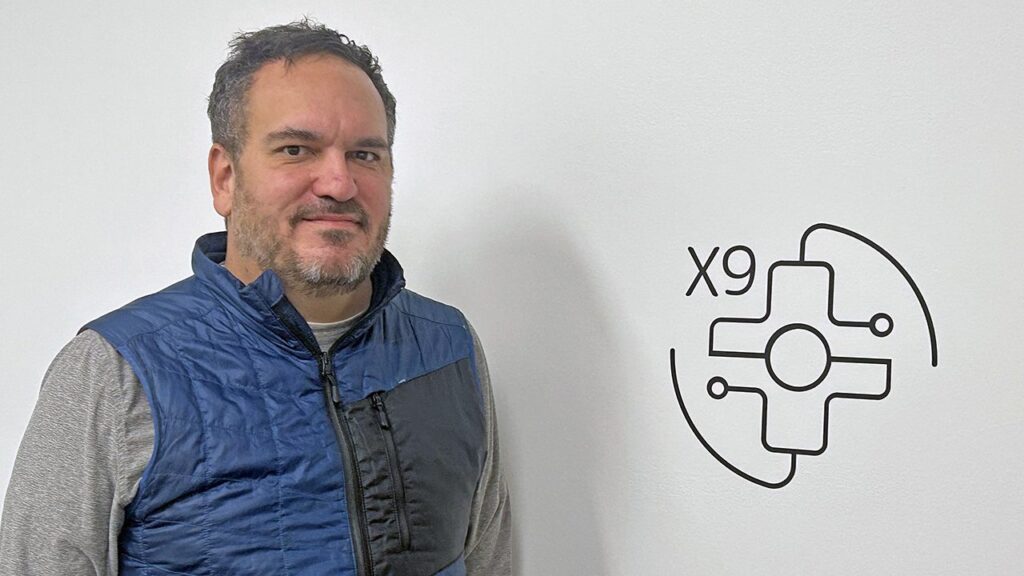
“Getting these needles safely in patients and monitoring those patients is a really important step,” said Eric Taylor, X9’s co-founder and vice president of research and development.
A ‘canal’ for blood
Cannulation can be challenging for both patients and providers, in part because placing the needles correctly is difficult, Taylor said. It’s also important to avoid repeatedly inserting needles in the same spot, which can lead to aneurysms and other complications.
Most dialysis patients rely on a surgically created access point — known as an arteriovenous, or AV, fistula or graft — that connects an artery to a vein. Cannulation creates a pathway — sometimes described as a “canal” — through which blood moves between the patient and the dialysis machine during treatment.
Over time, repeated needle insertions can damage that access point, causing scarring or weakening of the vein.
The device X9 is developing uses ultrasound to help guide where a needle should be placed and then inserts it.
The intent, Taylor said, is to take human error out of the process and give healthcare workers AI-guided tools that “ensure that we place dialysis needles correctly and safely and quickly.”
X9’s partners
X9’s progress toward developing and commercializing its device has been aided by partnerships with established players in the medical-device and dialysis industries.
One is ExploraMed, a Mountain View, California-based medical device incubator that provides early-stage companies with capital, engineering support and intellectual property resources. Another is DaVita Inc., one of the largest dialysis providers in the United States.
ExploraMed has helped launch eight previous companies, including Endomatrix, which developed treatments for incontinence and gastroesophageal reflux and was acquired by CR Bard Inc. in 1997, and Acclarent, an ear, nose and throat device company acquired by Johnson & Johnson in 2010.
Taylor said his company is the ninth to be incubated by ExploraMed, which is why it is called X9.
Before co-founding X9 with ExploraMed founder and executive chairman Dr. Joshua Makower, Taylor spent nearly two decades at Medtronic, the former U.S. Surgical, which is based in New Haven.
“My background is in engineering,” he said. “I’ve been in the medical device industry pretty much my whole career.”
DaVita, which operates about 2,800 dialysis centers nationwide, has also played a key role. Its DaVita Venture Group, the company’s strategic investment arm, was the primary investor in X9’s seed round and later led a Series B fundraising round.
Taylor said most of the capital raised is being directed toward preparing the device for commercialization, while a portion will support expansion of X9’s six-person staff, which could double over the next year.
Federal approval
Commercialization would require federal clearance to sell the device to the nation’s more than 7,500 dialysis centers, including nearly 50 in Connecticut.
Taylor said X9 has broken the U.S. Food and Drug Administration approval process into discrete steps, focusing first on demonstrating safety and effectiveness.
“What you’ve got to do for the FDA is, you have to demonstrate safety and efficacy, and it makes it a lot easier when you can separate out some of those parts,” he said.
In October, X9 received FDA approval for an AI-supported ultrasound-only version of its device. The company did a small study with the device in Eastern Europe in November.
Taylor said the initial clearance allows X9 to advance its ultrasound and artificial-intelligence capabilities independently of the full needle-insertion function.
DaVita officials were unavailable for comment, but the company’s chief transformation officer, Misha Palecek, said in a recent interview with medical technology publication MedTech Dive that DaVita hopes X9’s device can have uses beyond dialysis patients.
“DaVita’s excited about it because there’s use cases, hopefully, a lot further beyond DaVita, which are really going to have an impact on the American healthcare system,” Palecek said.
The next phase for X9, Taylor said, involves refining the device’s design to prepare it for commercialization and submission to the FDA for broader approval. That work will also include a human trial involving full needle insertion.
Committed to CT
In addition to its work with DaVita, X9 collaborates with a vascular surgeon in North Haven and clinicians around the country, Taylor said.
“We have some really good relationships with clinicians … that help us answer and inform decisions that we have to make,” he said.
DaVita has also provided access to its dialysis clinics, which Taylor said has been critical to understanding the needs of both patients and providers.
“It’s very hard to design a product without really having access to the clinical environment,” Taylor said.
Taylor, who lives in West Hartford, said X9 plans to remain headquartered in Connecticut, despite its ties to ExploraMed, which is based in the San Francisco Bay Area.
“When I got involved with the incubator, they had reached out and actually tried to get me to move out to the West Coast,” he said. “But I grew up in Connecticut, and my anchor’s here, my kids. So I pitched the opportunity to do it here.”
Taylor said Connecticut offers a deep pool of electrical and mechanical engineering talent, and that the core of X9’s team is based in the state.
“We are not planning on moving anywhere,” he said.